The Martyrs' Memorial, Oxford
Architect: George Gilbert Scott
Sculptor: Henry Weekes
1843
Magnesian limestone
Oxford
Photograph by Phil Mottram
[See commentary below]
Commentary by Phil Mottram
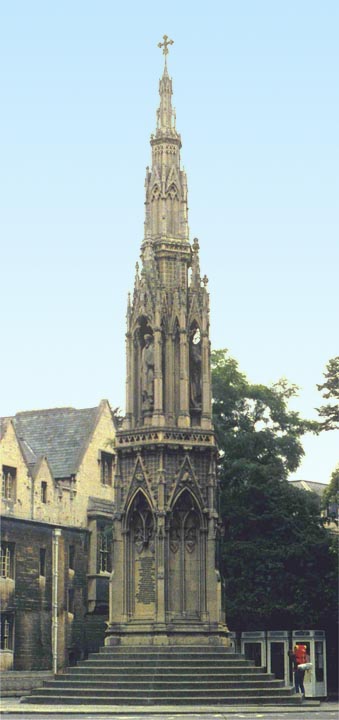
Many people in the Church of England, both clergy and laity, were horrified by what they saw as the Oxford Movement's affront to their Protestant heritage and sought ways to symbolise their determination to resist a drift back towards Rome. They wanted also to remind forgetful members of the Church of the martyrdom of Anglicans, who died for their refusal to abandon the Reformation. They proposed to erect a memorial to three Protestant leaders, Thomas Cranmer, Nicholas Ridley and Hugh Latimer, who were burnt at the stake as heretics, in Oxford in 1555/56, after Queen Mary set about restoring the Catholic faith as the state religion of England.
In November 1838, the opponents of the Tractarians set up a working group, the Martyrs' Memorial Committee, to conduct a public appeal and to make arrangements for a suitable public memorial in the centre of Oxford, as a warning of the dangers of neo-Catholicism. By March 1840, it had been decided that part of the Martyrs' Memorial should take the form of an Eleanor cross, based on that at Waltham, and a private competition was held to select an architect/designer.
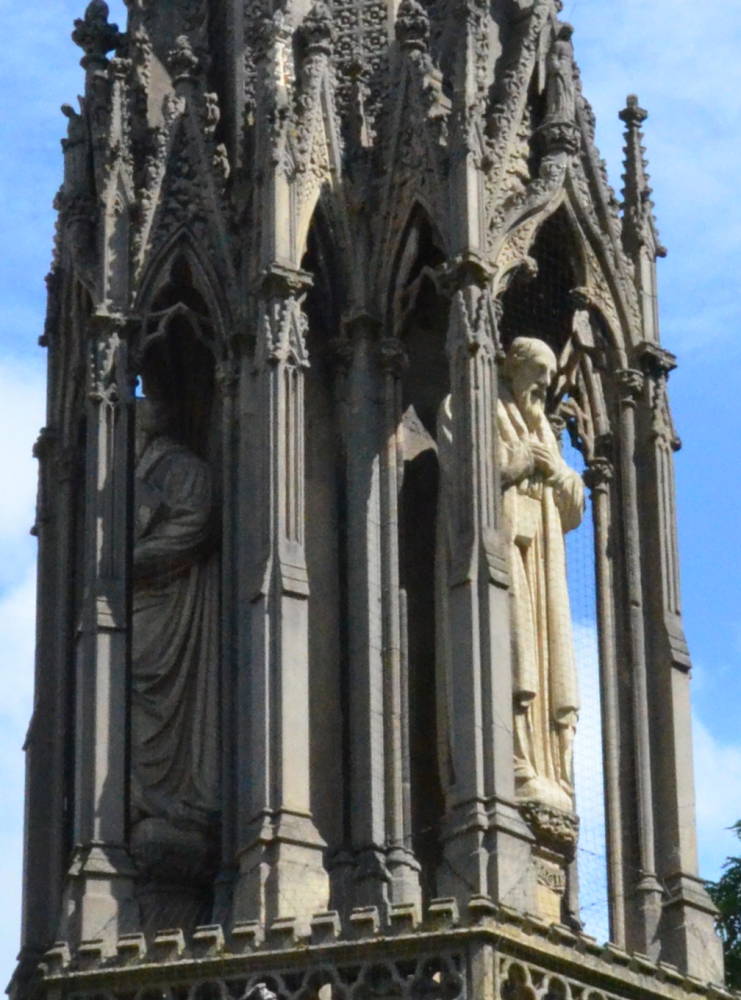
The Oxford Cross took until the spring of 1843 to complete, though the inscription is dated to the laying of the foundation stone in 1841. It is constructed mainly of magnesian limestone. Scott did not like the stone from the famous quarry at Mansfield Woodhouse in Nottinghamshire, from which the stone for the new Houses of Parliament was taken, but found a material he preferred in a nearby disused quarry. However, the statues of the three martyrs were carved by Weekes in oolitic Caen stone from France, blocks of which were obtained from the stock held by Canterbury Cathedral, through the initiative of Dr. William Buckland, the famous geologist and Dean of Westminster, who was an extremely influential member of the Martyrs' Memorial Committee. This choice of material turned out to be unfortunate, since the stone did not weather well in Oxford, even though the statues are sheltered by the deep niches in which they stand. [Adapted from "The History of Ilam Cross"]
References
Mottram, Phil. "The History of Ilam Cross." The Ilam Cross Trust (UK)
Brooks, Chris. The Gothic Revival. London: Phaidon, 1999.
Last modified 5 May 2005