
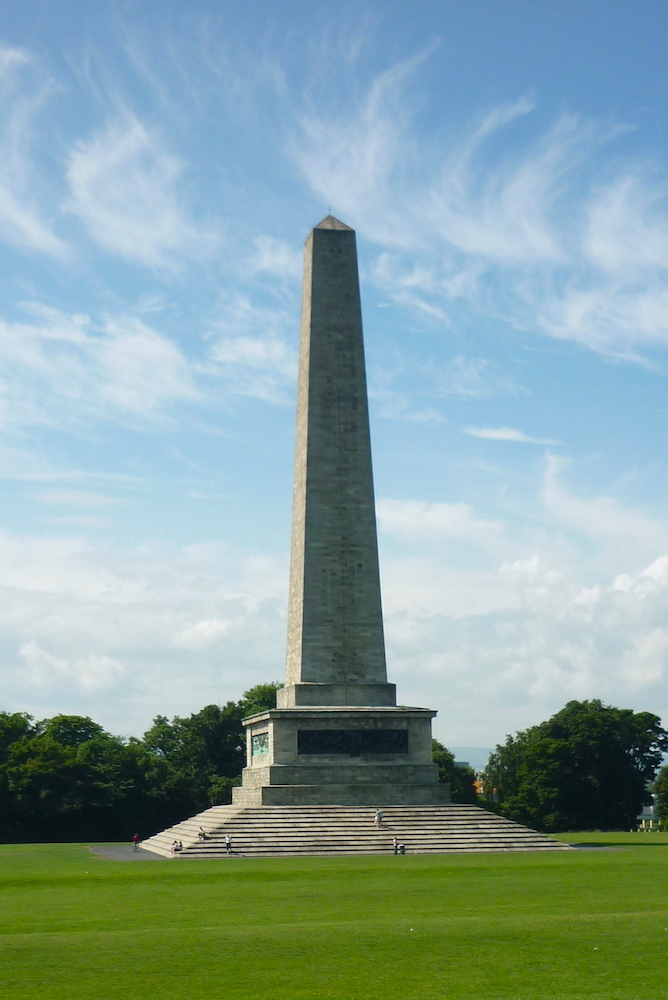
Wellington Testimonial
Robert Smirke (1781-1867)
1817-1861 (held up by problems with funding)
Kilgobbin granite
Phoenix Park
Dublin, Ireland
At 62 m. high, this is the tallest obelisk in Europe (see "Wellington Monument"), and interesting in other ways, too, [Commentary continues below.]
Photograph on left, and of the Waterloo relief, captions and commentary by Jacqueline Banerjee, with additional information provided by Patrick Carson. Photograph of the inscription by "owj" at Wikipedia, kindly released on a Creative Commons license, cropped and corrected for perspective. Click on the images to enlarge them, and mouse over the text for links.
Unusual in that it was started in Wellington's own lifetime (hence the official term "testimonial" rather than "monument," which usually refers to a memorial), the obelisk is made of a particularly hard and crystalline form of Irish granite. It was remarkable for its time, although the Washington Monument in America reached just over 169 m., much more than twice its height, later in the century.
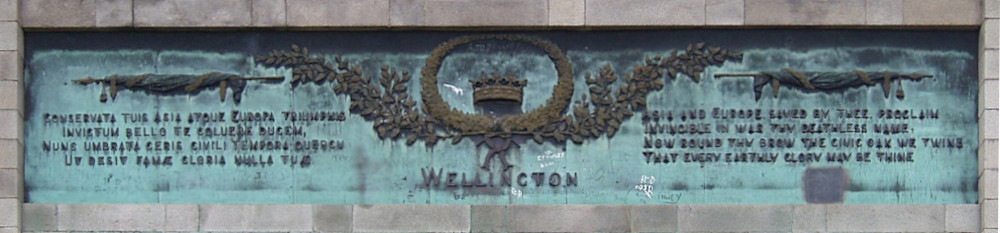
Bronze plaque designed by Thomas Potter & Sons, bearing the inscription.
The pediment carries four bronze panels. One, as shown above, bears the inscription. This reads, first in Latin and then in English: "Asia and Europe, saved by thee, proclaim / Invincible in war thy deathless name, / Now round thy brow the civic oak we twine / That every earthly glory may be thine." P. F. Garrett tells us that designs proposed for the inscription plaque by two of the other sculptors involved (John Hogan and Joseph Kirk) were rejected, but that this one, both designed and executed by metalworker Thomas Potter of London, who was commissioned to cast all four panels, met with general satisfaction.
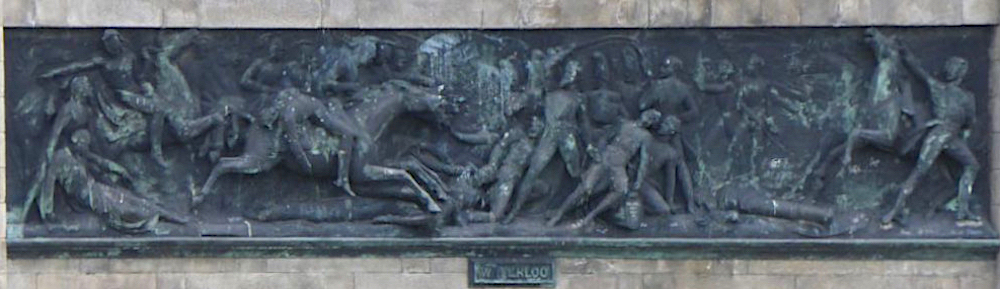
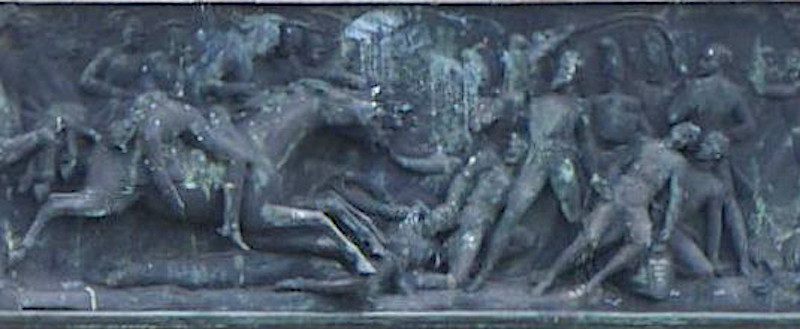
The Battle of Waterloo relief depicting the fall of the Earl of Uxbridge, which roused the cavalry to launch a more fervid attack on the French soldiers. Completed in March 1860, the relief was cast, like the others, in the Potter foundry and Sons [Close-up of central part of relief].
The panels on the other three sides are reliefs featuring some of Wellington's key achievements. The one shown immediately above is by Thomas Farrell, and depicts an episode in the Battle of Waterloo. The other two are representations of Civil and Religious Liberty, by John Hogan, showing Wellington as an administrator; and victory in India, another battle scene complete with cannon and a palm tree, by Joseph Kirk.
Farrell, for one, was displeased with the casting of his panel at the Potter foundry. He wrote, "so battered and butchered is every part of it, that I had considerable difficulty in recognising any of my own work at all ... Thank Heaven, it is gone up to such a height, for I would not for any consideration that it was seen on the ground as my work" (qtd. in Garnett 61). But P. F. Garnett, in his paper on the Testimonial, still finds this relief a "very fine work" (61) — and Patrick Carson, who has compiled a comprehensive record of Potter's work, wonders if Farrell had some hidden motive for his criticism. Perhaps the sculptor was generally dissatisfied with his composition, though, here again, there seem to be no grounds for this.
There are, inevitably, different opinions abut the monument as a whole. On the one hand Garnett admires its "poise and grandeur ... rugged dignity" (61); on the other, it has been described as "formidable and rather dreary" (Casey 308). But no one can deny that it is very striking, a notable manifestation of the Egyptian Revival of that time. It certainly helped to confirm a trend. James Stevens Curl comments on "the growing popularity of this Egyptian form as a commemorative object" (266). Later monuments influenced by this trend include a memorial designed by Philip Hardwick for the young French explorer Joseph René Bellot in Greenwich, London, and William Goscombe John's Memorial to the Engine Room Heroes in Liverpool.
Related Material
Bibliography
Casey, Christine. The Buildings of Ireland: Dublin. New Haven: Yale University Press, 2005.
Curl, James Stevens. The Egyptian Revival: Ancient Egypt as the Inspiration for Design Motifs in the West. London: Routledge, 2005.
Garnett, P. F. "The Wellington Testimonial." Dublin Historical Record 13, no. 2 (1952): 48-61. Accessed via Jstor. Web. 29 September 2020.
"History and Culture." National Park Service. Web. 29 September 2020.
""Wellington Monument, Phoenix Park, Dublin." National Inventory of Architectural Heritage. Web. 29 September 2020.
Updated and extended 29 September 2020; last modifed 3 November 2020