"Tilly Slowboy and the 'Precious Darling'"
E. A. Abbey
1876
18.4 cm high x 12.4 cm framed
Title-page vignette for Dickens's The Cricket on the Hearth in Christmas Stories (1876)
[Click on image to enlarge it.]
Scanned image and text by Philip V. Allingham. Formatting, color correction, and linking by George P. Landow.

[You may use these images without prior permission for any scholarly or educational purpose as long as you (1) credit the photographer and (2) link your document to this URL in a web document to this URL in a web document or cite the Victorian Web in a print one.]
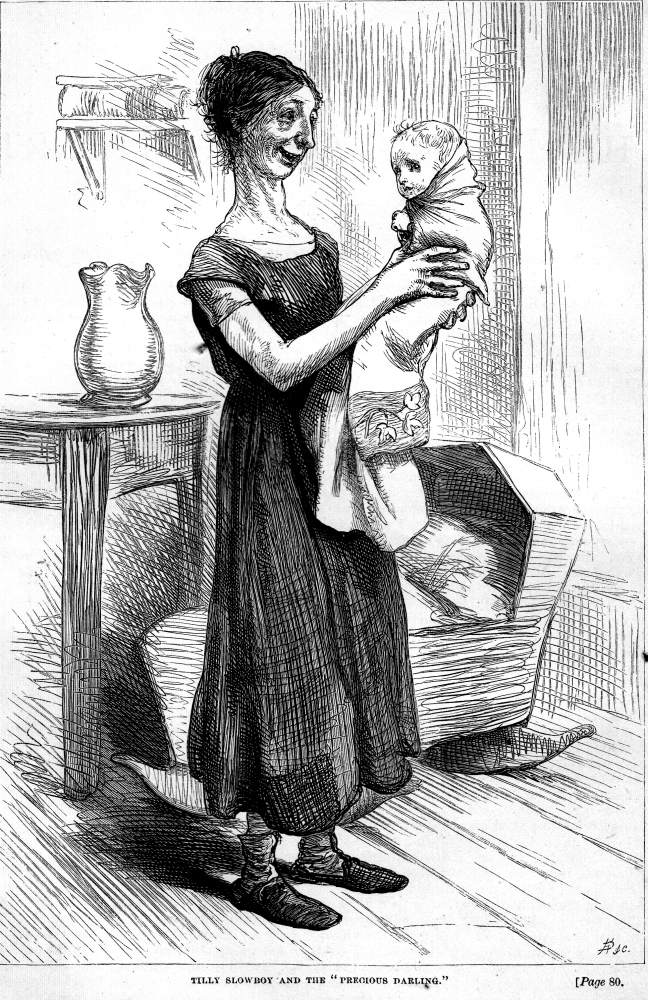
In a separate title-page vignette for The Cricket on the Hearth in the American Household Edition of Dickens's collected Christmas Stories (one of just three such full-page illustrations in the series of twenty-eight), E. A. Abbey focuses not one of the novella's principals — John and Dot Peerybingle — or even on the secondary characters around whom the subplot of the lost son revolves (Caleb and Bertha Plummer, the toymakers), but on the comic woman on the melodrama as represented by the gangly, androgynous orphan Tilly Slowboy. Abbey's choice is especially surprising in light of the contemporary interest in Dot Peerybingle, as evidenced by Dion Boucicault's popular 1859 adaptation Dot, A Drama in Three Acts, first performed at New York's Winter Garden, and many times afterwards in various New England centres, most pertinently perhaps at both Boston's Liberty Hall and Opera House in 1874, as well as at the Music Hall in Lowell, Massachusetts, in that same year. Abbey might well have travelled north from New York City to see one of these productions, although he would certainly have found it easier three years earlier to see Boucicault's adaptation at Booth's in New York City in November, 1871.
Although, as Henry James has suggested of Abbey's mature style, the simple line drawing is a "direct, immediate, solicitous study of the particular case" (the Peerybingles' adolescent nurse), in choosing her as his focal character Abbey has hardly "steered clear of the danger of making his people theatrical types" (James), although he lovingly depicts the infant and the rocking cradle which give Tilly her present purpose in life. The style, like the composition itself, is minimalist — to Abbey in this scene nothing else matters. Consequently, the Sixties style, of which this full-page woodblock engraving is a fine example, offers a sharp departure from the humorous detailism of Punch cartoonist John Leech, as well as from the elaborate engravings of the other original illustrators: Daniel Maclise, Richard Doyle, Edwin Landseer, and Clarkson Stanfield. If one may judge from her besotted expression which implies that she is a kindly "natural," the foundling Tilly clearly dotes upon the infant whom the Peerybingles have placed in her charge. Her dress is patched but utterly lacking in ornamentation — indeed, as the text stipulates, it is little more than a shift, implying her background as an orphan. The passage illustrated is Dickens's detailed description of Tilly which occurs four pages later, implying a proleptic reading of the picture, an initial impression that is clarified by encountering this textual moment after seeing the image:
"Don't let the dear child fall under the grate, Tilly, whatever you do!"
It may be noted of Miss Slowboy, in spite of her rejecting the caution with some vivacity, that she had a rare and surprising talent for getting this baby into difficulties: and had several times imperilled its short life, in a quiet way peculiarly her own. She was of a spare and straight shape, this young lady, insomuch that her garments appeared to be in constant danger of sliding off those sharp pegs, her shoulders, on which they were loosely hung. Her costume was remarkable for the partial development, on all possible occasions, of some flannel vestment of a singular structure; also for affording glimpses, in the region of the back, of a corset, or pair of stays, in colour a dead-green. Being always in a state of gaping admiration at everything, and absorbed, besides, in the perpetual contemplation of her mistress's perfections and the baby's, Miss Slowboy, in her little errors of judgment, may be said to have done equal honour to her head and to her heart; and though these did less honour to the baby's head, which they were the occasional means of bringing into contact with deal doors, dressers, stair-rails, bedposts, and other foreign substances, still they were the honest results of Tilly Slowboy's constant astonishment at finding herself so kindly treated, and installed in such a comfortable home. For, the maternal and paternal Slow-boy were alike unknown to Fame, and Tilly had been bred by public charity, a foundling; which word, though only differing from fondling by one vowel's length, is very different in meaning, and expresses quite another thing. [Chirp the First," p. 80]
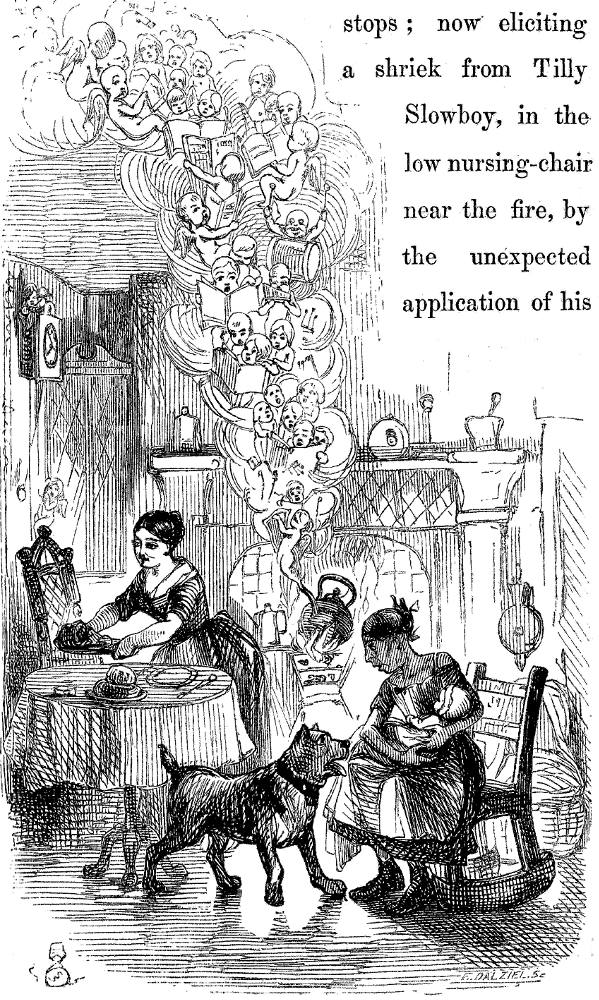
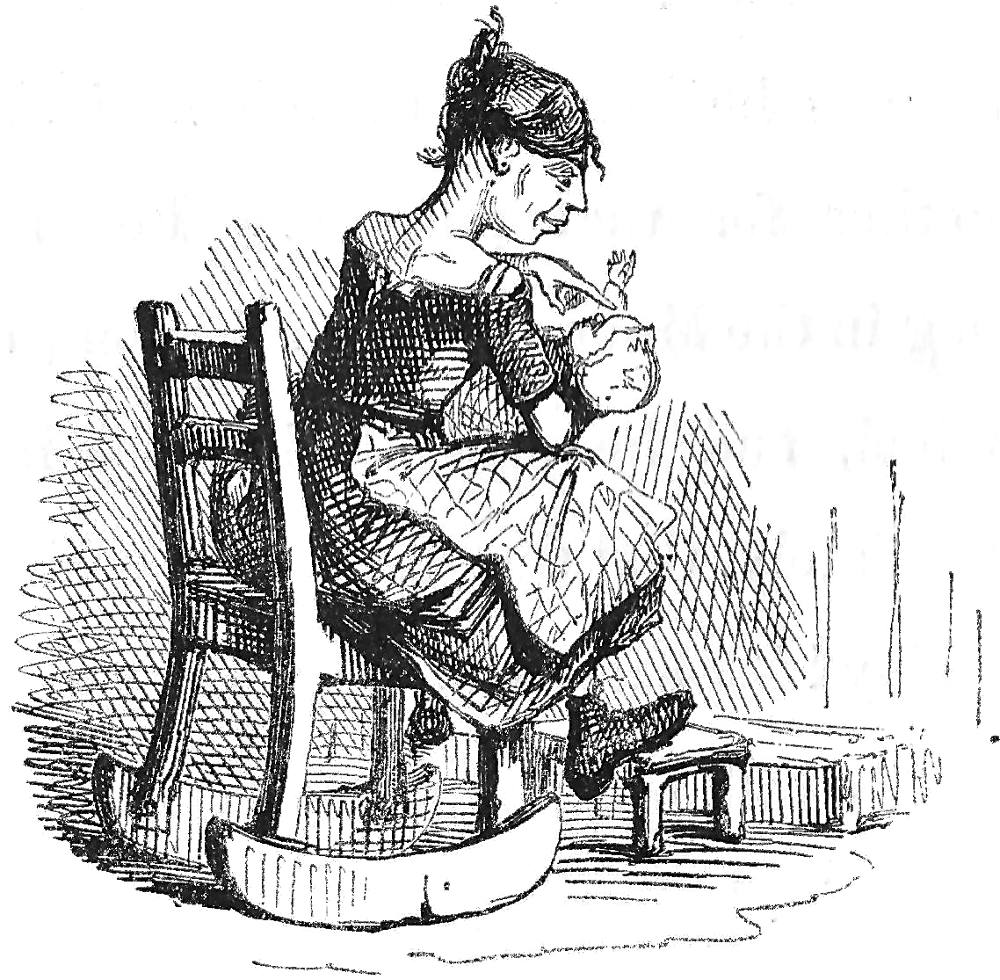
A comparable moment in the original 1845 series is John Leech's "John's Arrival", in which Tilly, seated in the rocker, struggles to hold the baby (right foreground) while Dot sets the table in preparation for John's arrival in "Chirp the First." Leech's focus is the kettle on the hearth and the numerous fairies emanating from its steaming spout. She appears a second time in a thumbnail by Leech entitled "Tilly Slowboy", which again features the solid rocker, the nursing stool, and an angular Tilly tipping the "precious darling" backwards (p. 89). The loving detail with which Abbey has conveyed the details of Tilly's visage is a sharp departure from Leech's caricature.
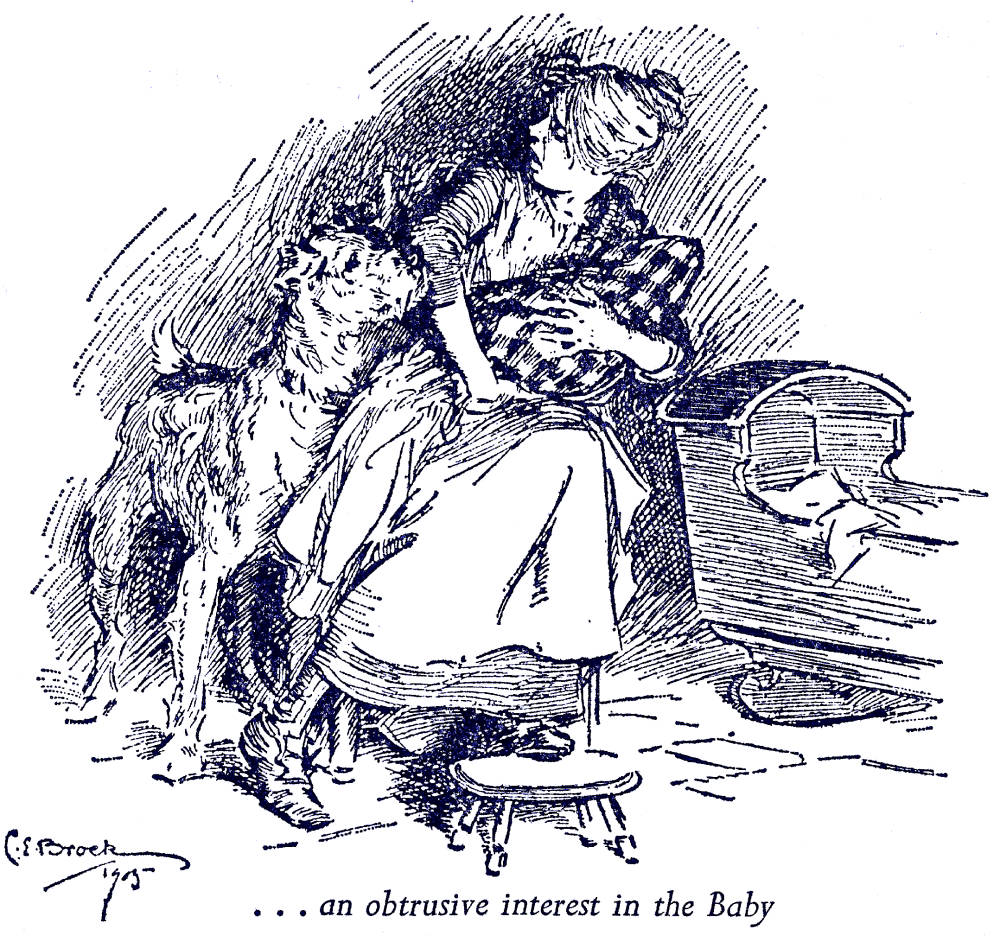
For alternate versions of Tilly Slowboy, see details of the two illustrations by John Leech below, and the much more sympathetic large-scale wood-engraving by Fred Barnard from the British Household Edition just two years after Abbey's series Essentially a satirical cartoonist, Leech does not extend his sympathy to the awkward adolescent nurse, who for him is merely a comic character who establishes the inclusive atmosphere of the Peerybingle household. In contrast, Barnard finds something endearing about Tilly and her fascination with the "precious darling." Indeed, by juxtaposing her against the family dog (Boxer) based on the relationship between these two guardians of the hearth and home in Leech's "John's Arrival," Fred Barnard has reconceived Tilly as an image of domestic devotion:
Other nineteenth-century illustrations of Tilly Slowboy by John Leech (1845) and Fred Barnard (1878)
References
Bolton, Philip H. Dickens Dramatized. London and Boston: Mansell and G. K. Hall, 1987.
Dickens, Charles. The Chricket on the Hearth: A Fairy Tale of Home. Il. John Leech, Daniel Maclise, Richard Doyle, Clarkson Stanfield, and Edwin Landseer. London: Bradbury and Evans, 1846.
Dickens, Charles. Christmas Books. Il. Fred Barnard. The Household Edition. London: Chapman and Hall, 1878.
---. Christmas Stories. Il. E. A. Abbey. The Household Edition. New York: Harper and Brothers, 1876.
James, Henry. Picture and Text. New York: Harper and Brothers, 1893. Pp. 44-60.
Last modified 10 December 2012