
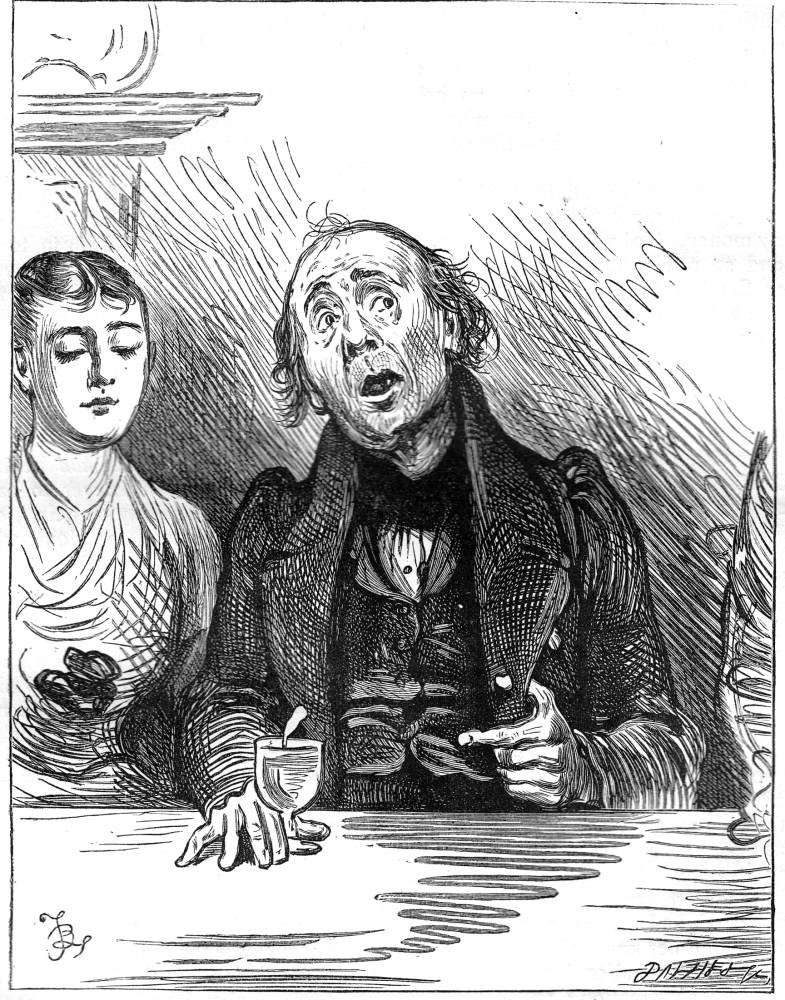
After dinner Caleb sang the song about the Sparkling Bowl
Fred Barnard
1878
13.9 cm high by 10.6 cm wide, framed
Final Illustration for Dickens's The Cricket on the Hearth, Chirp the Third, p. 116.
Scanned image and text by Philip V. Allingham
Commentary
After dinner Caleb sang the song about the Sparkling Bowl by Fred Barnard. Household Edition (1878) of "Chirp the Third" of Dickens's The Cricket on the HearthChristmas Books, p. 116. Engraved by one of the Dalziels, and signed "FB" [i. e., Fred Barnard] in lower left corner. ” [Click on the image to enlarge it.]
Barnard's final illustration for the 1845 Christmas Book suggests that, in the Dance of Life that ends the novella the long-suffering toy-maker Caleb Plummer is decidedly the odd man out — contradicting John Leech's fanciful pairing of the dancing Caleb with the awkward nurse, Tilly Slowboy, in the final illustration. The portrait of the melancholy widower and devoted single-parent, sitting beside his blind daughter and sining what ought to be a jolly seasonal catch, is a decidedly off way to conclude the novella — other nineteenth-century illustrators have tended to focus on the dance in which all of the characters, including the sarcastic Tackleton, pair off.
Other Illustrators' Choices for the Final Illustration for this Novella, 1845-1910
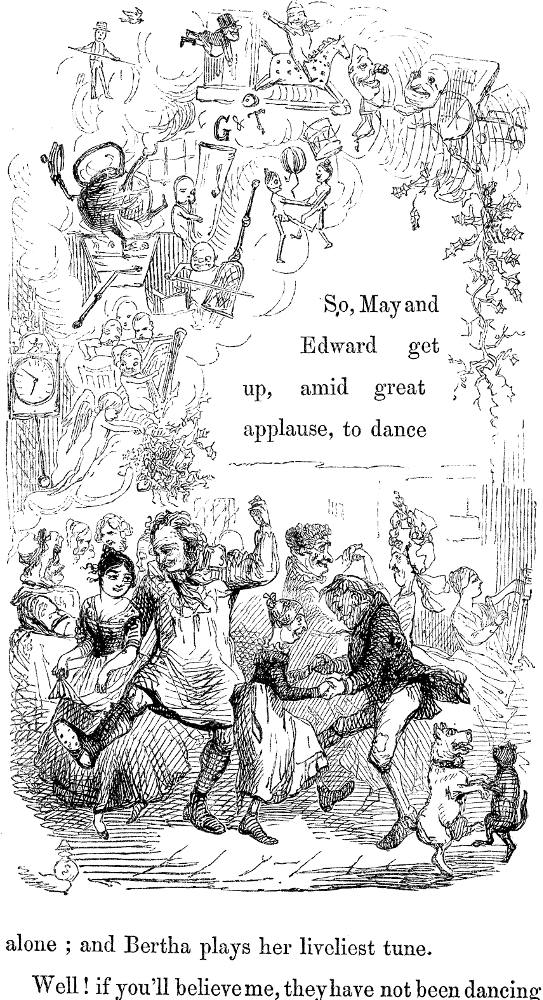


Three illustrations from the closing of the novella: Left: John Leech's scene of the community at festival, The Dance (1845). Centre: E. A. Abbey's melodramatic "'Listen to me!' he said. 'And take care that you hear me right'." (1876). Right: E. A. Brock's uncaptioned tailpiece, Caleb and Tilly dancing. (1905) [Click on the images to enlarge them.]
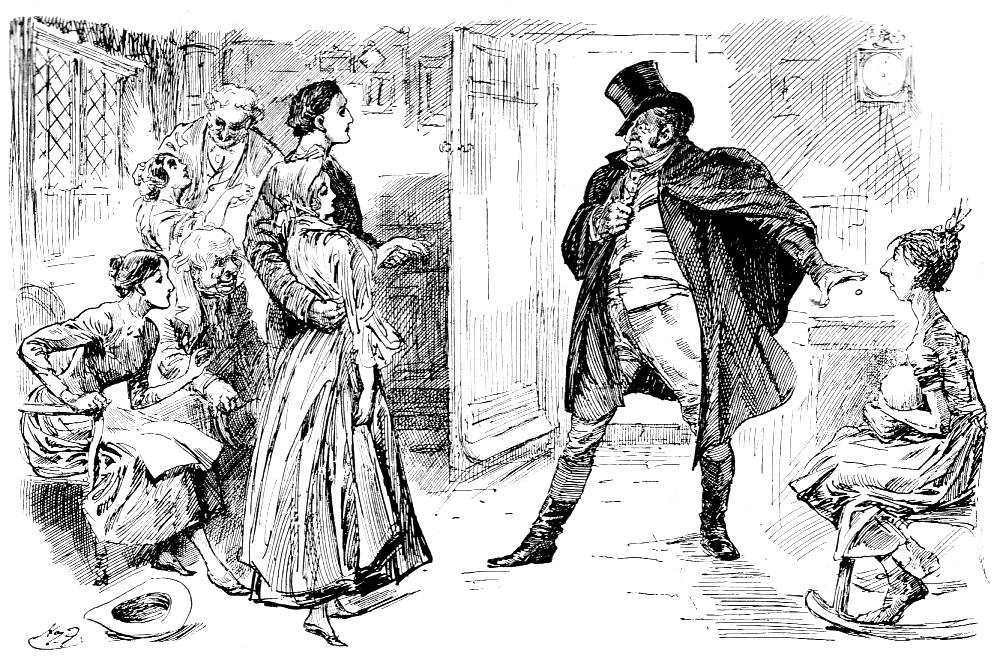
Above: Harry Furniss's depiction of Tackleton's arrival after the revelation of the lost bridegroom, Tackleton's Wedding Day! (1910). [Click on the image to enlarge it.]
References
Cohen, Jane Rabb. Charles Dickens and his Original Illustrators. Columbus: University of Ohio Press, 1980.
Dickens, Charles. The Battle of Life: A Love Story. Christmas Stories. Il. E. A. Abbey. The Household Edition. New York: Harper and Brothers, 1876.
Dickens, Charles. The Battle of Life: A Love Story. Christmas Books. Il. Fred Barnard. The Household Edition. London: Chapman and Hall, 1878.
Dickens, Charles. The Battle of Life: A Love Story. Il. John Leech, Richard Doyle, Daniel Maclise, and Clarkson Stanfield. London: Bradbury and Evans, 1846.
Goldman, Paul. "Defining Illustration Studies: Towards a New Academic Discipline." Reading Victorian Illustration, 1855-1875: Spoils of the Lumber Room. Ed. Paul Goldman and Simon Cooke. Farnham, Surrey & Burlington, VT: Ashgate, 2012. Pp. 13-32.
Hammerton, J. A. The Dickens Picture-Book. London: Educational Book, 1912.
Kitton, Frederic G. Dickens and His Illustrators. 1899. Rpt. Honolulu: U. Press of the Pacific, 2004.
Parker, David. "Christmas Books and Stories, 1844 to 1854." Christmas and Charles Dickens. New York: AMS Press, 2005. Pp. 221-282.
Patten, Robert L. Charles Dickens and His Publishers. University of California at Santa Cruz. The Dickens Project, 1991. rpt. from Oxford U. p., 1978.
Slater, Michael. "Introduction to The Battle of Life." Dickens's Christmas Books. Harmondsworth, Middlesex: Penguin, 1971. Rpt., 1978. Vol. 2: 123--126.
Slater, Michael. "Notes to The Battle of Life." Dickens's Christmas Books. Harmondsworth, Middlesex: Penguin, 1971. Rpt., 1978. Vol. 2: 364-365.
Solberg, Sarah A. "'Text Dropped into the Woodcuts': Dickens' Christmas Books." Dickens Studies Annual 8 (1980): 103-118.
Thomas, Deborah A. Dickens and The Short Story. Philadelphia: U. Pennsylvania Press, 1982.
Last modified 31 July 2016