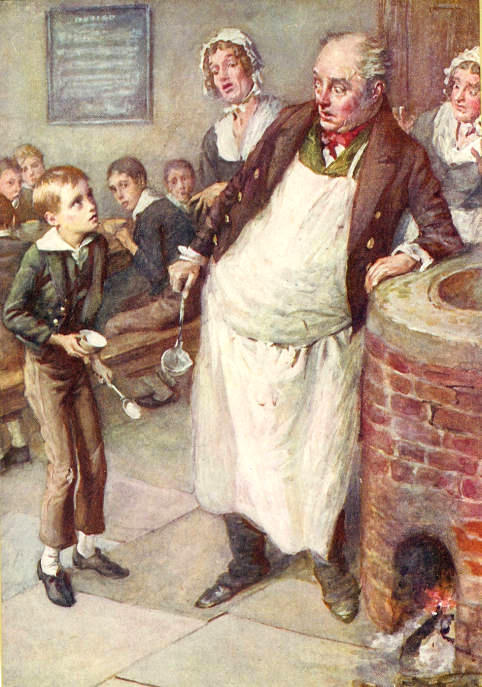
Oliver Asks for More
Harold Copping
1924
Colour lithography
Approximately 7 x 5 inches (17.9 x 12.4 cm)
From Character Sketches from Dickens, facing p. 36
[Click on image to enlarge it.]
Scanned image and text by Philip V. Allingham.


[Victorian Web Home —> Visual Arts —> Illustration —> Harold Copping —> Next]
Oliver Asks for More
Harold Copping
1924
Colour lithography
Approximately 7 x 5 inches (17.9 x 12.4 cm)
From Character Sketches from Dickens, facing p. 36
[Click on image to enlarge it.]
Scanned image and text by Philip V. Allingham.
[You may use this image without prior permission for any scholarly or educational purpose as long as you (1) credit the person who scanned the image, and (2) link your document to this URL in a web document or cite the Victorian Web in a print one.]
The scene is one of the most famous in the Dickens canon; significantly, the original was not by Hablot Knight Browne ("Phiz"), but rather by George Cruikshank, the first in his series of twenty-four that accompanied the serial text in Bentley's Miscellany between February 1837 and March 1839. Copping had the advantage in knowing from eight decades of reader responses that this scene was highly memorable and somehow signified in miniature Dickens's whole view of the callousness of early Victorian charity. Oliver, "desperate with hunger, and reckless with misery" (ch. 2), dares to challenge the unspoken credo of the system, namely that the "master" of the orphanage must exercise the utmost economy in feeding his charges, none of whom shall ever dare to assert his right to the most basic of all human necessities, adequate food. Despite his desperation, Oliver is "alarmed at his own temerity," as he approaches the master, his empty bowl in his hand, and utters the telling line, "Please, sir, I want some more." In both Cruikshank's orginal and Copping's reworking, the master contrasts with his boys, for he is "fat, healthy" and of course full grown. Never having been challenged by any of his charges, he turns pale (hardly evident in Cruikshank's line drawing), and "gaze[s] in stupefied astonishment on the small rebel," the precise moment that the illustrators have realized.
Cruikshank put Oliver in the centre of his composition and placed one of the female assistant "gruel-dispensers" to the extreme left, behind the corpulent master, adding to the viewer's focus on Oliver by placing a half-standing inmate behind him. Copping, on the other hand, has shifted the focus to the serving ladle between the petitioner and the master, who leans for support against the oven. Copping's master is clearly stunned, almost afraid of this half-starved stripling who has dared to speak up; Cruikshank's well-fed master of the refectory is more aggressive, ready to interrogate the diminutive "rebel" at whom he will momentarily aim the ladle, which Cruikshank has curiously omitted. The cartoonish boys behind Oliver in the 1837 plate are gaunt bodied, large headed, and the wall behind them is a blank, as are their prospects in life. The boys in Copping's lithograph are more believable and less distorted, but the realism of the scene underlines the force of the text's social criticism.
Dickens, Charles. The Adventures of Oliver Twist. Illustrated by George Cruikshank. London: Bradbury and Evans; Chapman and Hall, 1846.
Matz, B. W., and Kate Perugini; illustrated by Harold Copping. Character Sketches from Dickens. London: Raphael Tuck, 1924. Copy in the Paterson Library, Lakehead University, Thunder Bay, Ontario, Canada.
Created 6 March 2009 Last updated 21 September 2023