
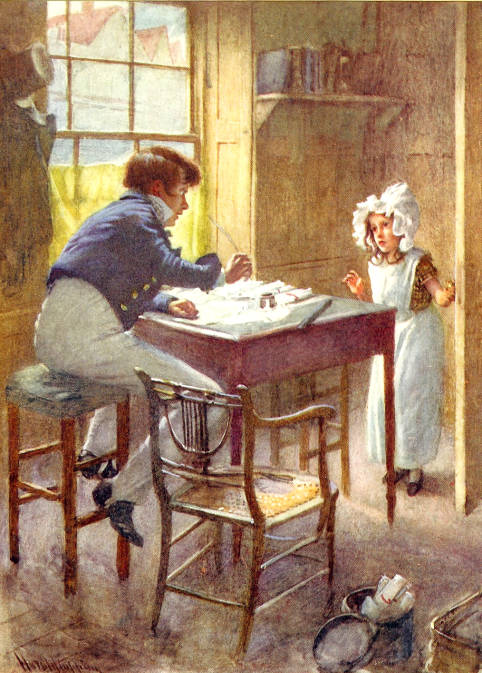
Dick Swiveller Meets the Marchioness
Harold Copping
1924
Colour lithography
18 cm. by 12.9 cm.
From Character Sketches from Dickens, facing p. 54 (illustrating The Old Curiosity Shop)
Scanned image, caption, and commentary below by Philip V. Allingham

[You may use this image without prior permission for any scholarly or educational purpose as long as you (1) credit the person who scanned the image and (2) link your document to this URL.]
Bernard W. Matz's introduction
The Old Curiosity Shop has for its chief the wanderings of Little Nell and her grandfather seeking a safe retreat. Incidentally, it aims at showing the evils of gambling. Dickens, in writing about the book, said: "The many friends it won me, and the many hearts it turned to me when they were full of private sorrow, invest it with an interest in my mind which is not a public one, and the rightful place of which appears to be 'a more removed ground.'" In writing the book, he has told us, he had it always in his fancy to surround the lovely figure of the child with grotesque and wild, but not impossible companions, and to gather about her innocent face and pure intentions associates as strange and uncongenial the grim objects that are about her bed when her history is first foreshadowed.
In addition to the two central figures, the story is full of life-like and uncommon characters, two of whom form the text of the first extract here given: Dick Swiveller and the Marchioness, whilst the second is devoted to a pathetic incident in Little Nell's career.
Philip Allingham's Commentary
Copping's initial composition for the darkest of Dickens's earliest novels, The Old Curiosity Shop, involves not the juvenile lead, the enchanting and ill-fated Little Nell, but two secondary juvenile characters incidental to Quilp's persecution of the child-heroine, the happy-go-lucky clerk Dick Swiveller and the child-servant whom he nicknames "The Marchioness." The scene in Sampson Brass's office occurs in the thirty-fourth chapter, in what was originally Part 19 (12 September 1840):
Dick leant over the table, and descried a small slipshod girl in a dirty coarse apron and bib, which left nothing of her visible but her face and feet. She might as well have been dressed in a violin-case.
'Why, who are you?' said Dick.
To which the only reply was, 'Oh, please will you come and show the lodgings?' [Ch. 34]
According to Angus Easson in the Penguin edition of the novel (1977), Dickens modelled the servant-girl upon an orphan from the Chatham Workhouse who worked for the Dickenses as a general servant during Charles's childhood. In the novel, the girl's oddness may be accounted for in part by her suggested parentage, in that Dickens hints at her being the daughter of the singularly ugly Sally Brass and the repulsive dwarf and pedophile Fred Quilp (see Easson's article in The Modern Language Review, 65 [1970], 517-518). She is, moreover, denied any sort of childhood play and even adequate nourishment, as evidenced by Phiz's illustration "The Small Servant's Dinner" (ch. 36, part 20, 19 September 1840), so that she is both preternaturally old, having to survive under such stressful circumstances, physically stunted, and emotionally repressed. Copping's illustration distorts both characters somewhat in that the servant-girl is hardly the ill-kempt, dirty child of Dickens's text, and Dick Swiveller appears much younger—more dutiful as a clerk in the absence of his employers.
References
Dickens, Charles. The Old Curiosity Shop. Ed. Angus Easson. Harmondsworth: Penguin, 1977.
Matz, B. W., and Kate Perugini; illustrated by Harold Copping. Character Sketches from Dickens. London: Raphael Tuck, 1924. Copy in the Paterson Library, Lakehead University.
Last modified 10 April 2009