
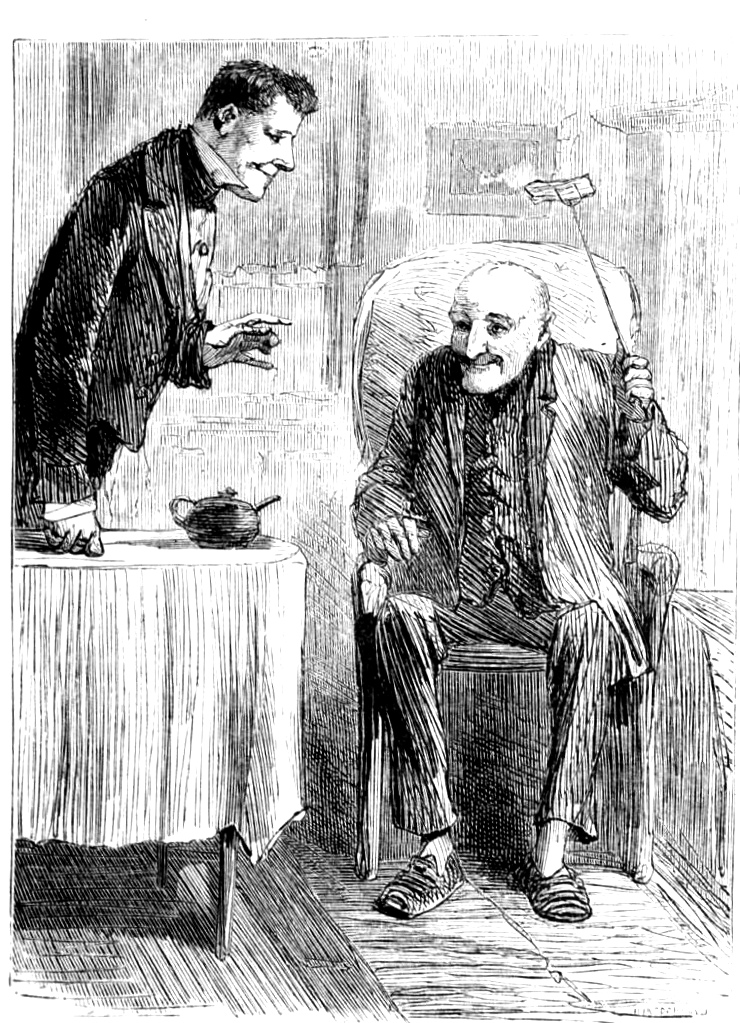
Wemmick and "The Aged"
Sol Eytinge
Wood engraving, approximately 10 cm high by 7.5 cm wide (3 ¾ by 3 inches) framed
Sixth illustration for Dickens's Great Expectations in A Tale of Two Cities and Great Expectations in the Ticknor & Fields (Boston, 1867) Diamond Edition.
Scanned image and text by Philip V. Allingham.

Passage Illustrated: Wemmick Fires The Stinger to the Delight of the Aged P.
I tipped him several more, and he was in great spirits. We left him bestirring himself to feed the fowls, and we sat down to our punch in the arbour; where Wemmick told me, as he smoked a pipe, that it had taken him a good many years to bring the property up to its present pitch of perfection.
“Is it your own, Mr. Wemmick?”
“O yes,” said Wemmick, “I have got hold of it, a bit at a time. It’s a freehold, by George!”
“Is it indeed? I hope Mr. Jaggers admires it?”
“Never seen it,” said Wemmick. “Never heard of it. Never seen the Aged. Never heard of him. No; the office is one thing, and private life is another. When I go into the office, I leave the Castle behind me, and when I come into the Castle, I leave the office behind me. If it’s not in any way disagreeable to you, you’ll oblige me by doing the same. I don’t wish it professionally spoken about.”
Of course I felt my good faith involved in the observance of his request. The punch being very nice, we sat there drinking it and talking, until it was almost nine o’clock. “Getting near gun-fire,” said Wemmick then, as he laid down his pipe; “it’s the Aged’s treat.”
Proceeding into the Castle again, we found the Aged heating the poker, with expectant eyes, as a preliminary to the performance of this great nightly ceremony. Wemmick stood with his watch in his hand until the moment was come for him to take the red-hot poker from the Aged, and repair to the battery. He took it, and went out, and presently the Stinger went off with a Bang that shook the crazy little box of a cottage as if it must fall to pieces, and made every glass and teacup in it ring. Upon this, the Aged — who I believe would have been blown out of his arm-chair but for holding on by the elbows — cried out exultingly, “He’s fired! I heerd him!” and I nodded at the old gentleman until it is no figure of speech to declare that I absolutely could not see him. [Chapter XXV]
Commentary: The Secret Castle in the suburb of Walworth
In Wemmick and "The Aged" Sol Eytinge contrasts the private, sentimental "Walworth" existence of Jaggers's clerk John Wemmick, Jr., with the sordid business of the law offices in Little Britain, represented by the previous illustration, Jaggers. Despite the years of labour that John Wemmick has lavished on his castle and his devoted care of his "Aged Parent," John Wemmick, Sr., he has never invited his secretive employer, the criminal attorney Jaggers down to Walworth. A self-centred young aristocrat such as Bentley Drummle would not have been prepared to humour Wemmick and his deaf father as Pip does — but then Wemiick would not have invited any of the others from among the privileged ranks of "The Finches of the Grove" in the first place.
In the 1877 Household Edition, illustrator F. A. Fraser includes a scene in which John Wemmick, Sr., is heating a poker in preparation for setting off "The Stinger," a small cannon which Wemmick sets off with his father's help daily so that the old fellow can continue to hear some sound and maintain some tenuous connection with the outside world, in a scene entitled We found the aged heating the poker, with expectant eyes (p. 97). The fact that in Ch. 25 Dickens specifies a heated poker, depicted here, and that Eytinge here has given the Aged P. a toasting fork would suggest that the moment illustrated is not the scene that Eytinge has chosen to depict. Despite the marvellous detail involved in the parlour setting in the Household Edition's woodcut, Fraser does not convey as effectively as Eytinge either the genial relationship of father and son or the old man's delight in his "castle." Eytinge may have only a teapot and a cloth-covered table as properties; however, he creates a surer dual portrait of John Wemmick, Sr., cheerful and well-dressed, despite his advanced age and hearing impairment, and John Wemmick, Jr., happy to indulge his father's Walworth sentiments to the full.
John McLenan's thirtieth illustration in the Harper's Weekly series of 1860-61 contains, however, an illustration of what is apparently the same moment that engaged Eytinge five years later, The responsible duty of making the toast was delegated to the Aged (27 April 1861): 269. McLenan's slightly larger plate — 11.3 cm high by 11.4 cm wide — again does a proficient job of delineating the setting, giving us, like Fraser's, all the paraphernalia of the parlour (indeed, his fireplace and hearth are rather more credible than Fraser's), but he gives us little sense of the character of the Aged P., in leggings and the skull-cap traditionally worn by aged men in the early nineteenth century. Again, a teapot (down left) dominates the scene from chapter 37, which lacks all the other characters at Wemmick's marriage feast, notably Miss Skiffins:
After a little further conversation to the same effect, we returned into the Castle where we found Miss Skiffins preparing tea. The responsible duty of making the toast was delegated to the Aged, and that excellent old gentleman was so intent upon it that he seemed to me in some danger of melting his eyes. It was no nominal meal that we were going to make, but a vigorous reality. The Aged prepared such a haystack of buttered toast, that I could scarcely see him over it as it simmered on an iron stand hooked on to the top-bar; while Miss Skiffins brewed such a jorum of tea, that the pig in the back premises became strongly excited, and repeatedly expressed his desire to participate in the entertainment.
Other Artists' Renderings of Wemmick's Aged P., 1867 to 1916
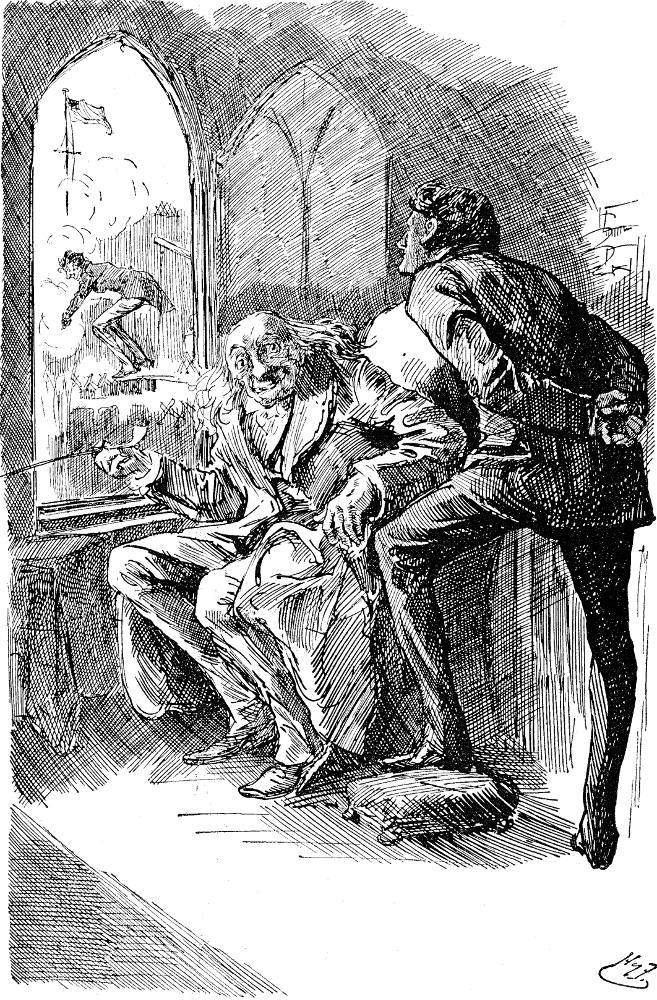
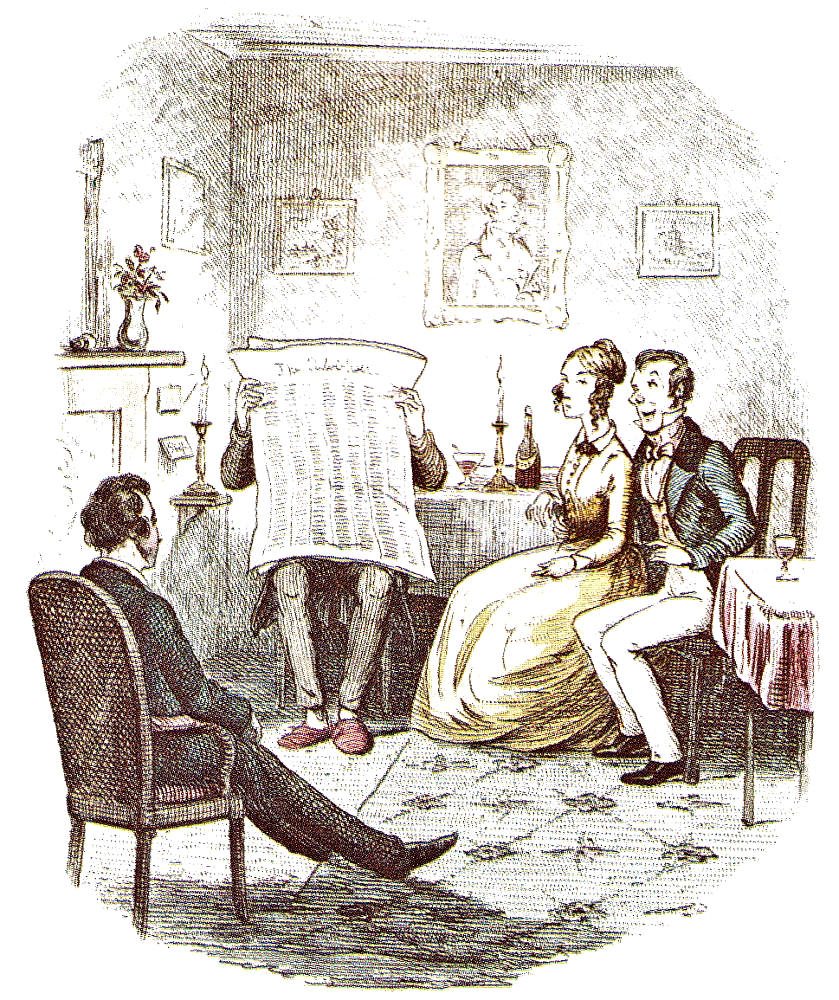
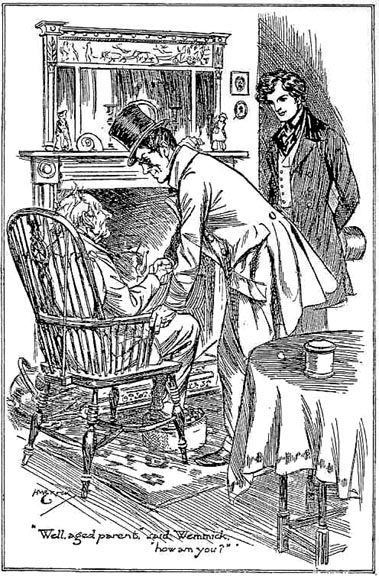
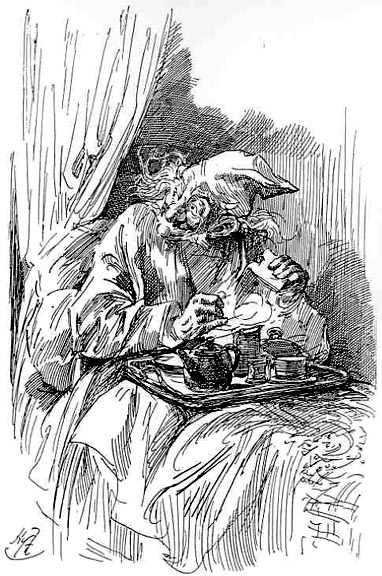
Left:Harry Furniss's Charles Dickens Library Edition illustration of a scene at Wemmick's castle: Pip shares the Treat of Mr. Wemmick, Senior (1910). Left of centre: F. W. Pailthorpe's Robson and Kerslake scene of The agreeable visit that Pip pays the Wemmicks at Walworth: "Now, Aged Parent, tip us the Paper" (1885). Right of centre: H. M. Brock's revision of the same scene: "Well, aged parent." said Wemmick, "how am you?", in the Hodder and Stoughton Edition (1916). Right: Furniss's portrait for the Charles Dickens Library Edition of JohnWemmick's father, in his nightcap: Mr. Wemmick, Senior, has Breakfast in Bed (1910).
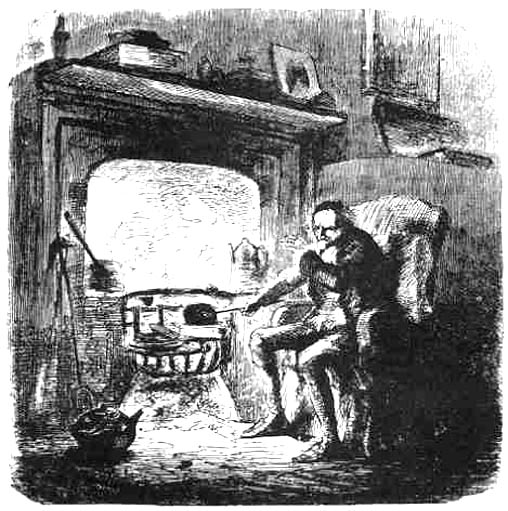
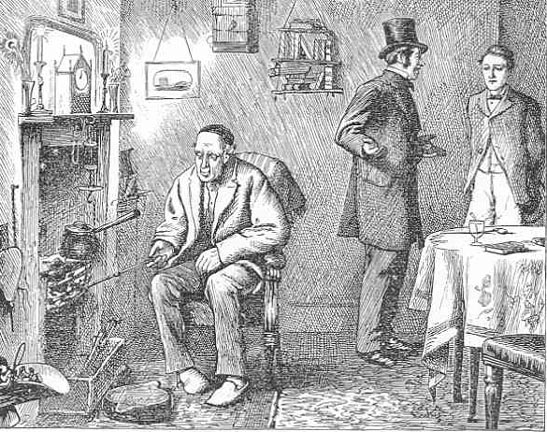
Left: In the first American serialisation, periodical illustrator John McLenan emphasizes the cozziness of Mr. Wemmick, Sr.'s rooms in The responsible duty of making the toast was delegated to the Aged (27 April 1861). Right: F. A. Fraser's Household Edition version of the same scene: We found the aged heating the poker, with expectant eyes (1876).
Related Material
- Charles Dickens’s Great Expectations
- Bibliography of works relevant to illustrations of Great Expectations
Other Artists’ Illustrations for Dickens's Great Expectations
- Edward Ardizzone (2 plates selected)
- H. M. Brock (8 lithographs)
- J. Clayton Clarke ("Kyd") (2 lithographs from watercolours)
- Felix O. C. Darley (2 plates)
- Sol Eytinge, Jr. (8 wood engravings)
- Marcus Stone (8 wood engravings)
- John McLenan (40 wood engravings)
- F. A. Fraser in the Household Edition (1876) (30 wood-engravings)
- Frederic W. Pailthorpe (21 lithographs)
- Charles Green (10 lithographs)
Bibliography
Allingham, Philip V. "The Illustrations for Great Expectations in Harper's Weekly (1860-61) and in the Illustrated Library Edition (1862) — 'Reading by the Light of Illustration'." Dickens Studies Annual, Vol. 40 (2009): 113-169.
Dickens, Charles. Great Expectations. Illustrated by John McLenan. [The First American Edition]. Harper's Weekly: A Journal of Civilization, Vols. IV: 740 through V: 495 (24 November 1860-3 August 1861).
______. ("Boz."). Great Expectations. With thirty-four illustrations from original designs by John McLenan. Philadelphia: T. B. Peterson (by agreement with Harper & Bros., New York), 1861.
______. Great Expectations. Illustrated by Marcus Stone. The Illustrated Library Edition. London: Chapman and Hall, 1862. Rpt. in The Nonesuch Dickens, Great Expectations and Hard Times. London: Nonesuch, 1937; Overlook and Worth Presses, 2005.
______. A Tale of Two Cities and Great Expectations. Illustrated by Sol Eytinge, Jr. The Diamond Edition. 16 vols. Boston: Ticknor and Fields, 1867. XIII.
______. Great Expectations. Volume 6 of the Household Edition. Illustrated by F. A. Fraser. London: Chapman and Hall, 1876.
______. Great Expectations. The Gadshill Edition. Illustrated by Charles Green. London: Chapman and Hall, 1898.
______. Great Expectations. The Grande Luxe Edition, ed. Richard Garnett. Illustrated by Clayton J. Clarke ('Kyd'). London: Merrill and Baker, 1900.
______. Great Expectations. "With 28 Original Plates by Harry Furniss." 18 Volumes. The Charles Dickens Library Edition. London: Educational Book Co., 1910. XIV.
Paroissien, David. The Companion to "Great Expectations." Westport, Conn.: Greenwood, 2000.
Created 2 October 2011 Last updated 27 October 2021