
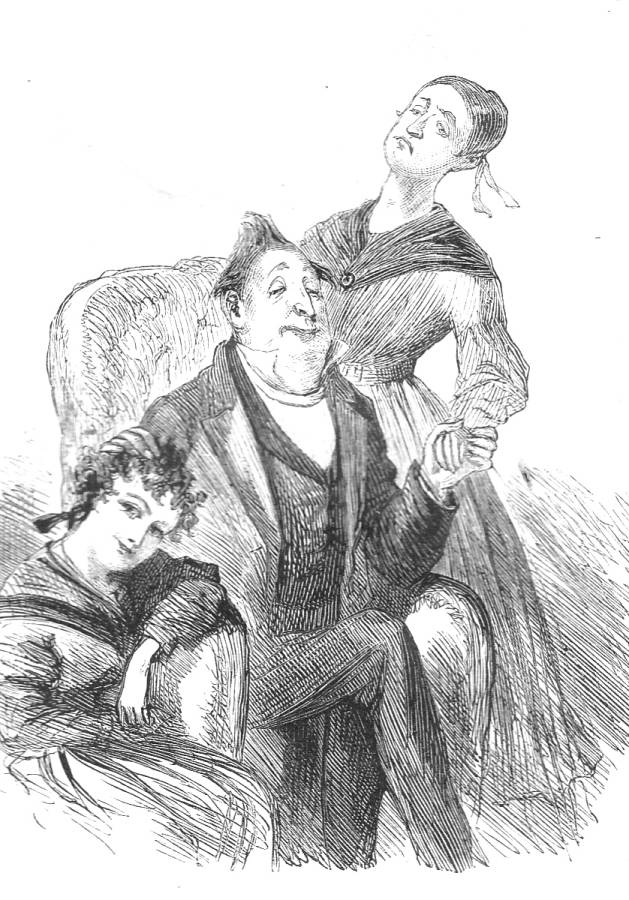
Mr. Pecksniff and his Daughters
Sol Eytinge, Jr.
1867
Dickens's Martin Chuzzlewit (Diamond Edition)
[Click on image to enlarge it.]
Wood engraving, approximately 10 cm high by 7.5 cm wide (framed)
This second full-page character study introduces the story's arch-hypocrite, Seth Pecksniff, a widower and architect living in a village not far from Salisbury. Portraiture was high on the Royal Academy scale, and Eytinge has used the academician's trick of conveying the characters of the sitters through their faces, postures, and juxtapositions, showing their close affinity but subtle personality differences.
Image scan and text by Philip V. Allingham; formatting by George P. Landow.
You may use this image without prior permission for any scholarly or educational purpose as long as you (1) credit the person who scanned the image and (2) link your document to this URL in a web document or cite the Victorian Web in a print one. in a web document or cite the Victorian Web in a print one. in a web document or cite the Victorian Web in a print one.
As members of a single family, the sitters all bear considerable resemblance to one another, but Pa's favourite (as signified by his gesture of patting her on the head) is the far more comely younger sister, Mercy, whose charming, free-flowing locks the illustrator has captured most effectively. Charity is of a different physical and psychological cast entirely: plain, discontented, and somewhat morose. And between the standing Charity and the sitting Mercy is enthroned Seth Pecksniff, a portrait derived from Phiz's original Martin Chuzzlewit serial illustrations, particularly "Meekness of Mr. Pecksniff and His Chaming Daughters" (January 1843). As in Phiz's series, we should associate the number three with Pecksniff, as if he is the head of a trinity, his daughters being his complements as a three-personed deity and divine patron of the family parlour, which here is missing all those facetious details that in Phiz's original illustration represent Seth Pecksniff's egocentricity. The passage that we should regard as connected with the family portrait is this:
Mr. Pecksniff having been comforted internally, with some stiff brandy-and-water, the eldest Miss Pecksniff sat down to make the tea, which was all ready. In the meantime the youngest Miss Pecksniff brought from the kitchen a smoking dish of ham and eggs, and, setting the same before her father, took up her station on a low stool at his feet; thereby bringing her eyes on a level with the teaboard.
It must not be inferred from this position of humility, that the youngest Miss Pecksniff was so young as to be, as one may say, forced to sit upon a stool, by reason of the shortness of her legs. Miss Pecksniff sat upon a stool because of her simplicity and innocence, which were very great, — very great. Miss Pecksniff sat upon a stool because she was all girlishness, and playfulness, and wildness, and kittenish buoyancy. She was the most arch and at the same time the most artless creature, was the youngest Miss Pecksniff, that you can possibly imagine. It was her great charm. She was too fresh and guileless, and too full of child-like vivacity, was the youngest Miss Pecksniff, to wear combs in her hair, or to turn it up, or to frizzle it, or braid it. She wore it in a crop, a loosely flowing crop, which had so many rows of curls in it, that the top row was only one curl. Moderately buxom was her shape, and quite womanly too; but sometimes — yes, sometimes — she even wore a pinafore; and how charming that was! Oh! she was indeed "a gushing thing" (as a young gentleman had observed in verse, in the Poet's Corner of a provincial newspaper), was the youngest Miss Pecksniff!
Mr. Pecksniff was a moral man — a grave man, a man of noble sentiments and speech — and he had had her christened Mercy. Mercy! oh, what a charming name for such a pure-souled being as the youngest Miss Pecksniff! Her sister's name was Charity. There was a good thing! Mercy and Charity! And Charity, with her fine strong sense and her mild, yet not reproachful gravity, was so well named, and did so well set off and illustrate her sister! What a pleasant sight was that the contrast they presented; to see each loved and loving one sympathizing with, and devoted to, and leaning on, and yet correcting and counter-checking, and, as it were, antidoting, the other! To behold each damsel in her very admiration of her sister, setting up in business for herself on an entirely different principle, and announcing no connection with over-the-way, and if the quality of goods at that establishment don't please you, you are respectfully invited to favour ME with a call! And the crowning circumstance of the whole delightful catalogue was, that both the fair creatures were so utterly unconscious of all this! They had no idea of it. They no more thought or dreamed of it than Mr. Pecksniff did. Nature played them off against each other; they had no hand in it, the two Miss Pecksniffs. [Chapter 2; Diamond Edition, p. 7-8]
References
Bentley, Nicolas, Michael Slater, and Nina Burgis. The Dickens Index. Oxford and New York: Oxford U. P., 1988.
Davis, Paul. Charles Dickens A to Z: The Essential Reference to His Life and Work. New York: Checkmark and Facts On File, 1998.
Dickens, Charles. The Life and Adventures of Martin Chuzzlewit. Il. Sol Eytinge, Jr. The Diamond Edition. Boston: Ticknor and Fields, 1867.
Dickens, Charles. The Life and Adventures of Martin Chuzzlewit (1842-43). Il. Hablot Knight Browne ("Phiz"). London: Chapman and Hall, 1843.
Hammerton, J. A. The Dickens Picture-Book. London: Educational Book Co., 1910.
Kitton, Frederic G. Dickens and His Illustrators. 1899. Rpt. Honolulu: U. Press of the Pacific, 2004.
Lester, Valerie Browne. Phiz: The Man Who Drew Dickens. London: Chatto and Windus, 2004.
Steig, Michael. Dickens and Phiz. Bloomington & London:
Last modified 1 April 2012
