
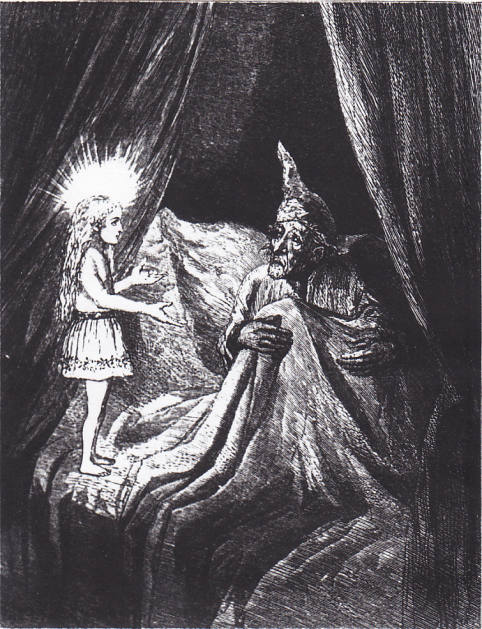
The Spirit of Christmas Past
Sol Eytinge
Wood engraving
12.4 high x 9.5 cm.
Illustration for Dickens's A Christmas Carol in
This is the only scene in the sequence in which Scrooge is actuallyin bed as he receives a spirit guide. See below for the passage at the beginning of Stave Two that Eytinge has depicted.
Image reproduced courtesy of Halyna Kozar, E. J. Pratt Library, Victoria University, Toronto
Text by Philip V. Allingham.
[You may use this image without prior permission for any scholarly or educational purpose as long as you (1) credit the person who scanned the image and (2) link your document to this URL in a web document or cite it in a print one.]
He spoke before the hour bell [one o'clock] sounded, which it now did with a deep, dull, hollow, melancholy ONE. Light flashed up in the room upon the instant, and the curtains of his bed were drawn.
The curtains of his bed were drawn aside, I tell you, by a hand. Not the curtains at his feet, nor the curtains at his back, but those to which his face was addressed. The curtains of his bed were drawn aside; and Scrooge, starting up into a half-recumbent attitude, found himself face to face with the unearthly visitor who drew them: as close to it as I am now to you, and I am standing in the spirit at your elbow.
It was a strange figure — like a child: yet not so like a child as like an old man, viewed through some supernatural medium, which as like an old man, which gave him the appearance of having receded from the view, and being diminished to a child's proportions. Its hair, which hung about its neck and down its back, was white as if with age; and yet the face had not a wrinkle in it and the tenderest bloom was on the skin. The arms were very long and muscular; the hands the same, as if its hold were of uncommon strength. Its legs and feet, most delicately formed, were, like those upper members, bare. It wore a tunic of the purest white; and round its waist was bound a lustrous belt the sheen of which was beautiful. It held a branch of fresh green holly in its hand; and, in singular contradiction of that wintry emblem, had its dress trimmed with summer flowers. But the strangest thing about it was, that from the crown of its head there sprung a bright clear jet of light, by which all this was visible; and which was doubtless the occasion of its using, in its duller moments, a great extinguisher for a cap, which it now held under its arm. [Stave Two, "The First of the Three Spirits"]
Re-reading this textual moment and trying to visualise it, one can readily see why Dickens's original illustrator, John Leech, did not attempt to realise it. Eytinge has simply eliminated those features that he must have felt defied the illustrator's art, so that, for example, although he has included the white tunic trimmed with flowers and the beam of light emanating from the spirit's head from which white hair depends to the waist, and the disproportionately long arms, he has omitted the extinguisher cap, the "lustrous" nature of the belt, and any suggestion that the spirit (most famously in the Alastair Sim 1951 Renown cinematic adaptation) is an old man. Eytinge has made obvious Scrooge's almost pre-natal posture, with knees draw up under his chin, ready for his spiritual rebirth and reintegration into the human family.
Bibliography
Dickens, Charles. A Christmas Carol in Prose: being a Ghost Story of Christmas. Il. Sol Eytinge, Jr. Boston: Ticknor & Fields, 1868.
Last modified 24 December 2010