
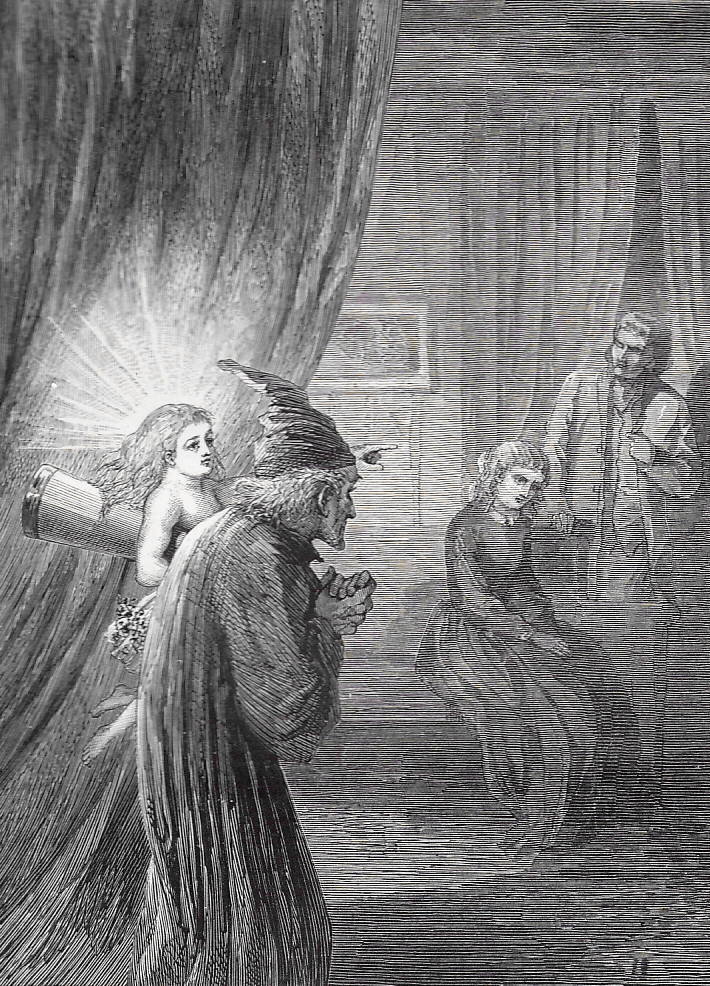
A Retrospect
Sol Eytinge
Wood engraving
12.6 high x 9.4 cm
Eighth full-page Illustration for Dickens's A Christmas Carol in Prose: being a ghost story of Christmas in the Ticknor and Fields (Boston), 1869, edition.
[Click on image to enlarge it.]
Scanned image and text by Philip V. Allingham.
[You may use this image without prior permission for any scholarly or educational purpose as long as you (1) credit the person who scanned the image and (2) link your document to this URL in a web document or cite the Victorian Web in a print one. in a web document or cite the Victorian Web in a print one.]
After "The Fezziwig Ball" (p. 47) in "Stave 2: The First of the Three Spirits" Eytinge shows Scrooge how as a young man several Christmases later he failed in one of his most important relationships. One of the most significant scenes in the first two "staves" from a psychological perspective is the interview between young Scrooge and his fiancee, Belle, that brings the visit of the Spirit of Christmas Past to an abrupt close when the dreamer stifles the spirit guide under his gigantic candle-snuffer cap to extinguish painful memories. This is the point that Dickens raises most forcibly in The Haunted Man (1848), namely that one cannot fully experience moments of pleasure in life without experiencing some pain, and that none of us, no matter how fortunate or prosperous, is exempt from personal loss and suffering. In the 1951 Renown film, Scrooge's spirit guide commands him, after the Fezziwig-sponsored festivities, to "Turn, and see yourself in love." In fact, the text moves swiftly to Ebenezer's and Belle's cancelling their engagement because, as Belle remarks, her fiance has replaced her image in his heart with that of the Golden Calf, in other words, the pursuit of wealth. Although Scrooge, whose maturity is signalled by his hair and stern expression, is standing and Belle sitting, whereas the text specifies that they are both sitting, that she has turned her head away from him suggests that this is the precise moment in the interview that Eytinge has chosen to realise:
He was about to speak; but with her head turned from him, she resumed.
"You may — the memory of what is past half makes me hope you will — have pain in this. A very, very brief time, and you will dismiss the recollection of it, gladly, as an unprofitable dream, from which it happened well that you awoke. May you be happy in the life you have chosen!" [Stave Two, "The First of the Spirits"]
As in the text, Belle is depicted as "a fair young girl in a mourning-dress, but otherwise Eytinge was free to improvise, particularly with respect to the figures of the spirit and his charge. Pointing not merely toward the scene but a future devoid of companionship, the Spirit of Christmas Past has his upstage (left) hand in the very centre of the composition, which is otherwise dominated by Scrooge, his back towards us, wringing his hands.
Reference
Dickens, Charles. A Christmas Carol in Prose: being a Ghost Story of Christmas. Il. Sol Eytinge, Jr. Boston: Ticknor & Fields, 1868.
Hearne, Michael Patrick, ed. The Annotated Christmas Carol. New York: Avenel, 1989.
Last modified 20 August 2011
