
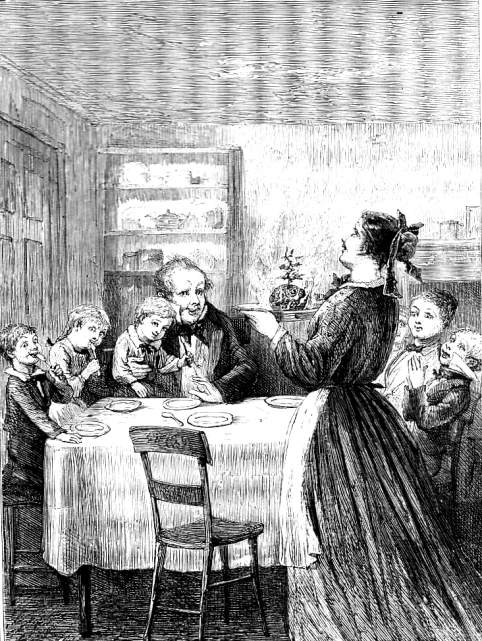
The Wonderful Pudding
Sol Eytinge
Wood engraving
12.6 high x 9.4 cm
Eleventh full-page Illustration for Dickens's A Christmas Carol in Prose: being a ghost story of Christmas in the Ticknor and Fields (Boston), 1869, Diamond Edition.
Scanned image and text by Philip V. Allingham.
[You may use these images without prior permission for any scholarly or educational purpose as long as you (1) credit the photographer and (2) link your document to this URL in a web document or cite the Victorian Web in a print one. ]
In "The Wonderful Pudding" (p. 68), the eleventh full-page illustration, Eytinge continues the heart-warming narrative of the mutually devoted and supportive Cratchit family, who are happy despite the bread-winner's modest income and the affliction of having a physically challenged child. As in the text, the children have crammed their spoons into their mouths to restrain the temptation to scream as Mrs. Cratchit presents her signature dish, the flaming Christmas pudding. In that the illustration describes both the juxtaposition and demeanour of the diners and the unveiling of the pudding, Eytinge appears to have synthesized two separate passages concerning the family dinner:
Bob took Tiny Tim beside him in a tiny corner at the table; the two young Cratchits set chairs for everybody, not forgetting themselves, and mounting guard upon their posts, crammed spoons into their mouths, lest they should shriek for goose before their turn came to be helped.
and, after the main course, and the disappearance of Mrs. Cratchit to the washhouse to retrieve the dessert.
In half a minute Mrs. Cratchit entered: flushed, but smiling proudly : with the pudding, like a speckled cannon-ball, so hard abd firm, blazing in half of half-a-quartern of ignited brandy, and bedight with Christmas holly stuck into the top. [Stave Three, "The Second of the Spirits"]
The scene, set in Bob Cratchit's four-room Camden Town home, is suggestive of John and Elizabeth Dickens's Christmases celebrated in the early 1820s at 16 Bayham Street. It continues the description of the family gathering which Eytinge initiated in "Bob Cratchit at home", with the six children now seated around the table as Mrs. Cratchit presents the flaming dessert. One naturally wonders, since the composition of the scene precedes John Forster's publishing the authoritative biography The Life of Charles Dickens, whether Eytinge learned from Dickens himself in 1868-69 that the original of the Cratchit family was his own in childhood. As becomes a scene in the "domestic sphere," the dominating figure in this scene is that of Mrs. Cratchit, clad in a white apron, but Eytinge has been careful to place the family's provider, Bob Cratchit, at the very centre of the illustration, with the smallest child, Tiny Tim, in his arms. One notes a strong family resemblance among the children, the shape of their noses in particular reflecting that feature of their father.
Reference
Dickens, Charles. A Christmas Carol in Prose: being a Ghost Story of Christmas. Il. Sol Eytinge, Jr. Boston: Ticknor & Fields, 1868.
Hearne, Michael Patrick, ed. The Annotated Christmas Carol. New York: Avenel, 1989.
Last modified 30 December 2010