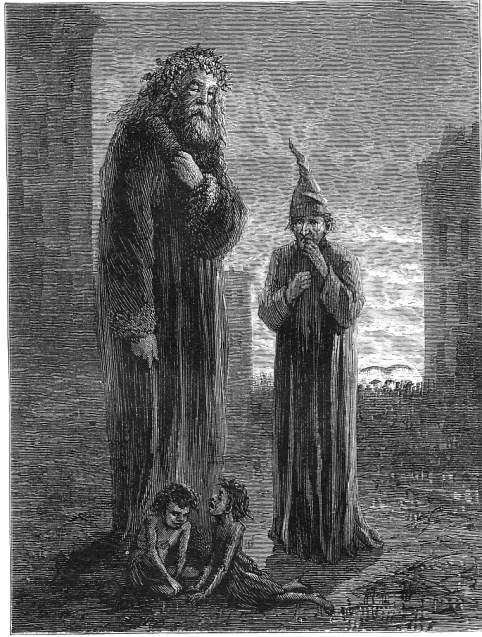
Want and Ignorance
Sol Eytinge
Wood engraving
12.6 high x 9.5 cm"
Fifteenth Illustration for Dickens's A Christmas Carol in Prose: being a ghost story of Christmas in the Ticknor and Fields (Boston), 1869 Diamond Edition.
Scanned image and text by Philip V. Allingham.
[You may use these images without prior permission for any scholarly or educational purpose as long as you (1) credit the photographer and (2) link your document to this URL in a web document or cite the Victorian Web in a print one. ]
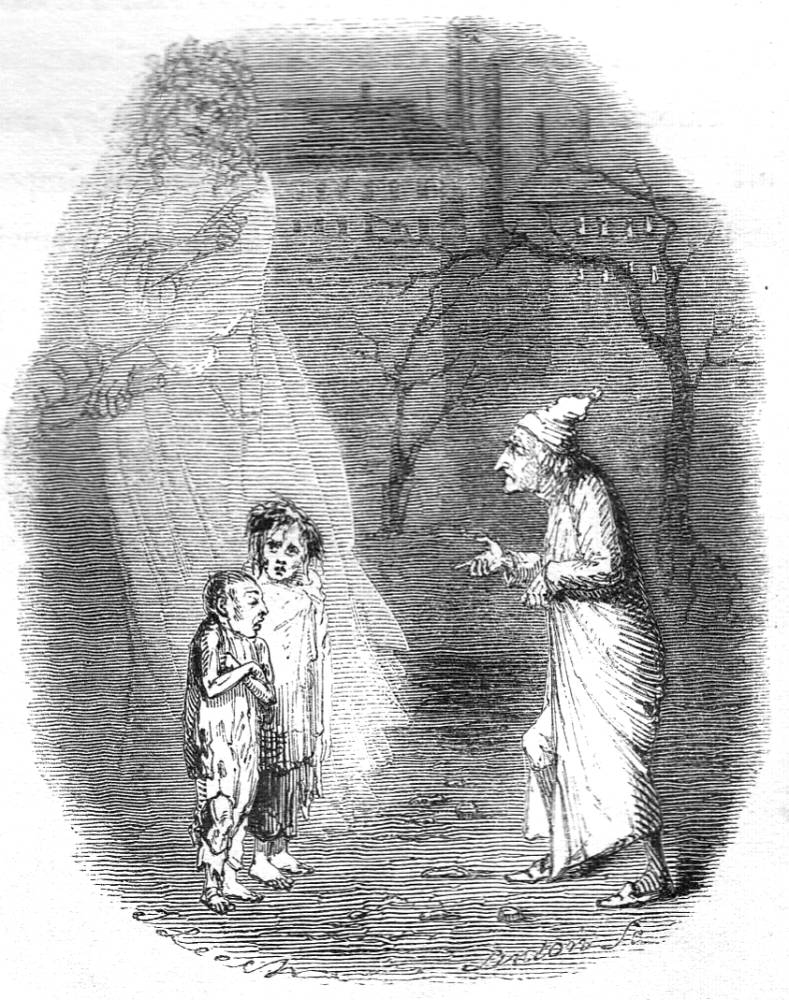
Like the illustrators of the Household Edition, Sol Eytinge, Jr., was composing within a pictorial tradition established by Dickens and his original graphic artists, so that, for example, in drawing "Want and Ignorance" in A Christmas Carol in Prose: being a ghost story of Christmas he did not have an entirely free hand since even many of his American readers in the Christmas season of 1868 would have been thoroughly aware of Leech's 1843 small but radical woodcut "Ignorance and Want." Since Dickens's prophetic Christmas Present warns mankind about the graver dangers represented by the shivering, ragged, diminutive male figure, Ignorance —
Beware them both, and all of their degree, but most of all beware this boy, for on his brow I see that written which is Doom, unless the writing be erased. (Stave 3)
&mdash Eytinge has chosen to reverse the order of their names in the title and render them squatting rather than standing, for their power drives humanity to the condition of animals. Leech's figures, though ill-clad, are markedly human, and the girl even seems to turn towards her ill-clothed brother in concern; in contrast, Eytinge's quasi-naked, dark figures more closely realize Dickens's description: "meager, ragged, scowling, wolfish; but prostrate, too, in their humility." Whereas Leech's spirit points a chastising finger at Scrooge for harbouring the existence of such social ills, Eytinge's points downward as the text describes, with the slum children kneeling at his feet as the spirit cries, "Oh, Man! look here. Look, look, down here!" In neither illustration, curiously, do the allegorical children cling to the spirit's garments, but at least in Eytinge's there is an urban as opposed to the factory backdrop that Leech substituted. In place of the blighted tree, emblematic of the consequences of the factory system, Eytinge has a bird of ill-omen haloed by the setting moon. In keeping with the serious subject of the illustration, Eytinge has given us a sombre Druid rather than "a jolly Giant, glorious to see." The implied movement of the 1868 "dark" plate is entirely upward and downward, with the pillar-like tenement blocks in the background complementing the pillar-like figures of Scrooge and his spirit-guide. Finally, as the chimes strike midnight, Leech's Spirit of Christmas Present is fading, even though the text does not so specify; rather, he vanishes utterly at the moment the bell strikes twelve, presumably on the night of the last of twelve days of Christmas. In contrast, Eytinge's leaden spirit clasps his collar with his left hand against the chill; his holly and berry head-dress, however, seems to have wilted if we compare it to its rendering in Eytinge's "The Spirit of Christmas Present" five plates earlier, and in the frontispiece, in which the crown is more luxuriant and the figure both more nimble, youthful, jolly, vigorous, and benign.
Last modified 22 December 2010