
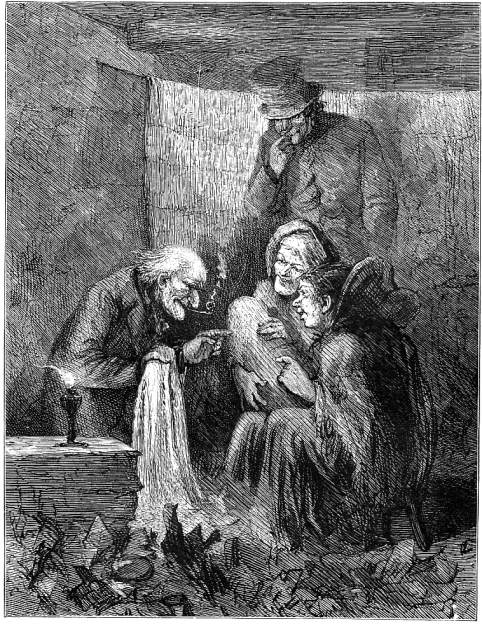
Old Joe's
Sol Eytinge
Wood engraving
12.2 high x 9.5 cm wide
Fifteenth full-page Illustration for Dickens's A Christmas Carol in Prose: being a ghost story of Christmas in the Ticknor and Fields (Boston), 1869, Diamond Edition.
Scanned image and text by Philip V. Allingham.
[You may use these images without prior permission for any scholarly or educational purpose as long as you (1) credit the photographer and (2) link your document to this URL in a web document or cite the Victorian Web in a print one. ]
"Old Joe's" (p. 91) is Eytinge's realisation of the scene in the East End rag-and-bone shop in which those associated with the winding up of Scrooge's house, including the undertaker's man, meet to cash in their meagre depredations. To use the term Marxist in connection with any Dickens fiction is dangerous since Dickens's works generally predate Marx's Das Capital (1867), and A Christmas Carol (1843) was published before Engel's socialistic Condition of the Working Classes in England (1844). Even though the second Christmas Book, The Chimes (1844), betrays a certain sympathy for the Chartist cause, Dickens was essentially a Liberal who, despite his anti-aristocratic biases, wrote out of and for the middle class experience. In Eytinge's "Old Joe's" (p. 91), we see once again Dickens's indictment of cupidity throughout his society, not merely of bourgeois materialism, for the "marine shop" proprietor, a petite bourgeois, and his working class clients (the laundress, the charwoman, and the undertaker's man) are every bit as as greedy as the capitalists whom we have just seen in "On 'Change."
The figures include Old Joe, the fence, left; the charwoman, right; the laundress, centre; and the undertaker's man, behind. Although the text specifies that the setting is Old Joe's parlour, behind the shop, Eytinge shows rags and other rubbish on the floor, suggesting Dickens's initial description of the place as full of
heaps of rusty keys, nails, chains, hinges, files, scales,and refuse iron of all kinds. Secrets that few would like to scrutinise were bred and hidden in mountains of unseemly rags, masses of of corrupted fat, and sepulchres of bones. Sitting in among the wares he dealt in, by a charcoal stove, made of old bricks, was a gray-haired rascal, nearly seventy years of age. . . . [stave 4, "The Last of the Spirits"]
Technically, Joe is a "rag-and-bone man," who deals, like Mr. Krook in Bleak House (1853) deals in "kitchen stuff" such as grease, rendered fat, drippings, rags (for paper), and bones; like the proprietors of "marine-store" shops, he also deals in all manner of used iron. For these frequent trades, Joe opens his parlour behind a ragged screen (which is draped behind the undertaker's man in Eytinge's illustration). Since Joe is depicted as kneeling as he examines a garment of white fabric such as cotton brought in by the charwoman in her bundle, which she had initially laid at Joe's feet, Eytinge has probably combined several moments in the scene, beginning with:
"I wish it was a little heavier one," replied the woman; "and it should have been, you may depend upon it, if I could have laid my hands on anything else. Open the bundle, old Joe, and let me know the value of it. Speak out plain. I'm not afraid to be the first, nor afraid for them to see it. We knew pretty well that we were helping ourselves,before we met here. It's no sin. Open the bundle, Joe."
However, since there is neither honour nor manners among thieves, the undertaker's man (who dressed the corpse) and the laundress, Mrs. Dilber (who produces sheets and towels, some old clothes, teaspoons and sugar-tongs) intervene. Finally, however, the charwoman prevails upon Joe to open her bundle:
Joe went down on his knees for the greater convenience of opening it, and having unfastened a great many knots, dragged out a large and heavy roll of some dark stuff.
This material, it turns out, is the dead man's bed-curtains. She also has made away with his blankets ("I hope he didn't die of anything catching?" Eh?"said old Joe), and even his white cotton shirt, the sign of his class:
"You may look through that shirt till your eyes ache; but you won't find a hole in it, nor a thread-bare place. It's the best he had, and a fine one too. They'd have wasted it, if it hadn't been for me."
And so Ebenezer Scrooge, well known on the Royal Exchange, is buried in calico ("It's quite as becoming to the body") rather than cotton. Although Dickens describes the quartet as "obscene demons," only Eytinge's rag-and-bone man is rendered as a distorted caricature as he inspects the shirt by the light of an oil lamp with no glass chimney. He gestures at the charwoman with his upstage (left) index finger, perhaps in agreement of her assessment of the quality of the fabric.
Reference
Dickens, Charles. A Christmas Carol in Prose: being a Ghost Story of Christmas. Il. Sol Eytinge, Jr. Boston: Ticknor & Fields, 1868.
Hearne, Michael Patrick, ed. The Annotated Christmas Carol. New York: Avenel, 1989.
Last modified 2 January 2011