
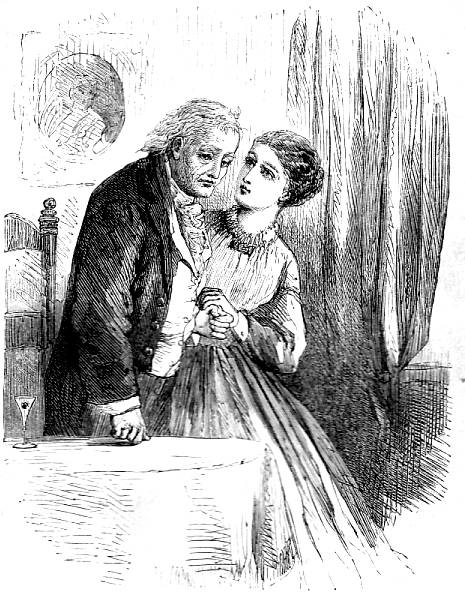
Mr. Wickfield and Agnes
Sol Eytinge
Wood engraving
10.2 high x 7.8 cm wide
Twelfeth full-page illustration for Dickens's David Copperfield in the Ticknor and Fields (Boston), 1867, Diamond Edition.
Scanned image and text by Philip V. Allingham.

[You may use these images without prior permission for any scholarly or educational purpose as long as you (1) credit the photographer and (2) link your document to this URL in a web document or cite the Victorian Web in a print one. ]
The twelfth illustration — taking its cue from Dickens's text in Chapter 35, "Depression" — describes the relationship between Canterbury attorney Wickfield and his daughter of marriageable age. In essence, his daughter, Agnes, serves as a surrogate wife for the elderly widower in that, even from girlhood, she has managed the household and held all the keys to the house. In Eytinge's illustration she communicates her concern for her aging father's physical and mental deterioration through her facial expression and the physical support she offers him as he rises from his chair (left) in the evening in order to rest on the chesterfield after dinner. On the table, a very small glass of wine has been emptied, minimizing the reader's suspicion that the old lawyer has chosen to escape his sense of guilt in alcohol as he bends to the will of his devious and manipulative junior partner, Uriah Heep. Eytinge's Mr. Wickfield seems physically frail and mentally exhausted, as is suggested by his posture, bleary eyes, thinning hair, and balancing himself by putting his right hand on the table. The illustration is undoubtedly intended to complement the following passage on the facing page:
After dinner, Agnes sat beside him, as of old, and poured out his wine. He took what she gave him, and no more, — like a child, — and we all three sat together at a window as the evening gathered in. When it was almost dark, he lay down on a sofa, Agnes pillowing his head. . . . [292]
Eytinge gives the pair a common facial bone structure, but distinguishes the the head of the daughter by placing it in the very centre of the composition to increase her prominence. Her father's tailcoat, waistcoat, and cravat are consistent with the fashions of the 1840s, but in contrast to the richly-textured cravat of the father Eytinge has dressed Agnes very plainly, in part to focus the reader's attention on her face. Compare the solid modelling of Eytinge's version of these characters to the lighter, more delicate lines of Phiz's in "Mr. Wickfield and his partner wait upon my Aunt" for the same chapter. Phiz's analyses of the characters of the father and daughter are somewhat superficial — the original Dickens illustrator achieves his effect (placing the concerned child and abstracted parent centre stage) in a markedly theatrical manner, setting the characters in a dramatic and narrative-pictorial context; in contrast, Eytinge studies the pair with deep conviction and psychological penetration, but offers only the empty wine glass as a contextual clue to define the moment realized. A "New Man of the Sixties," Eytinge offers an interesting commentary on the Wickfields; Phiz had dramatized their situation with reference to Uriah Heep and Betsey Trotwood to flesh out the scene that Dickens describes. One might argue that, while Eytinge's illustration is an interesting adjunct to the experience of reading the 1867 Diamond Edition of the novel, Phiz's is "indispensable to comprehensive understanding of [Dickens's] time and his texts" (Cohen, 234), in this case David Copperfield, since the illustration must have profoundly shaped the serial reader's interpretation of the particular scene in the monthly instalment, in this case, the twelfth part, issued at the beginning of April, 1850.
Reference
Cohen, Jane Rabb. Charles Dickens and His Original Illustrators. Columbus: U. Ohio Press, 1980.
Dickens, Charles. The Personal History of David Copperfield. Il. Sol Eytinge, Jr. The Diamond Edition. Boston: Ticknor & Fields, 1867.
Vann, J. Don. Victorian Novels in Serial. New York: MLA, 1985.
Last modified 23 January 2011