
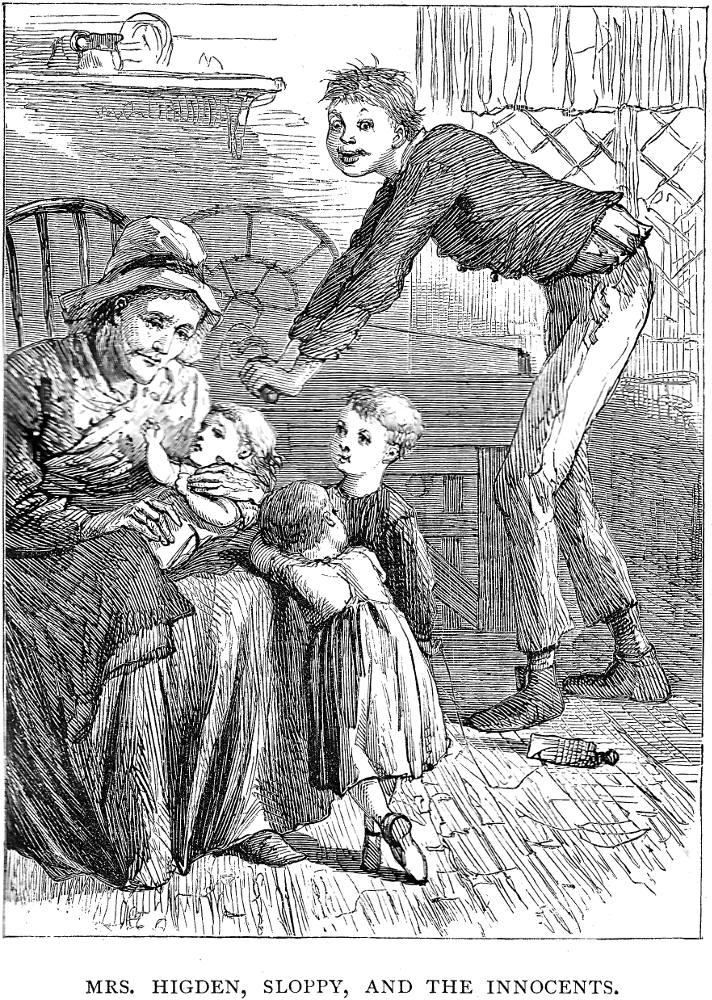
Mrs. Higden, Sloppy, and the Innocents
Sol Eytinge
Wood engraving
7.5 cm wide by 10 cm high
Illustration for chapter 16 of Dickens's Our Mutual Friend in the Lee & Shepard (Boston), and Charles T. Dillingham (New York) 1870 Illustrated Household Edition.
Scanned image and text by Philip V. Allingham.

[You may use this image without prior permission for any scholarly or educational purpose as long as you (1) credit the person who scanned the image and (2) link your document to this URL in a web document or cite the Victorian Web in a print one. in a web document or cite the Victorian Web in a print one. ]
To illustrate "Minders and Reminders," Eytinge has focused not on the middle-class woman in search of an orphan to adopt, Mrs. Boffin, or her secretary, John Rokesmith, but on the noble, long-suffering Brentford widow, the resolute survivor of hunger and poverty, Betty Higden, the children whom she minds ("Toddles" and "Poddles"), and in particular the Poor-House orphan and "natural," Sloppy:
It was then perceived to be a small home with a large mangle in it, at the handle of which machine stood a very long boy, with a very little head, and open mouth of disproportionate capacity that seemed to assist his eyes in staring at the visitors. [122]
Dickens reflects the simple but noble character of Betty Higden in the neatness and cleanliness of the cottage's main room, whose detailed description Eytinge realizes:
It had a brick floor, and a window of diamond panes, and a flounce hanging below the chimney-piece, and strings nailed from bottom to top outside the window on which scarlet-beans were to grow in the coming season. . . . [122]
However well he realizes the odd but benign Sloppy, Eytinge fails to convey the stoic dignity of Betty Higden and her love for the grandchild on her lap. Nevertheless, Eytinge's treatment of Betty's unconventional family and working class dignity is a considerable advancement over Marcus Stone's in the original Chapman and Hall serial publication. Eytinge permits the reader to enter the honest woman's cottage and see the oddly assorted grouping of children with a focus on the whimsical sloppy, whereas Stone in "Mrs. Boffin Discovers an Orphan" leaves us at the open door of the cottage, wondering who the darkened figure in the door may be in an illustration that captures a precise moment in the text:
After many inquiries and defeats, there was pointed out to them in a lane, a very small cottage residence, with a board across the open doorway, hooked on to which board by the armpits was a young gentleman of tender years, angling for mud with a headless wooden horse and line. [122]
Whereas Stone, interested in the anticipation of what Mrs. Boffin and her secretary will discover within, has supplied a great many external details that the text lacks with respect to the poor widow's cottage, Eytinge — avoiding depicting any one narrative moment — focuses instead on the interior and the occupants, realizing in particular the buttons on the jacket of the singular and angular mangle-turner, Sloppy:
Of ungainly make was Sloppy. Too much of him longwise, too little of him broadwise, and too many sharp angles of him angle-wise. One of those shambling male human creatures, born to be indiscreetly candid in the revelation of buttons; every button he had about him glaring at the public to a quite preternatural extent. A considerable capital of knee and elbow and wrist and ankle, had Sloppy, and he didn't know how to dispose of it to the best advantage, but was always investing it in wrong securities, and so getting himself into embarrassed circumstances. [124-125]
Last modified 30 October 2010