
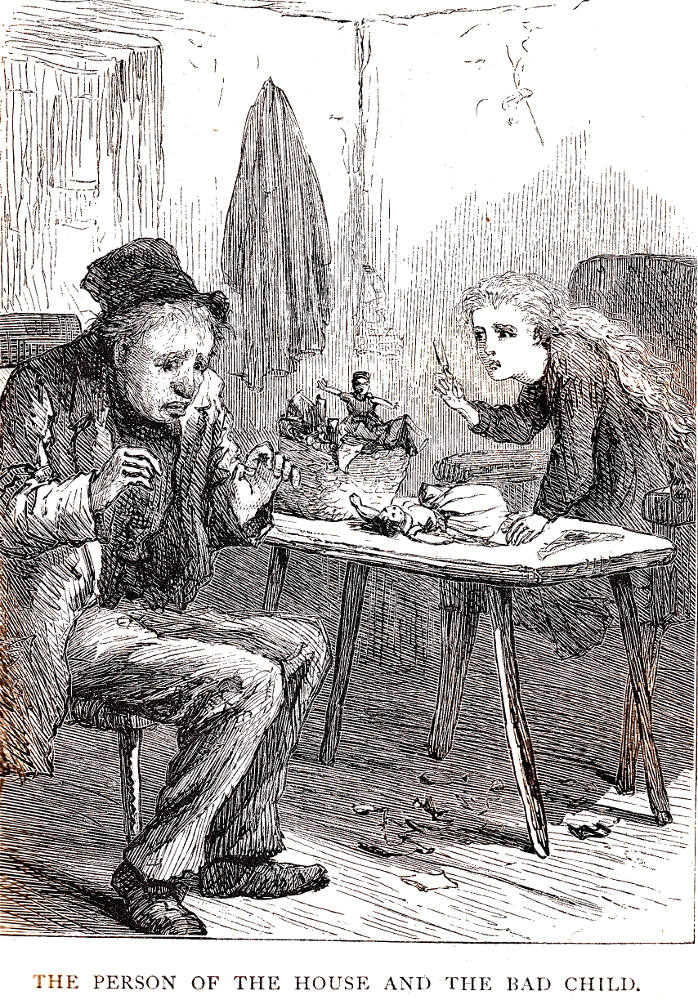
The Person of the House and the Bad Child
Illustration for Book 2, chapter 2, of Dickens's Our Mutual Friend in the Lee & Shepard (Boston), and Charles T. Dillingham (New York) 1870 Illustrated Household Edition.
Scanned image and text by Philip V. Allingham.

[You may use this image without prior permission for any scholarly or educational purpose as long as you (1) credit the person who scanned the image and (2) link your document to this URL in a web document or cite the Victorian Web in a print one. in a web document or cite the Victorian Web in a print one. ]
This illustration for "Still Educational," depicting Fanny Cleaver (but self-nicknamed "Jenny Wren," perhaps for her bird-like animation and movements) and her alcoholic father, is similar in composition to a full-page Marcus Stone woodcut of the same name in the 1865 Chapman and Hall volume.
Undoubtedly Sol Eytinge had had ample opportunity to study the original and — at least, in his aesthetic judgment — to improve upon it by altering the viewer's perspective in order to study Miss Wren's facial expression. Eytinge also foregrounds the dolls'-dressmaker's fine work, and renders the hapless parent merely a melancholic, bedraggled clown, more comic and less sympathetic. Eytinge reveals his innate theatrical sense as, instead of having the principal speaker turned upstage, he reconfigures the scene, changing the places and juxtapositions of his actors, placing the earnest child — who has had a parent's responsibility for and oversight of "The Bad Child" thrust upon her by circumstances beyond her control — upstage left and the object of her vociferous scolding downstage right, with both faces clearly discernible. In other words, to direct the viewer's gaze and to control his or her response, Eytinge has reversed the characters' positions in Marcus Stone's illustration, retaining precisely the same large easy-chair and work-table, but moving the former right and the latter from centre-stage to stage left.
The revised illustration features a number of other subtle changes that adjust the reader's response, rendering the scene essentially comic parent-child reversal rather than a serious commentary on the dangers of dipsomania. The overall difference in these two interpretations of the same textual scene is the difference between the effect of the three-dimensional and social realism for which the New Men of the Sixties such as Fred Walker, Fred Barnard, and George DuMaurier strove in the new illustrated magazines and the comic caricatures of the previous generation of British illustrators, notably George Cruikshank, Hablot Knight Browne ("Phiz") and John Leech of Punch fame. In terms of the theatre, the difference is much the same as that between the over-the-top physical comedy of the early nineteenth-century farce and burletta and the more subtle social comedy of Tom Robertson, dominating the English-language theatre on both sides of the Atlantic in a series of verbally witty dramas, including Society (1865), Caste (1867), and School (1869).
The contrapposto modeling of the figure of the "Bad Child" renders him the sympathetic focus of attention in Stone's illustration, his agony over his addiction and its consequences implied by his posture, and attempt to retreat from his lively little daughter and her pointed chastisement of his recent binge. In contrast, the hard-working dolls'-dressmaker, interrupted in the midst of her labours, performing surgery on a doll's dress, is Eytinge's focus; by positioning her to the right (i. e., stage left), Eytinge has blocked the insentient parent's retreat, were he capable of so much action. A subtle detail in Stone's treatment is the walking cane beside the Bad Child, implying that he, too, has a disability. His top-hat he holds between his knees, as his whole pose betokens shame and self-loathing. On the wall, an adult-sized female's bonnet and shawl hang on the peg in Stone's plate to imply the daughter's grown up status as bread-winner and money-minder ("The Person of the House"), whereas in Eytinge's version the short garment on the peg is better suited to Jenny Wren's diminutive form, and perhaps implies that it is unjust and unnatural that one so young should have to assume such authority. Eytinge's "Bad Child," barely able to raise his hands as described in the text, is so stupefied that he sits inert, with his shabby great coat and disreputable hat still covering his ill-kempt hair, as if unable to exert himself even in so minor a matter as removing these garments indoors. His mask-like face and lifeless eyes he directs away from her and at the floor.
The greatest difference between the two similarly named illustrations' figures lies in Eytinge's much more detailed treatment Jenny Wren herself. In Stone's plate, we see her naturalistic face in profile as she wags a scolding finger at the inebriate; she does not seem to be misshapen or twisted in any way. In Eytinge's, we see her full-face, and note the doll and work-basket (resembling a Noah's ark) on her work-table, and in her gesturing hand a small pair of scissors, indicative of her sharp mind and tart tongue. As in Dickens's description of her, Eytinge has given luxuriant hair and very little shoulder.
Although the woodcut realizes the serio-comic interview in its entirety, perhaps the single passage that the Eytinge plate so well illustrates in conveying the text's comic spirit with scrupulous attention to detail is this:
"How's my Jenny?" said the man, timidly. "How's my Jenny Wren, best of children, object dearest affections broken-hearted invalid."
To which the person of the house, stretching out her arm in an attitude of command, replied with irresponsive asperity: "Go along with you! Go along into your corner! Get into your corner directly!"
The wretched spectacle made as if he would have offered some remonstrance; but not venturing to resist the person of the house, thought better of it, and went and sat down on a particular chair of disgrace.
Oh-h-h!" cried the person of the house, pointing her little finger, "You bad old boy! Oh-h-h you naughty, wicked creature! What do you mean by it?"
The shaking figure, unnerved and disjointed from head to foot, put out its two hands a little way, as making overtures of peace and reconciliation. Abject tears stood in its eyes, and stained the blotched red of its cheeks. The swollen lead-coloured under-lip trembled with a shameful whine. The whole indecorous threadbare ruin, from the broken shoes to the prematurely-grey scanty hair, grovelled. [150]
Last modified 31 October 2010