Estella And Pip
Harry Furniss
1910
7.4 x 4.7 inches
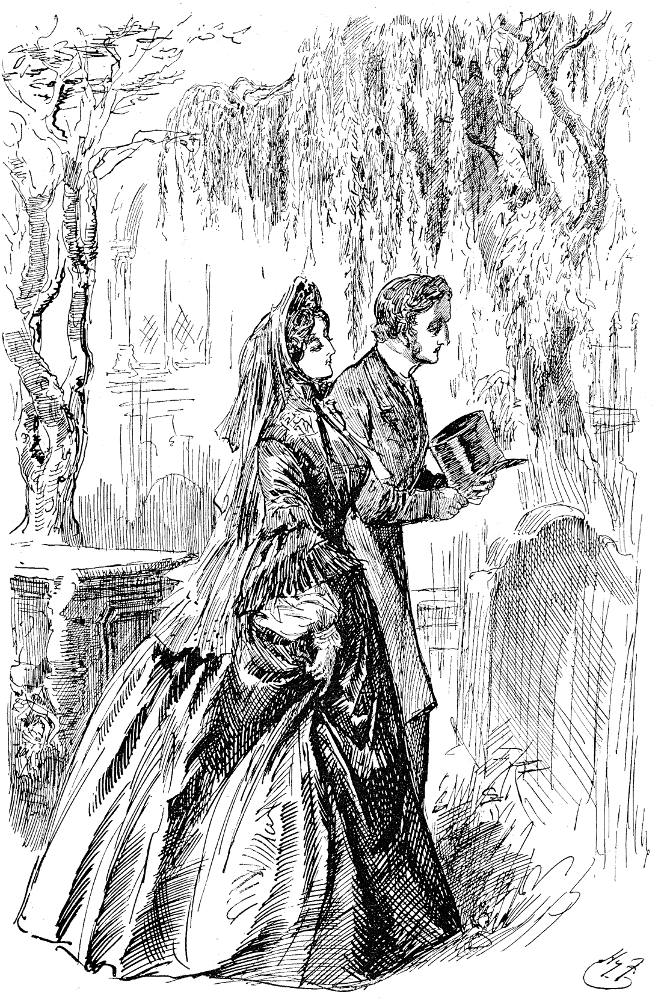
"I saw no shadow of another parting from her." [Closing lines of the novel, Chapter 59.]
Dickens's Great Expectations, Library Edition, p. 461.
Scanned image and text by Philip V. Allingham
This image is reproduced courtesy of The Charles Dickens Museum, 48 Doughty Street, London WC1N 2LF
Earlier in the ultimate day of the action of Great Expectations, Pip, just returned from the eastern offices of Clarriker and Company, takes his nephew, little Pip, to visit the old cemetary where the narrative began, among the tombstones of the Pirrip family. The narrator specifically mentions reliving the opening scene by setting the child of Biddy and Joe "on a certain tombstone" (Ch. LIX) in the churchyard. However, in Harry Furniss's final plate for the 1910 Charles Dickens Library Edition of the novel, "Estella and Pip: I saw no shadow of another parting from her.--Great Expect., p. 461," we are not in the garden of the former Satis House at all, but once again in the churchyard. Thus, perhaps to provide a neat complement to the opening scene, the illustrator has conflated the churchyard and the garden into a single setting. Since this twenty-seventh plate has been placed some five pages prior to the moment realized, the reader may not notice the incongrous elements: the willow tree (right), the tomb (left rear), and the tombstone (right). Symbolically, since the scene between Pip and Estella lays rest the vengeful spirit of Miss Havisham, that it has been re-set in the graveyard may be appropriate, even if in doing so Furniss has challenged the authority of Dickens's text as no previous illustrator before him had done.
Almost as incongruous as the properties in the background is the sour expression of the protagonist, hardly that of an ardent lover who has just completed his life-time quest. Estella (downstage centre, so to speak) dominates the ultimate scene, as proud, haughty, unbowed, and poised as ever as she gently lifts her voluminous skirt with her right hand while lightly resting her left on Pip's arm. Lightly sketched in the background are an area railing (right) and the leaded panes of a church window (left). Although Dickens specifies that the scene occurs on a misty December evening, Furniss suggests neither the twilight hour nor the season, for the scene is well lit and the willow in full leaf.
Such a departure from the letter-press is rare among Victorian illustrated editions because the illustrator was aware of the constraints placed upon artistic license by the presence of the text, and therefore produced plates that complemented the written text rather than undermined it. Screenwriters and dramatic adapters, on the other hand, appear not to have operated under the same constraints. At the conclusion of the 1921 silent-film adaptation of Great Expectations, for example, Pip (Harry Komdrop) and Estella (Olga d'Org), without the benefit of winter coats, embrace in front of the shattered walls and barred windows of Satis House. This is a relatively modest example of how screenwriters have taken liberties with the novel, for although the Nordisk filmn dresses the set with a gate leading into the garden, as specified in the text, Dickens mentions that the house itself together with its outbuildings has been levelled: "There was no house now, no brewery, no building whatever left . . . ."
In contrast, screenwriters David Lean, Ronald Neame, and Anthony Havelock-Allan completely revised both the setting and the dialogue of the closing scene to recreate it as a Poe-esque moment in a Gothic setting. Inside the mansion, its windows draped to shut out the life-giving light of day, Pip (John Mills) confronts a Havisham-possessed Estella (Jean Simmons) in the 1947 Cineguild/J. Arthur Rank production (No. 39 in Bolton) directed by screen-legend David Lean. Pip, rehearsing the closing, melodramatic moments of a vampire film, realizes that the spirit of arrested time and emotion must be exorcized by bringing the light of reason to the obssessed heroine, thereby banishing the oppressive shade of Miss Havisham from Estella's psyche into the shadows of the past where that warped spirit belongs. In other respects, the film is an acknowledged classic of black-and-white cinematography, mixing Dickensian realism and psychological fantasy with modernist montage and closeups, according to Paul Davis (205).
References
Bolton, H. Philip. Dickens Dramatized. Boston: G. K. Hall, 1987.
Davis, Paul. Charles Dickens A to Z: The Essential Reference to His Life and Work. New York: Facts On File, 1998.
Dickens, Charles. Great Expectations. Charles Dickens Library Edition. 18 vols. London: Educational Book Company, 1910. Vol 14.