
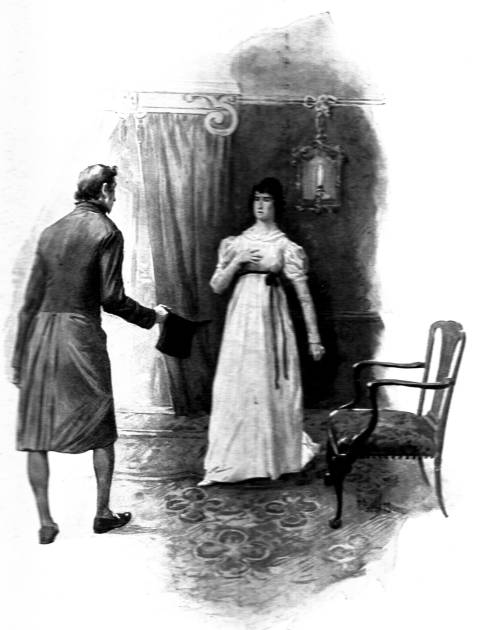
"My God! Why do you intrude here, Monsieur!" she gasped as soon as she saw his face
H. Burgess
1896
Lithograph
21 cm high by 15.5 cm wide.
Thomas Hardy's "A Committeeman of 'The Terror'." The Illustrated London News (22 November 1896): 5.
Scanned image, caption, and commentary by Philip V. Allingham; html and formatting by George P. Landow
[You may use this image without prior permission for any scholarly or educational purpose as long as you (1) credit the person who scanned the image and (2) link your document tothis URL.]
The second illustration, based on Hardy's descriptions of the two emigres in the story's main chronological and geographical setting, is much sharper, and its placement in juxtaposition with their first two conversations on page 5 quite effective. As she delivers her accusation, and again as she probes his motives and religious convictions, the reader studies Mademoiselle V—'s reactions to the former administrator of the Revolution, but cannot assess the emotions conveyed by her facial expression. Her indignation, shock, and long-simmering anger, marring her "highly refined and delicate appearance" (5) are Burgess's focus. Monsieur B—, his back towards the reader and his respectable beaver in his right hand, is merely the catalyst for reviving these emotions. Although Burgess has had to invent most of the visual context for this interview in General Newbold's back parlour, he has done so with an historian's eye to correctness of detail in clothing and interior decoration, especially in the Regency chair in the foreground. Such fidelity to the period makes the illustration a useful extension of the writer's dialogue and description, for it induces acceptance of what turns out to be a rather incredible narrative: Mademoiselle V— recognizes the Committee-Man at a distance in the opening of the story, but not in close proximity at the conclusion. Her plain Regency dress in the second illustration, his "long coat of faded superfine cloth" (3) and his stockings, like the domestic lantern, valence, patterned carpet, and rich draperies of the period 1802-3 (still available for the visitor's inspection at British country houses and, closer to London, Kew Palace) win the reader's confidence in the story's accurately recording what transpires between these two antagonists who will—incredibly—become lovers.
The second illustration is less successful either as an independent picture as an adjunct to the narrative. The scene with the penknife and linen in Monsieur B—'s sick-room, he rendered defenseless by illness and she armed, might have been a much more telling subject for psychological study, but doubtless Burgess wanted his second half-page illustration to anchor the story's enigmatic conclusion. Reading the visual text ahead of the letterpress, one might expect that the meeting will lead to a romantic liaison between the French expatriots.
References
Brady, Kristin. The Short Stories of Thomas Hardy. London and Basingstoke: Macmillan, 1982.
Cassis, A. F. "A Note on the Structure of Thomas Hardy's Short Stories." Colby Library Quarterly 10 (1974): 287-296.
Gilmartin, Sophie, and Rod Mengham. Thomas Hardy's Shorter Fiction: A Critical Study. Edinburgh: Edinburgh U. P., 2007.
Hardy, Thomas. "A Committee-man of 'The Terror'," il H. Burgess. The Illustrated London News, Christmas Number. 22 November, 1896: pp. 3-8.
Johnson, Trevor. "Illustrated Versions of Hardy's Works: A Checklist 1872-1992." Thomas Hardy Journal 9, 3 (October, 1993): 32-46.
Page, Norman. "Hardy Short Stories: A Reconsideration." Studies in Short Fiction 11, 1 (Winter, 1974): 75-84.
Quinn, Marie A. "Thomas Hardy and the Short Story." Budmouth Essays on Thomas Hardy: Papers Presented at the 1975 Summer School (Dorchester: Thomas Hardy Society, 1976), pp. 74-85.
Ray, Martin. Thomas Hardy: A Textual Study of the Short Stories. Aldershot: Ashgate, 1997.
Last modified 19 April 2010