
[Home —> Visual Arts —> Illustration —> James Abbott Pasquier—> Next]
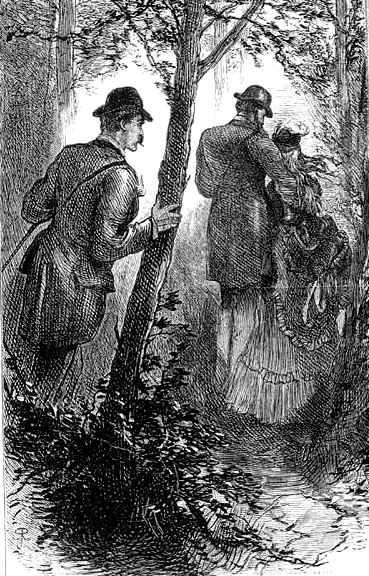
A Scene in The Belvedere
James Abbott Pasquier
Tinsley's Magazine, Vol. XII, chapters XXII-XXV, p. 240
March 1873
Illustration for Thomas Hardy's A Pair of Blue Eyes
11.4 cm wide and approximately 17.6 cm high
[See commentary below]
Scanned image and text by Philip V. Allingham.
[This image may be used without prior permission for any scholarly or educational purpose.]
"A Scene in the Belvedere" is a condensed version of "Knight's arm stole farther round the waist of Elfride" from serial chapter XXV (the last of four in the March 1873 instalment). To show all three figures clearly and to parallel the poses of Elfride's suitors, the artist has avoided the lines of Hardy's description in which "Part of the scene reached Stephen's eyes through the horizontal bars of woodwork, which crossed their forms like the ribs of a skeleton" (Ch. XXV). Shifting from Hardy's limited omniscient point of view to a more dramatic one, the illustrator leaves the reader to mediate between the description of the moment in the letterpress and the plate, in which both Stephen Smith (downstage right) and Henry Knight (upstage left) have their backs to us, wear similar coats and hats (Stephen even has a developed "a more pronounced moustache," as Hardy notes in Ch. XXIII), and have their right arms outstretched--Stephen supporting himself, his spirit "shattered" by the loss of his romantic dream, and Knight patriarchally controlling Elfride's body as he has tried to curb her spirit. Whereas Hardy's description implies that Stephen Smith is effectively "barred" from his beloved by his rival and that she is doomed to an early death, Pasquier's illustration simply shows that Knight, like the tree (centre) blocks Stephen from obtaining Elfride's hand.
As Michael Millgate notes in Thomas Hardy: His Career as a Novelist (1971), the chief organizing principle of A Pair of Blue Eyes is rigorous symmetry or parallelism, which is evident in both Pasquier's March plate, with its vertical parallels of trees and figures (the two males being almost identical), and Hardy's March instalment. In Chapters XXII-XXV, Hardy once again makes use of the standard Sensation Novel plot devices of the overheard conversation and "shadowing" or stalking others to learn their intentions. "The stress of pain and loneliness in these various eavesdropping scenes, furthermore, helps to tone down the many plot contrivances in this early novel," observes Arlene Jackson in Illustration and the Novels of Thomas Hardy," even though the eavesdropping situation itself depends on the coincidence of being in the right place at the right time" (75). Having gone north to attend to business affairs when Elfride failed to keep their appointment at the Endelstow church tower, Stephen has returned on the Bristol steamer, exactly as in the previous instalment, and by coincidence has been a few minutes behind Elfride and Knight as they return to Endelstow from the harbour at Stanton. The note of loss and of the mortality of all things complements Stephen's discovery that he has been supplanted; this theme is reinforced throughout the instalment, first by Knight's confronting the possibility of his own death on the cliff-face, then by the arrival of the pig-killer, Maria Smith's discussion of Jacob's ladders (thematically associated with passing into the next life), Robert Lickpan's digressions on the individual characters of pigs he has killed, and William Worm's observation that, for all his ingenuity and commanding height, uncle Levi is "dead and gone now, nevertheless, poor man, as we all shall" (Ch. XXIII). This note of tragedy, of sudden death and inexplicable loss, is sounded again when Mrs. Jethway laments the loss of her son and at the cliff-hanger close of the instalment with the gathering of the sexton and masons at the Luxellian tomb, when we with Stephen are left wondering who has died. In terms of imagery, the inevitability of death--even for the beautiful and vital Elfride, beloved by a succession of eligible bachelors--is underscored by the "shadow of death" image in Stephen's perspective as he spies Knight and Elfride in the belvedere, which is ostensibly the subject of the March illustration, if we are to credit the caption:
Their two foreheads were close together, almost touching, and both were looking down. Elfride was holding her watch, Knight was holding the light with one hand, his left arm being round her waist. Part of the scene reached Stephen's eyes through the horizontal bars of woodwork, which crossed their forms like the ribs of a skeleton. Knight's arm stole still farther round the waist of Elfride. [Ch. XXV]
In theory, this must be the moment realized by the seventh plate--however, as already noted, there is no indication of the octagonal summer-house supervening between Stephen and the couple--furthermore, it is Knight's right arm and not his left which is around Elfride. When one compares the plate and the letter-press carefully, one discovers that the illustration is not so much a realisation of a moment such much as a synthesis of about a page of text which begins when Elfride speaks and Stephen, in shock at recognizing that she is one of the "boat People" he has followed all the way from the harbour at Stanton, clutches "a sapling, to steady himself." Stephen does not actually see the faces of the couple until Knight strikes a light with his right hand to check his watch, thereby creating "a strongly illuminated picture" of their features and clothing. In order to heighten the parallelism and maintain the suspense with a plate that appears at the very opening of the seventh instalment, Pasquier has placed both Knight and Elfride with their backs to Stephen so that he cannot absolutely identify them. For the sake of visual continuity, the couple are wearing the same clothing (down to the very flounces on Elfride's dress) that they were wearing in the previous plate, although the copious, white hat-feather, mentioned by Hardy as the only discernible feature of the woman in the harbour, is more obvious here. Hardy specifies that, just after Knight strikes the light, Stephen is able to see "the face of his friend and preceptor" (hence, the chapter title derived from Psalm 41:9, "Mine own familiar Friend") and then that of "his bright particular star, Elfride." Thus, Pasquier has changed both the poses of Elfride and Knight and setting to meet the requirements of the serial, for the reader must kept in suspense as long as possible regarding precisely when Stephen will learn that he has lost his beloved to his best friend, and exactly how he will respond to this double betrayal.
Last modified 30 June 2003