
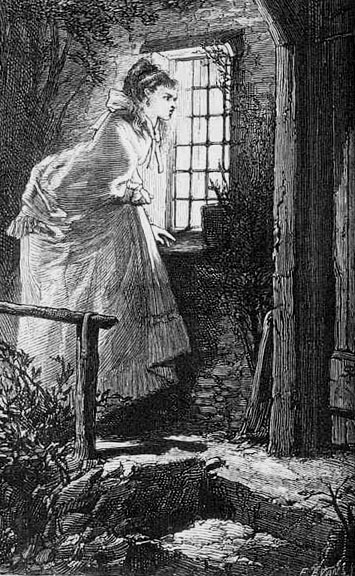
Elfride's Visit to the Widow's Cottage
James Abbott Pasquier
Tinsley's Magazine, Vol. XII, chapters XXIX-XXXI, Penguin, p. 302]
May 1873
Illustration for Thomas Hardy's A Pair of Blue Eyes
11.4 cm wide and approximately 17.6 cm high
Scanned image and text by Philip V. Allingham.

[You may use this image without prior permission for any scholarly or educational purpose as long as you (1) credit the person who scanned the image and (2) link your document to this URL in a web document or cite the Victorian Web in a print one. ]
Clearly the issue of "peeping" is central in a general way to the process of creation, reading, and criticism. . . . (Wittenberg 155)
"Elfride's Visit to the Widow's Cottage" is Pasquier's encapsulation of the following passage from Ch. XXX: "The female, after the third knocking, stepped a little to the left in order to gain a view of the interior, and threw back the hood from her face. The dancing yellow sheen revealed the fair and anxious countenance of Elfride." Thus, the ninth of Pasquier's plates has something of the quality of "The Mousetrap" in Hamlet in that, while Elfride violates social norms (committing trespass and intruding upon the Widow Jethway's privacy to ascertain whether her nemesis is at home), like the Globe audience watching the courtiers-as-audience as well as the mini-drama, the reader studies her while attempting to peer over her shoulder, so to speak, to determine what it is inside the isolated cottage that has provoked that peculiar expression of anxiety mixed with animosity that animates Elfride's features. We have waited at the cottage door as the lone female advances, and we have assumed (from the juxtaposition of this passage with the narrator's reading Elfride's mind about trying to avert the threat the widow's knowledge poses) that the muffled one who knocks at the widow's door is our heroine, bent on eliciting from the householder a promise not to ruin her chances of happiness with Knight by revealing the secret of her elopement with Stephen. As she inspects the main room of the Jethway cottage, we observe and judge her.
As the novel opens with Elfride reading the third volume of a romance in which she is disappointed to learn that the hero, whose exploits she has followed through two volumes, dies, so we shall be disappointed in this novel which we have taken up -- without the advantage, if we are subscribers of Tinsley's Magazine, of being able to scan the chapters-headings as she has done to learn the outcome of the story. The voyeuristic impulse has seized us as we learn the most intimate details of the lives of Stephen Smith, Elfride Swancourt, and Henry Knight by "eavesdropping" through the mechanism of the omniscient narrator. Stephen has spied on Elfride and Knight at the Belvedere; we have spied on all three twice -- once in the letter-press and once in the March illustration. If we are readers of Tinsley Brothers' three-volume edition of late May 1873, we have now arrived at the middle of the third chapter of the third volume--we have committed ourselves to the project of reading the three volumes without being able judge from the ambiguous chapter headings whether our heroine lives or dies at the end of the third. As readers of either the serial or the volume edition, we have witnessed a sleepless Elfride, feeling haunted by the spectre of Mrs. Jethway all the way from London Bridge to Plymouth aboard the very packet-steamer that Hardy himself took to the west country on 7 August 1872; we have judged her fear unreasonable, it being unlikely that the widow with a modest income and no knowledge of Elfride's movements has been able to shadow the girl so effectively. And, back at Endelstow, we have watched and listened, like the audience in a theatre, as she and Knight, on a garden bench (perhaps that very bench depicted in the eighth plate), discussed her former (and still-unnamed) "lover"--Knight revealing through his jealousy an overwhelming emotional insecurity that seems to Elfride and us to threaten their marrying. Praying that her adversary will "listen to reason" (Ch. XXX) and relent, she adopts the rather daring expedient of visiting the widow's cottage in secret, after sunset. Such clandestine activity and assertiveness is hardly consistently with the social norms that regulate the conduct of proper middle-class Victorian maidens.
The mere fitful flickering of the widow's fire seems hardly adequate to illuminate the anxious face and hunched over figure of her young visitor. The leaded panes are brightly lit, throwing intro stark relief the rocks and shrubs outside. Working against the plate, Hardy's letter-press mentions "The inequality of the rays falling upon the trees outside" (Ch. XXX); the artist depicts just one tree, immediately behind the heroine who, after her third attempt to rouse the cottager, has "stepped a little to the left [of the front door] in order to gain a view of the interior" through the unshuttered and uncurtained window. Pasquier captures Elfride just after she has thrown back her hood to reveal a pinched and anxious visage. Having had the opportunity to study this ninth illustration for two chapters, the reader of Tinsley's Magazine for May 1873 has been wondering all the while why Elfride Elfride has sought out her enemy (for PasquierÕs caption establishes the place from the outset) and what she is seeing that produces such an expression.
Elfride's hooded cloak, though certainly not improbable, connects her as she stands at the cottage window with such fairy-tale heroines as Red Riding Hood and Goldilocks. Ironically, entering the cottage presents no danger after all, for the owner is absent and does not return to chastise the trespasser; at this point, then, the scene seems to be something of a red herring, playing upon the apprehensions engendered by our childhood reading. In fact, like Wilkie Collins, Hardy is carefully laying the groundwork for a future plot gambit as Elfride leaves a note begging for the widow's continued silence about her railway trip to London with Stephen. As Pamela Dalziel comments in her first appendix to the 1998 Penguin edition, physically this does not seem to be the Elfride of the early illustrations:
As Hardy's narrative proceeds Pasquier's visual text . . . renders Elfride progressively unattractive until she becomes virtually unrecognizable in the illustration of her nocturnal visit to Mrs. Jethway's cottage. While the differences may simply be attributable to Pasquier's lack of skill, it is tempting so see them as reflective of his own response (conscious or unconscious) to Elfride. What is in any case certain is that she is visually represented as 'undesirable' when she behaves in unconventional ways. . . . That Hardy had any input into these later illustrations seems unlikely . . . . ("A Note on the Illustrations," p. 382).
Although the heroine as depicted in the eighth and ninth plates is hardly "unattractive," she bears little resemblance facially to the light-hearted and light-haired beguiling adolescent of the first and second plates. Pasquier may have consciously effected this transformation to manifest the consequences of Mrs. Jethway's threats upon the heroine's consciousness. Elfride's features seem more pinched and her cheeks not so pleasingly rounded, perhaps from lack of sleep produced by gnawing anxiety about her accuser's unmasking her before Knight. In fact, Pasquier first seems to have matured Elfride's visage for the December illustration, after her father's marriage has introduced her to affluence and privilege, after her romance has been published, and after she has returned from London in secret and unmarried. For Pasquier and for us as for Stephen, experience seems to have "shorn [her] of the radiance which glistened about her" (Ch. XII) on their ramble along the cliff-path earlier. As Aziz Bulaila in "A Pair of Blue Eyes: Choice of a Husband" has noted,
Although Smith and Elfride are both emotionally immature when they have started off together in their love relationship, the heroine succeeds in asserting her womanhood while he remains in his boyhood until he returns from India: "Elfride was as if she had grown years older than Stephen now". (PBE, p. 168 [in the 1986 Penguin edn.]), and he tells her "You don't seem the same woman" (PBE, p. 171). (13)
References
Bulaila, A. Aziz. "A Pair of Blue Eyes: Choice of a Husband." Thomas Hardy Year Book 31 (2001) : 9-16.
Wittenberg, Judith Bryant. "Early hardy Novels and the Fictional Eye." Novel: A Forum on Fiction 16: 2 (1983) : 151-164).
Last modified 20 July 2003