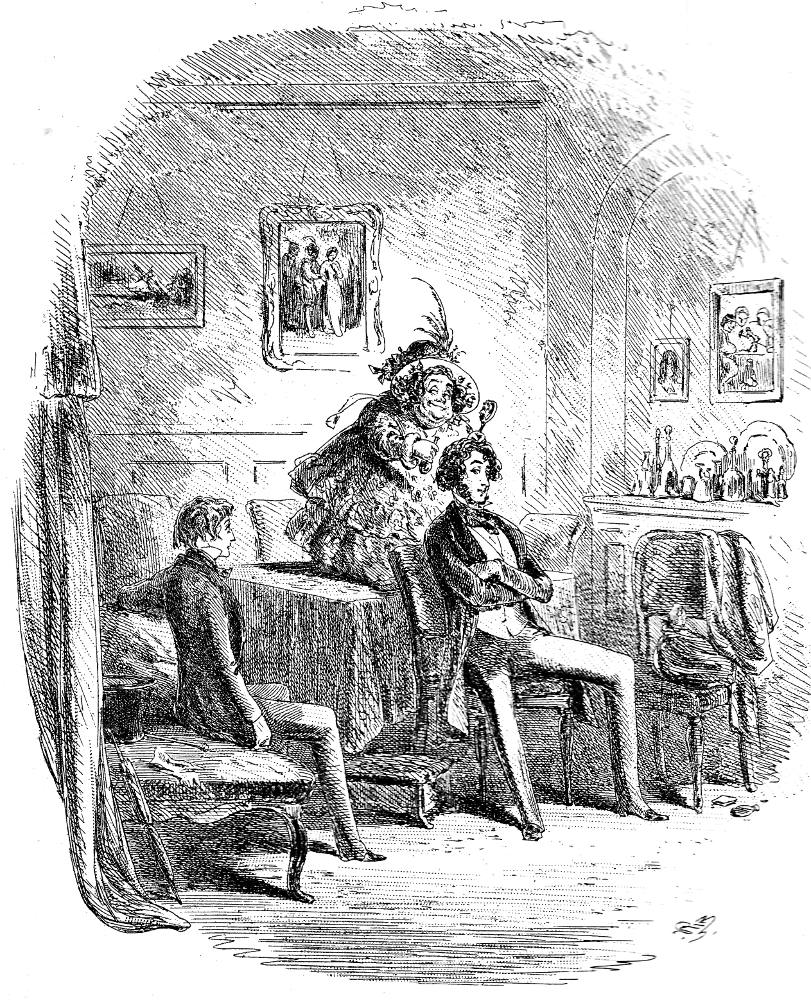
I make the acquaintance of Miss Mowcher
Phiz (Hablot K. Browne)
December 1849
Etching
Dickens's David Copperfield, chapter 22, "Some Old Scenes, and Some New People."
Source: Centenary Edition, facing page 394.
Image scan and text by Philip V. Allingham.

[You may use this image without prior permission for any scholarly or educational purpose as long as you (1) credit the person who scanned the image and (2) link your document to this URL.]
First December 1849 illustration for Charles Dickens's David Copperfield. Steel etching. Source: Centenary Edition (1911), volume one, facing page 394. All forty Phiz plates were etched in duplicate, as was the case with Dombey and Son, the duplicates differing only slightly from the originals. Phiz contributed forty etchings and the "life of every man" wrapper design. Image scan and text by Philip V. Allingham. [You may use this image without prior permission for any scholarly or educational purpose as long as you (1) credit the person who scanned the image and (2) link your document to this URL.]
Commentary
According to J. A. Hammerton (1910), I make the acquaintance of Miss Mowcher, the first illustration for the eighth monthly number (chs 22, 23, and 24), illustrates this sentence from chapter 22: "I never did in my days behold anything like Mowcher as she stood upon the dining-table, intensely enjoying this refreshment, rubbing busily at Steerforth's head, and winking at me over it: (397). However, in drawing the cartoon-like figure of Miss Mowcher, Phiz has drawn heavily on this earlier paragraph:
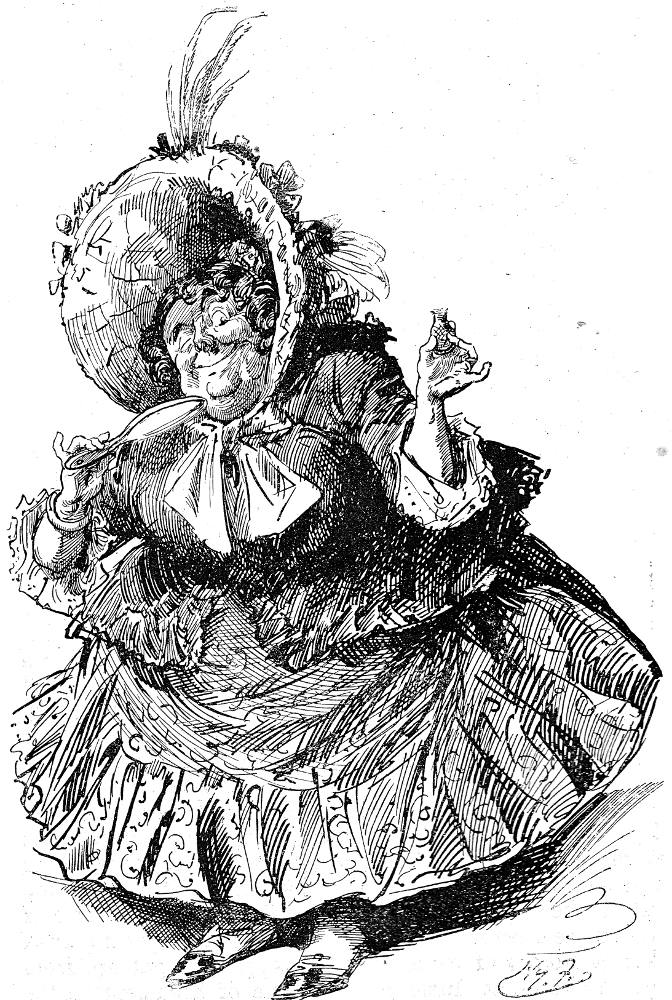
I looked at the doorway and saw nothing. I was still looking at the doorway, thinking that Miss Mowcher was a long while making her appearances, when, to my infinite astonishment, there came waddling round a sofa which stood between me and it, a pursy dwarf, of about forty or fory-five, with a very large head and face, a pair of roguish grey eyes, and such extremely little arms, that, to enable herself to lay a finger archly against her snub nose as she ogled Steerforth, she was obliged to meet the finger half-way, and lay her nose against it. Her chin, which as what is called a double-chin, was so fat that it entirely swallowed up the strings of her bonnet, bow and all.Throat she had none; waist she had none; legs she had none, worth mentioning; for though she was more than full-sized down to where her waist would have been, if she had had any, and though she terminated, as human beings generally do, in a pair of feet, she was so short that she stood at a common-sized chair as at a table, resting a bag she carried on the seat. This lady; dressed in an off-hand, easy style; bri nging her nose and her forefinger together, with the difficulty I have described; standing with her head necessarily on one side, and, with one of her sharp eyes shut up, making an uncommonly knowing face; after ogling Steerforth for a few moments, broke into a torrent of words. [391]
The only aspect of her character, as opposed to her physical presence, that David finds disconcerting about Miss Mowcher is her "knowingness," for her candid remarks about her clients imply her sexual awareness as well as her cynicism. Her attitudes like her diction seem more properly male and aristocratic — in short, more like Steerforth's than would seem appropriate to one of her gender and class. That she may be Steerforth's procuress does not occur to David at this point, so that the experience of the mature narrator is foiled by the naivete of the youthful, one might say here "virginal," protagonist, who once again observes — sometimes in great detail — but even as a young adult does not fully comprehend what he sees.
The dwarf manicurist/frisseur to the aristocracy is a grotesque but delightful adaptation of real-life chiropodist Mrs. Jane Seymour Hill, Dickens's neighbour at Devonshire Terrace, just off Marleybone Road, Regent's Park, where the novelist resided from 1839 through 1851. Ten chapters later, trying to mollify Mrs. Hill for the immoral characterisation (and to avoid the possible litigation threatened by Mrs. Hill's solicitor), Dickens excuses Miss Mowcher's manner and behaviour by revealing that she is the family bread- winner, and therefore a respectable bourgeois, after all. In contrast to David's self-conscious immaturity, which Miss Mowcher is in fact underscoring when she notes the peach-like texture of his facial skin, Phiz here emphasizes Steerforth's cool self-poesion and aristocratic curls, suggestive of his licentious, sensual nature. Gareth Cordery, taking his cue from Jane Rabb Cohen, asserts that Miss Mowcher is articulating David's hidden and forebidden desires desires regarding his "almost-sister" and chilhood companion, little Em'ly. Significantly, Miss Mowcher initially assumes that the beautiful young native of Yarmouth who has recently attracted Steerforth's interest is David's sister.
Cohen finds once again that Phiz comments — albeit obliquely, particularly with respect to sexual relationships — on the materials that the novelist has given him by adding telling emblemmatic details in characters' costumes and in background details.
The dwarf dramatically stands on the table, with an expression and sidelong glance of amusement, similar to Steerforth's, at David's innocence. There is a clear analogy between Miss Mowcher and the subject of the framed scene over the fireplace: Gulliver performing on a table top for the bemused Brobdingnagians. Her hair and hat feather, functioning like Pecksniff's hair tuft [in Phiz's narrative-pictorial sequence for Martin Chuzzlewit earlier in the decade], link her physically and hence morally to the mote complex p[icture over her head, apparently that of Mephistopheles observing the tryst he has arranged between Faust and Gretchen [in Goerthe's opera]. The turbulence of her hat also connects her with the picture of a storm-tossed ship behind David's head — which anticipates Em'ly's elopement, Steerforth and Ham's death in an ocean storm, and Em'ly's emigration to Australia with her uncle. The Faust picture, which Harvey notes is not included in Browne's original sketch, may have been requested by Dickens or added by Browne as a hint to the reader that Steerforth plans to seduce Em'ly with the assistance of Miss Mowcher as well as Littimer. [105-106]
Since Dickens only became fully acquainted with Goethe's opera after he had finished writing David Copperfield, the visual allusion must have originated with Phiz as an afterthought. What the common reader looks for in the illustration, having first met Miss Mowcher in the accompanying text, is her wonderful self-possession and magpie vivacity, and David's utter amazement at both her distorted form, non-stop, racey patter, and dynamic presence. And, in fact, Phiz communicates these aspects of the scene well, through David's rigidity (implying his straight-laced nature) and the identical sidelong glances of the dwarf and her patron, both trained on David. The three figures form a rough pyramid, with Miss Mowcher as the apex, parodying the romantic triangle of David, Steerforth, and Em'ly. Echoing the number of figures in the room and in the complicated emotional relationship, the three principal pictures in the room (a shipwreck scene appropriate to the coasts near Yarmouth, and illustrations of Gulliver's Travels, Book 2, and of Goethe's Faust) extend the moment through allusion and foreshadowing, preparing us for the moral wreck of the girl who lends her name to the former "Stormy Petrel" that Steerforth has just purchased.
References
Ackroyd, Peter. Dickens. London: Sinclai-Stevenson, 1990.
Cohen, Jane Rabb. Charles Dickens and His Original Illustrators. Columbus, Ohio: Ohio U. P., 1980.
Cordery, Gareth. "Making the Acquaintance of Miss Mowcher." Kingston University, London, UK: 13th Annual Dickens Society Symposium, 17-20 July 2008. (Conference Contribution - Oral presentation)
Davis, Paul. Charles Dickens A to Z: The Essential Reference to His Life and Work. New York: Checkmark and Facts on File, 1998.
Dickens, Charles. David Copperfield, il. Hablot Knight Browne ("Phiz"). The Centenary Edition. London and New York: Chapman & Hall, Charles Scribner's Sons, 1911.
Hammerton, J. A. The Dickens Picture-Book. London: Educational Book Co., 1910.
Lester, Valerie Browne. Phiz: The Man Who Drew Dickens. London: Chatto & Windus, 2004.
Steig, Michael. Dickens and Phiz. Bloomington, Indiana: Indiana U. P., 1978.
Last modified 14 December 2009