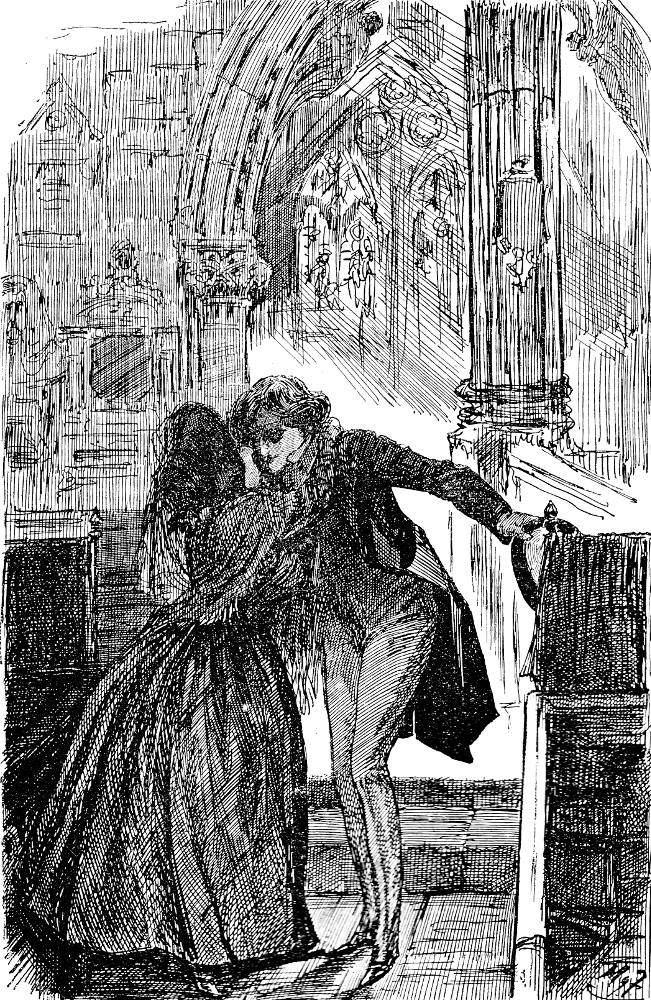
I am Married
Phiz (Hablot K. Browne)
June 1850
Etching on steel
Dickens's David Copperfield, chapter 43, "Another Retrospect."
Source: Centenary Edition, volume two, facing page 236.
In the second illustration in the fourteenth monthly number, which was issued in June 1850 and comprises chapters 41 through 43, Phiz bases the composition on the design of the first illustration in the serial publication, "Our pew at church", once again satirising the complacent Anglicanism of mid-nineteenth century Britain, suggested by the cobweb on the eighteenth-century statue and indifferent minister. As in the earlier picaresque novel Martin Chuzzlewit (1843-44), the entrapment of a fly in the web suggests victimization. [cont. below]
Image scan, caption, and commentary below by Philip V. Allingham.
[You may use this image without prior permission for any scholarly or educational purpose as long as you (1) credit the person who scanned the image and (2) link your document to this URL.]
Commentary
In this instance, however, Phiz is not commenting on the protagonist's being the victim of a fraudulent scheme, but rather on his making himself a victim by acquiring so helpless and incapable "hostage to fortune" as Dora Spenlow. As Michael Steig has noted,
Of all the Dora illustrations, those depicting the marriage and her death are most elaborate. In "I am Married," marriage is presented as a joyous occasion, a miracle, as the mural of the changing of water into wine at Cana suggests, but a good deal more is conveyed through the miscellaneous crowd. At the far right two women stand with infants behind the font, presumably awaiting their children's christening; in front of the font is a young girl with a small child of two or three years. Next to the large monument at right a pair of young lovers seem oblivious to all but each other, but behind them a woman clearly intended to be a spinster turns her nose up and her mouth down at the proceedings (which include another young man who is looking at her pretty companion). From the gallery above, Peggotty, in widow's weeds, looks down, and beneath the gallery, directly behind the font and the waiting mothers, is a casket covered with a sheet, implying a recent death. The panorama of the stages of man's life echoing the cover — is thus expressed, from birth through childhood, love and marriage, to death. And the inclusion of all these within such a small compass may foreshadow the brevity of David's marriage to Dora. [Steig 122]
Certainly the presence of so many family monuments, including one (right of David) which commemorates the death of young wife, as well as the casket and winding sheet to which Steig has drawn our attention, may be construed as foreshadowing the brevity of David's first marriage and Dora's early death. According to J. A. Hammerton (1910), the moment that Phiz has realized as the culmination of the courtship plot is this:
[A dream] Of my walking so proudly and lovingly down the aisle with my sweet wife upon my arm, through a mist of half-seen people, pulpits, monuments, pews, fonts, organs, and church-windows, in which there flutter faint airs of association with my childish church at home, so long ago. [Vol. 2, 236]
How, Phiz must have wondered, can a graphic artist communicate this sense of the onrush of objects described in the historic present in a loose series of periodic sentences each beginning with "Of"? The similarity to the first plate in the narrative-pictorial series, "Our pew at church", is obvious in the general layout of the church, including the central pillar (to the left of centre in both cases), the staircase, the cherubs, monuments, and — curiously — the elderly pew-openers situated down front left in both plates, the one in the earlier illustration, having let Mr. Murdstone into his pew, being fast asleep. Of the general layout of the church nave and its pews in this illustration Guiliano and Collins note: "Hablot Browne's 'I am Married' illustration — including, in the foreground, the pew opener with her keys — fails to show the pews, but the novel's first illustration, 'Our Pew at Church', shows the doors" (421). Here, the pew-opener has control of her keys and is wide awake, enjoying the spectacle afforded by the young couple and the wedding party. Indeed, the whole atmosphere of the present plate is energized by the youth of the two principals and the more active nature of the much more youthful congregation.
One of the curious features of Phiz's composition is the prominence he accords to Mr. Dick (on Dora's right, down centre); the second is the relative obscurity of David's Aunt Betsey (glimpsed just behind Mr. Dick) and of his best friend, Tommy Traddles, just behind Dora and immediately recognizable by his rebellious hair. Moreover, despite their importance in Dickens's text, Phiz has placed Dora's aunts, Lavinia and Clarissa, at the foot of the staircase, up centre. Finally, since in the text David ascenbds to the gallery expressly to bring Peggotty down, her position in the balcony as the wedding party reaches the porch is also problematic since logically she should be downstairs, and probably close to David. That Phiz has left her upstairs in the gallery suggests that he is using her to complement the earlier part of Dickens's description of the wedding, and therefore she exists as a realisation of the moment before the one upon which Phiz has chosen to focus. In other words, the action- and character-crammed illustration encompasses the entire description of David and Dora's wedding. Thus, Phiz has retained Peggotty in the gallery as appropriate to his intention to graph visually a full page of text; likewise, because their presence would realize Dickens's humorous literary allusion but would disrupt the atmosphere of youthful exuberance and ideallism, he entirely dispenses with the supernumerary boatmen and the rum-soaked "ancient mariner" (236), who does not interject his own personal narrative into the proceedings as Coleridge's does in the 1798 literary ballad.
Phiz's young women all too often resemble one another, so that Agnes and Dora here, and Martha in "The Wanderer" could be members of the same family. Thematically, the exterior similarities between the childish, incompetent Dora and the dutiful, mature Agnes are significant in that their narratives are complementary, and by juxtaposing them with David here Phiz embeds a conjecture in the reader-viewer's subconscious about her future relationship with David. Otherwise, the astute reader would find her position in the illustration problematic since the text indicates that she supports Dora throughout the marriage service; Agnes should, therefore, be stationed immediately behind the bride as the wedding party advances down the aisle. Instead, Phiz has placed her at David's left, and has drawn her in full, rather than merely head and shoulders as he has done Betsey Trotwood. Visually, then, Agnes becomes in effect an alternate bride, anticipating her role in the latter part of the text. Thus, through her strong visual presence Phiz implies that he already knows the use to which Dickens intends to put Agnes as he transforms the quondam "brother/sister" relationship that David and she have enjoyed since his starting school at Dr. Strong's in Canterbury.
Additional information about the plate
Second June 1850 illustration. Source: Centenary Edition (1911), volume two, facing page 236. All forty Phiz plates were etched in duplicate, as was the case with Dombey and Son, the duplicates differing only slightly from the originals. Phiz contributed forty etchings and the "life of every man" wrapper design.
References
Cohen, Jane Rabb. Charles Dickens and His Original Illustrators. Columbus, Ohio: Ohio U. P., 1980.
Dickens, Charles. David Copperfield, il. Hablot Knight Browne ("Phiz"). The Centenary Edition. 2 vols. London and New York: Chapman & Hall, Charles Scribner's Sons, 1911.
Guiliano, Edward, and Philip Collins, eds. David Copperfield. The Annotated Dickens. Vol. 2. New York: Clarkson N. Potter, 1986.
Hammerton, J. A. The Dickens Picture-Book. London: Educational Book Co., 1910.
Steig, Michael. Dickens and Phiz. Bloomington, Indiana: Indiana U. P., 1978.
Last modified 17 January 2010