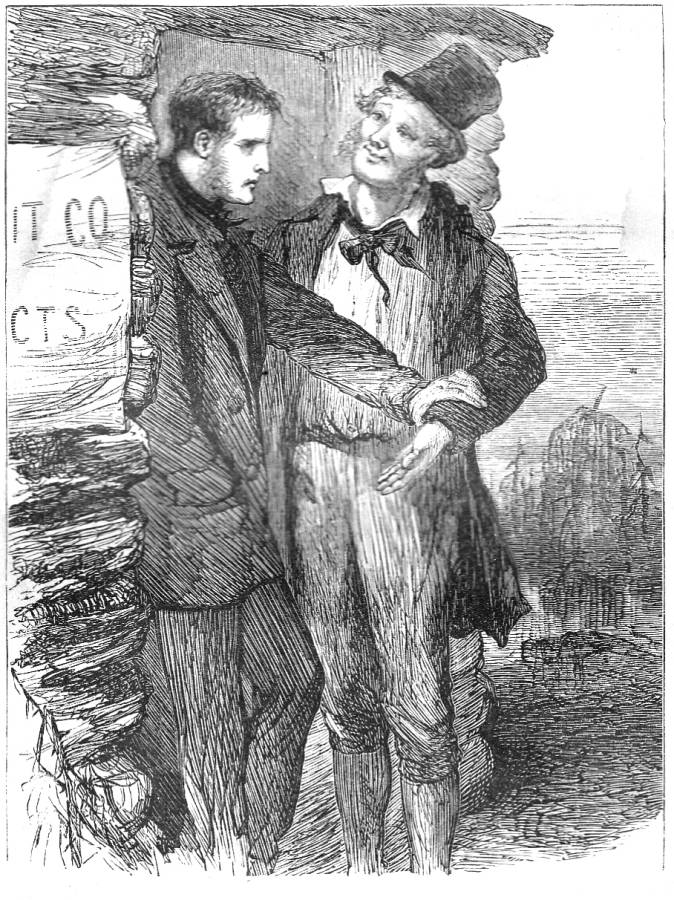
The Thriving City of Eden as it Appeared in Fact
Phiz (Halbot K. Browne)
September 1843
Etching
Mark displayed their placard on their premises, and said to Martin, "Now, if any gentleman wants a house built, he'd better give his orders, afore we're bespoke." — Chapter 23
Dickens's Martin Chuzzlewit
Scanned image and text by Philip V. Allingham.
[This image may be used without prior permission for any scholarly or educational purpose.]
Dickens's instructions to Phiz for this Illustration
The part of Dickens's 15-18 April 1843 letter on this "second subject" (the first being the envisioned "City" of Eden outlined in the town plan posted on the wall of the land office) has survived probably because it was neither returned to Dickens nor retained by Browne, both of whom burned much of their early correspondence. It is one of the few letters of instruction that survived the artist's and author's bonfires, possibly because it was retained by Chapman and Hall as instructions to the compositor. Valerie Lester mentions John Forster, Dickens's literary agent who sometimes acted on Dickens's behalf when the author was out of London, as another possible source of these letters of instruction for Martin Chuzzlewit since he may have "saved them, having given Phiz the instructions verbally or in another letter" (personal communication 16 May 2007). The contents of the letter do not furnish a clue to its survival, but the marginal notes, written in another hand but clearly dictated by Dickens, and Browne's penciled in rejoinder at the bottom of the page imply that the letter was initially sent to Browne, who then replied as to what he could and could not "shew" before Dickens dictated a few final thoughts about the composition of "The thriving City of Eden as it appeared in fact" (the second illustration for the ninth monthly part).
2nd Subject 2
The First Subject having shewn the settlement of Eden on paper, the second shews it in reality. Martin and Mark are displayed as the tenants of a wretched log hut (for a pattern whereof, see a Vignette brought by Chapman and Hall) in perfectly flat swampy, wretched forest of stunted timber in every stage of decay with a filthy river running before the door, and some other miserable loghouse indicated among the trees, whereof the most ruinous and tumbledown of all, is labelled BANK. And National Credit Office. Outside their door, as the custom is, is a rough sort of form or dresser, on which are set forth their pot and kettle and so forth: all of the commonest kind. On the outside of the house at one side of the door, is a written placard CHUZZLEWIT AND Co. ARCHITECTS AND SURVEYORS; and upon a stump of tree, like a butcher's block, before the cabin, are Martin's instrumentsÑa pair of rusty compasses &c On a three legged stool beside this block, sits Martin in his shirt sleeves, with long dishevelled hair, resting his head upon his hands: the picture of hopeless miseryÑwatching the river, as sadly remembering that it flows towards home. But Mr. Tapley, up to his knees in filth and brushwood, and in the act of endeavouring to perform some impossibilities with a hatchet, looks towards him with a face of unimpaired good humour, and declares himself perfectly jolly. Mark the only redeeming feature. Everything else dull, miserable, squalid, unhealthy, and utterly devoid of hope: diseased, starved, and abject. The weather is intensely hot, and they are but partially clothed. 1
According to the note in the Pilgrim Edition of Dickens's Letters,
At the foot of the page another hand has written: "With 2 Sketches" and Browne has written in pencil "I can't get all this perspective in--unless you will allow of a long subject--something less than a mile." Browne's sketch resembles the illustration except that the stump is larger and not growing in the ground, the Chuzzlewit placard is differently placed, and the other reads only "BANK". Beneath it is written (with two vertical lines indicating the width of the block) "too wide--cannot it be compressed by putting Martins label on the other side of the door and bringing Mark with his tree forwarder [.] qy is that a hat on his head", and "the stump of the tree should be in the ground in fact a tree cut off two up [rough sketch]". The hand is neither CD's nor Browne's, but the substance of the comment suggests that they are CD's, perhaps dictated at the printing office to a member of the staff when CD was in London again 24-26 Aug. The required changes were made, but the hat looks exactly the same on the plate. (The Pilgrim Letters 3: 542-3)
Steig in his 1972 Dickens Studies Annual article notes that, although the degree of correspondence between the detailed instructions and the eighteenth plate is great, Phiz has added from his own imagination two small toads, one regarding Martin and the other caught in the act of jumping into the water, "conceivably as an allusion to Martin's thoughts of suicide" (135). Jane Rabb Cohen in Charles Dickens and His Original Illustrators (1980) has positioned the seventeenth and eighteenth plates side by side on page 89 to invite her reader to compare these as expectation and fulfillment: the web-like plan (so unlike real American town plans, which customarily involved a rational grid) with the pump at its centre being the triumphant imposition of civilisation upon the wilderness, and then the trees and unruly grasses, suggestive of the power of nature, surrounding the settlers. Cohen concludes that the extreme number of details that Dickens specified (including the lines indicating the desired width) so curtailed Phiz's authority as an artist that he was able to respond with merely "a dutiful but uninspired picture" (88). However, whereas Dickens had specified that there be in the background a "wretched forest of stunted timber in every stage of decay," Browne has provided robust and stately trees of some height and possessing straight trunks, implying that the town-site possesses a potential for construction and habitation that Mark can see and Martin, filled with self-pity, cannot. Phiz, then, explodes the pathetic fallacy: whereas Mark revels in the challenge posed by the natural scene, Martin is immobilized by the apparent lack of opportunity for a young man who is trying to pass himself off as an architect. J. R. Harvey has remarked of Dickens's instructions for this illustrations that "Dickens is virtually moving the pencil himself: he imagines the plate in detail, and except for remembering that the river flows home, his details are not the psychic [i. e., psychological] details one expects of a novelist, but the telling visual particulars of an artist like Hogarth" (134). The placards and general confusion which Dickens envisages are especially reminiscent of Hogarth, and the rusty compasses are a detail reminiscent of such graphic artists as Dürer. Browne has asserted himself against Dickens the visualizer, the would-be illustrator, by rejecting aspects of these instructions impossible to realize visually (such as the intense heat) and by including the toads, changing the author's conception of the surrounding wilderness, and particularly through the hat with which he has persisted in providing Mark Tapley even as Dickens has queried it.
References
Buck, Anne. Victorian Costume and Costume Accessories. London: Herbert Jenkins, 1961.
Cohen, Jane R. Charles Dickens and His Original Illustrators. Columbus, Ohio: Ohio State University Press, 1980.
Cunnington, C. Willett and Phillis. Handbook of English Costume in the Nineteenth Century. Boston, Great Britain: Plays, 1970.
Dickens, Charles. The Pilgrim Edition of the Letters of Charles Dickens. Ed. Madeline House, Graham Storey, & Kathleen Tillotson. Oxford: Clarendon, 1974. Volume 3 (1842-3).
Harvey, J. R. "Dickens and Browne: Martin Chuzzlewit to Bleak House." Victorian Novelists and Their Illustrators. London: Sidgwick & Jackson, 1970.
Lester, Valerie Browne. "Note on CD's Letter to Phiz, 15-18 June 1844." Personal communication, 16 May 2007.
---. Phiz: The Man Who Drew Dickens. London: Chatto and Windus, 2004.
Steig, Michael. Dickens and Phiz. Bloomington & London: Indiana U. P., 1978.
---. "Martin Chuzzlewit's Progress by Dickens and Phiz." DSA 2 (1972): 119-149.
Related Material
- The American Plates, Parts Seven and Nine: Appearance Versus Reality, Expectation versus Fulfillment
- 17. IX. A. The Thriving City of Eden as it Appeared on Paper (September 1843)
Last modified 21 May 2007