The First Appearance of Sam Weller
Phiz (Hablot K. Browne)
July 1836
Steel Engraving
Dickens's Pickwick Papers
[Click on image to enlarge it.]
Details
Scanned image and text by Philip V. Allingham.
[You may use these images without prior permission for any scholarly or educational purpose as long as you (1) credit the photographer and (2) link your document to this URL in a web document or cite the Victorian Web in a print one.]

Literary historians generally agree that, over the course of its first three monthly instalments, sales of of The Posthumous Papers of the Pickwick Club were lack-lustre, at about one thousand per month — so tepid in fact that Chapman and Hall were tempted to abandon the venture. Then came Seymour's unexpected departure, Dickens's seizing control of the project, and the hiring — after false starts that included R. W. Buss, John Leech, and even W. M. Thackeray — of twenty-year-old Hablot Knight Browne as the new illustrator. When Boz and Phiz, but recently introduced themselves, introduced that indefatigable Cockney wit, Sam Weller, polishing boots in the courtyard of the galleried White Hart Inn, sales began to climb, rising steadily within a year to 20,000 per month and cresting in the late autumn of 1837 to the unheard of figure of 40,000 a month, enriching Chapman and Hall as publishers and effecting the overnight transformation of twenty-four-year-old shorthand reporter Charles John Huffam Dickens into a best-selling author. Thanks to the genial, aphoristic Sam, author and publishers had on their hands a palpable hit, and would not look back until declining sales of Martin Chuzzlewit in the next decade. Weller vests, Wellerisms, and Weller images came into vogue shortly after the publication of chapter 10 (in the fourth monthly part: July 1836). The innumerable unauthorised dramatic adaptations began some months later: H. Philip Bolton gives the first of these as announced for 27 March 1837, still eight months prior to Dickens's winding up the serial — theatrical adaptor William Moncrieff even renamed the work in Sam's honour: Sam Weller! or; The Pickwickians. Burletta (Bolton 78).
Prior to the arrival of Mr. Pickwick and Mr. Wardle at the White Hart, just off the High Street of the Borough (on the Surrey side of London Bridge), the ebullient Cockney "Boots" has been hard at work first thing in the morning, polishing the guests' varied footwear which he associates almost autistically with their particular rooms:
He was habited in a coarse, striped waistcoat, with black calico sleeves, and blue glass buttons; drab breeches and leggings. A bright red handkerchief was wound in a very loose and unstudied style round his neck, and an old white hat was carelessly thrown on one side of his head. [p. 75 of the 1868 Boston edition]
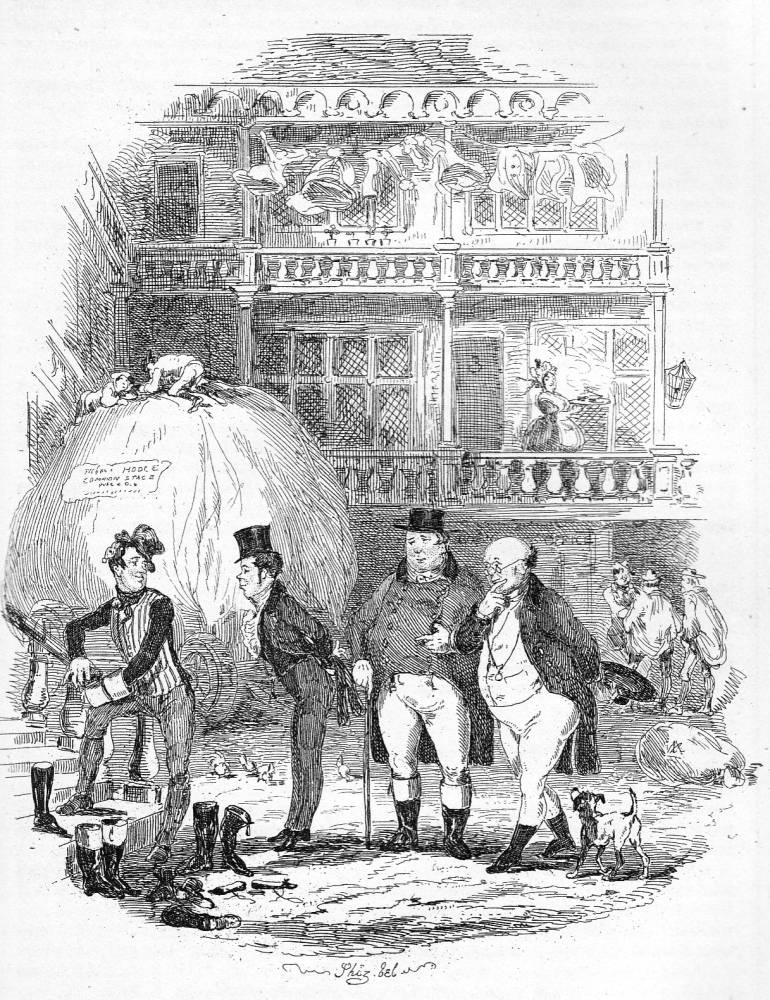
Phiz has assimilated this description of Sam in his illustration of a moment a page later, when, after confidence man Alfred Jingle has learned from Sam how he might locate Doctors' Commons and thereby obtain a marriage licence, old Mr. Wardle's lawyer, Perker, addresses Sam, his employer, and Pickwick in hyper-legalistic language in order to ascertain whether they are in time to save Rachael, old Wardle's spinster sister, from marrying the fortune-hunter:
Passage Illustrated:
He [Jingle] was yet on his way [back] to the White Hart, when two plump gentleman and one thin one entered the yard, and looked round in search of some authorised person of whom they could make a few inquiries. Mr. Samuel Weller happened to be at that moment engaged in burnishing a pair of painted tops, the personal property of a farmer who was refreshing himself with a slight lunch of two or three pounds of cold beef and a pot or two of porter, after the fatigues of the Borough market; and to him the thin gentleman straightway advanced.
"My friend," said the thin gentleman.
"You're one o' the adwice gratis order," thought Sam, "or you wouldn't be so wery fond o' me all at once." But he only said — "Well, Sir."
"My friend," said the thin gentleman, with a conciliatory hem — "have you got many people stopping here now? Pretty busy. Eh?"
Sam stole a look at the inquirer. He was a little high-dried man, with a dark squeezed-up face, and small, restless, black eyes, that kept winking and twinkling on each side of his little inquisitive nose, as if they were playing a perpetual game of peep-bo with that feature. He was dressed all in black, with boots as shiny as his eyes, a low white neckcloth, and a clean shirt with a frill to it. A gold watch-chain, and seals, depended from his fob. He carried his black kid gloves in his hands, and not on them; and as he spoke, thrust his wrists beneath his coat tails, with the air of a man who was in the habit of propounding some regular posers. [p. 78]
Thus, Pickwick met Sam Weller, and Dickens irrevocably altered the course of the episodic "something" for which Chapman and Hall had contracted, and The Pickwick Papers became a novel, albeit a loosely structured, picaresque narrative. As Michael Steig notes of this early Phiz illustration, the second July plate's Hogarthian detailism and genial humour would have appealed to the serial readers of 1836:
Dickens, in the passages relevant to the first of these plates, as well as frequently elsewhere, makes great play with Pickwick's tendency to burst into violent if ineffectual rages; in the second plate, reasonable action does temporarily triumph, but Dickens has not forgotten comedy and uses Sam's good-natured insolence as a means of deflating Pickwick's and especially Perker's self-importance. Phiz emphasizes this undercutting in a way which suggests an independent use of expressive iconography: he leads our eye from the jaunty cockney, Sam Weller, on the left, through the three gentlemen to the little dog on the right, who is contemplating Pickwick's calves with vicious intent. [25-26]
Left to right: (a) Sam Weller, the boots. (b) The sign pinned to the wagon's tarpaulin. (c) The landlady carrying a piping-hot breakfast tray to a room. [Click on these images for larger pictures.]
A trademark of Phiz is the sign pinned to the tarpaulin covering the cargo stowed on a waggon just in from the country, one of "three or four" that Dickens mentions at the opening of the chapter: "Thomas HODGE, COMMON STAGE, etc." As Phiz's style matured, he embedded more and more visual commentary in his illustrations, in the manner of his eighteenth-century master, Hogarth, often implanting paintings and signs that had bearing on the foregrounded action and characters.
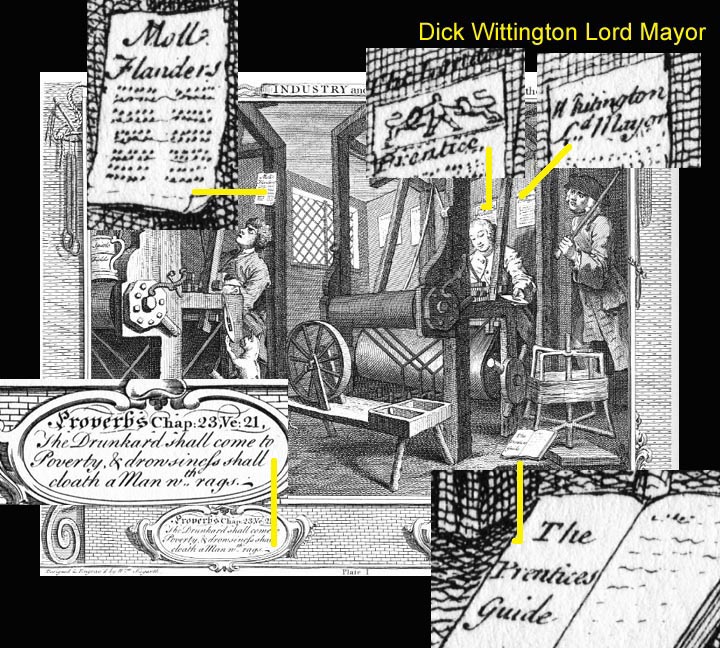
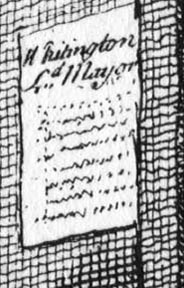
Examples of Hogarthian use of texts inside and outside the picture space. Left to right: (a) The enlarged texts from The Fellow Apprentices at their Looms from Hogarth's Industry and Idleness, I.. (b) Near the bad apprentice's loom -- Defoe's Moll Flanders, tale of a prostitute. (c) Near the bad apprentice's loom: a copy of the Rules of Apprenticeship. Follow for a discussion of use of such devices in Victorian painting. [Click on these images for larger pictures.]
Here, the sign (not alluded to in the text) underscores the commercial nature of the White Hart, and makes plain the business connections between town and country, "Hodge" being a signifier of an agricultural labourer, particularly of the Dorset region. The essential principle demonstrated here is selectivity; since Phiz cannot show all of the detail that Dickens gives about the yard of the White Hart, he has to choose such representative items as the laden waggon and tarpaulin, the balustrades of the galleries, two boys in smock-frocks atop the covered cargo, and loungers from the coffee-room (right) from among the total inventory:
The yard presented none of that bustle and activity which are the usual characteristics of a large coach inn. Three or four lumbering waggons, each with a pile of goods beneath its ample canopy, about the height of the second-floor window of an ordinary house, were stowed away beneath a lofty roof which extended over one end of the yard; and another, which was probably to commence its journey that morning, was drawn out into the open space. A double tier of bedroom galleries, with old clumsy balustrades, ran round two sides of the straggling area, and a double row of bells to correspond, sheltered from the weather by a little sloping roof, hung over the door leading to the bar and coffee-room. Two or three gigs and chaise-carts were wheeled up under different little sheds and pent-houses; and the occasional heavy tread of a cart-horse, or rattling of a chain at the farther end of the yard, announced to anybody who cared about the matter, that the stable lay in that direction. When we add that a few boys in smock-frocks were lying asleep on heavy packages, wool-packs, and other articles that were scattered about on heaps of straw, we have described as fully as need be the general appearance of the yard of the White Hart Inn, High Street, Borough, on the particular morning in question. [p. 75 in the Boston edition]
We might also note various elements that Phiz has interpolated: the landlady carrying a piping-hot breakfast tray to a room, a bird cage (right), the sign on the tarpaulin, the chickens, and of course the Hogarthian stableyard dog who is inspecting Pickwick's calves. The rakish tilt of Sam's white beaver, his lithe figure, and his fearless expression in addressing social superiors are all admirable extensions of Dickens's text that contributed to what we might today dub "Wellermania." Given this fascination with Sam Weller and his enduring popularity as a literary construct, we probably find Nast's illustration from chapter ten surprising in that it minimizes the figure of Sam Weller and focuses instead on the three vistors' rapping on Rachael Wardle's door ("Is this the room?" murmured the little gentleman. Sam [back towards the viewer] nodded assent: p. 64) after the scene in the yard which Phiz (and probably Dickens) chose to illustrate. The redrafted version of the scene in the British Household Edition, "Sam stole a look at the inquirer" (See page 62), is far less effective than the original because, even though the figures of 1873 are more three-dimensional, so many of those telling contextual details are missing, and one receives very little sense of the picturesque background, one of the last of London's galleried inns. Further, in shifting the perspective so that Sam is on the right, Phiz has almost crowded him out of the scene in the Household Edition's equivalent woodcut, minimalizing his importance, and focusssing instead on Pickwick (left), Wardle (centre) and Perker (right).
References
Bolton, H. Philip. Dickens Dramatized. London and Boston: Garland and G. K. Hall, 1987.
Cohen, Jane Rabb. Charles Dickens and His Original Illustrators. Columbus: Ohio State U. P., 1980.
Hammerton, J. A. The Dickens Picture-Book. London: Educational Book Co.,1910.
Steig, Michael. Dickens and Phiz. Bloomington & London: Indiana U.P., 1978. Pp. 51-85.
Dickens, Charles. Pickwick Papers (1836-37). Il. Robert Seymour and Hablot Knight Browne. London: Chapman & Hall.
Dickens, Charles. Pickwick Papers (1836-37). Il. Hablot Knight Browne. The Household Edition. London: Chapman & Hall, 1873.
Dickens, Charles. Pickwick Papers (1836-37). Il. Thomas Nast. The Household Edition. New York: Harper & Bros., 1873.
Dickens, Charles. Pickwick Papers (1836-37). Il. Hablot Knight Browne. The Charles Dickens Edition. Boston: Ticknor & Fields, 1867. Facing p. 78.
Last modified 23 January 2012