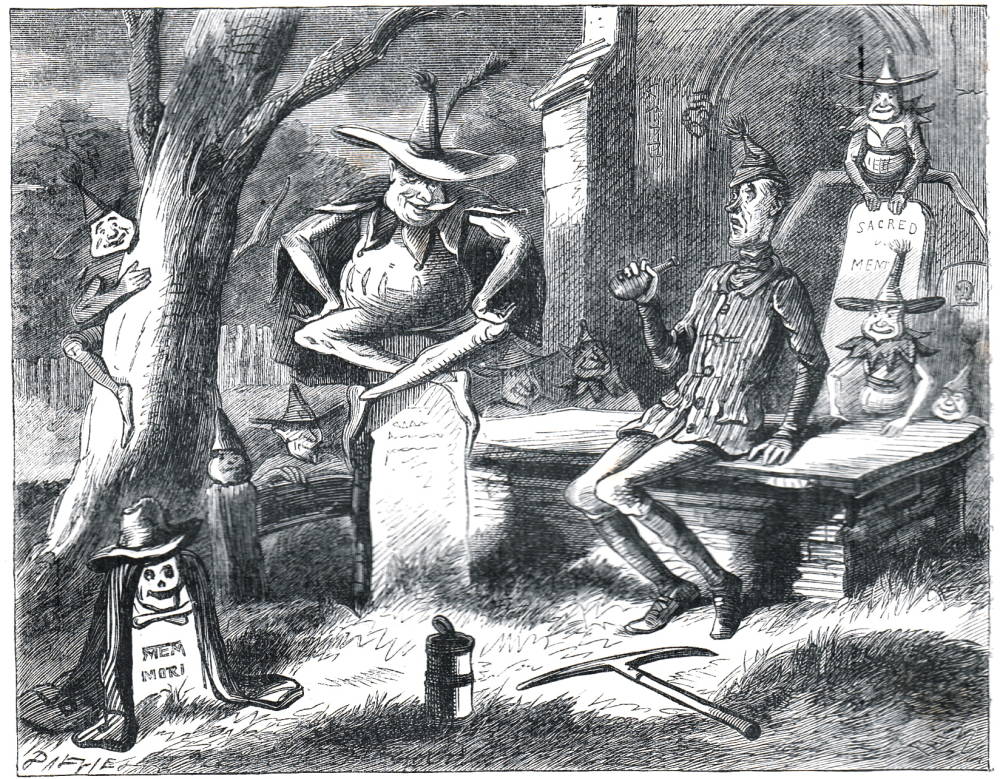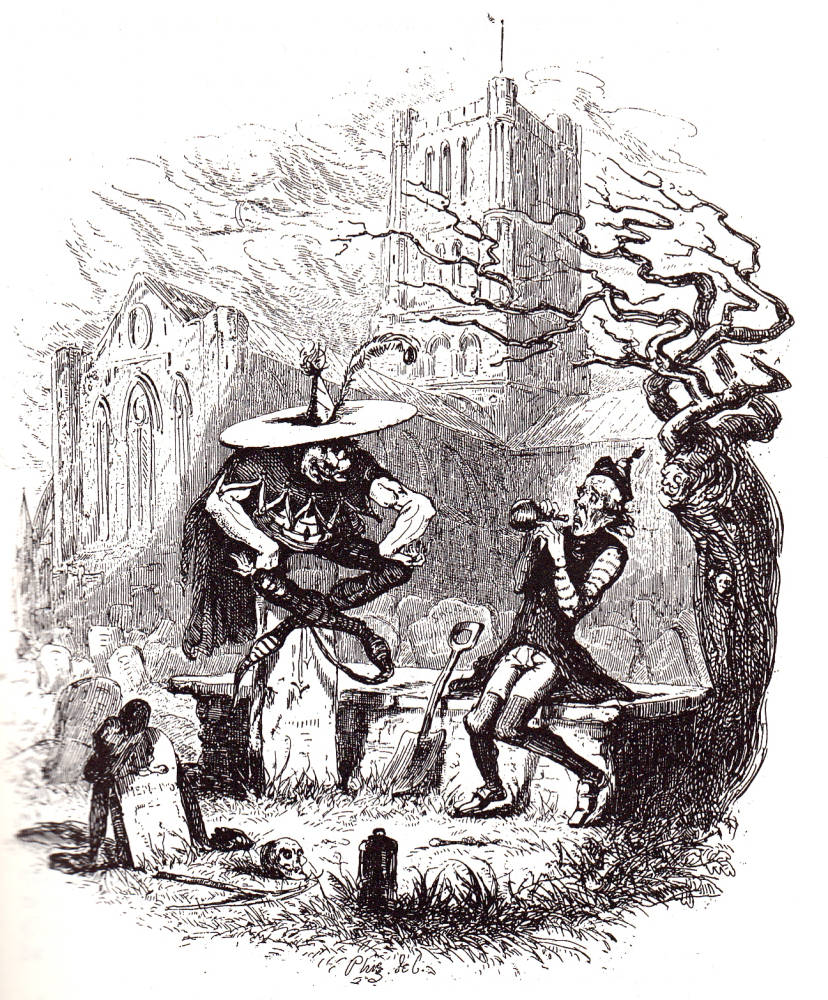
The Goblin and The Sexton
Phiz (Hablot K. Browne)
January 1837
Steel Engraving
Dickens's Pickwick Papers
[Click on image to enlarge it.]
See below for passage illustrated and commentary.
Scanned image and text by Philip V. Allingham.
[You may use this image without prior permission for any scholarly or educational purpose as long as you (1) credit the photographer and (2) link your document to this URL in a web document or cite the Victorian Web in a print one.]
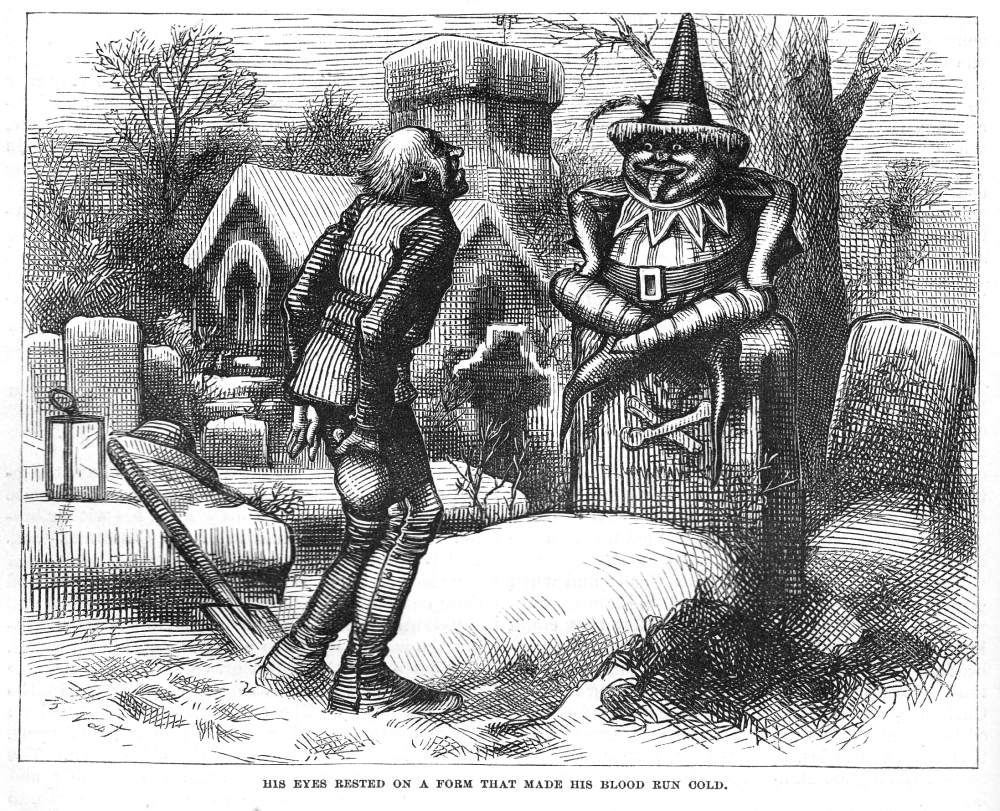
The passage from "The Story of the Goblins who stole a Sexton" illustrated is this:
Seated on an upright tombstone, close to him, was a strange, unearthly figure, whom Gabriel felt at once, was no being of this world. His long, fantastic legs which might have reached the ground, were cocked up, and crossed after a quaint, fantastic fashion; his sinewy arms were bare; and his hands rested on his knees. On his short, round body, he wore a close covering, ornamented with small slashes; a short cloak dangled at his back; the collar was cut into curious peaks, which served the goblin in lieu of ruff or neckerchief; and his shoes curled up at his toes into long points. On his head, he wore a broad-brimmed sugar-loaf hat, garnished with a single feather. The hat was covered with the white frost; and the goblin looked as if he had sat on the same tombstone very comfortably, for two or three hundred years. He was sitting perfectly still; his tongue was put out, as if in derision; and he was grinning at Gabriel Grub with such a grin as only a goblin could call up. [chapter 29]
"The Story of the Goblins who stole a Sexton," Dickens's version of Washington Irving's humorous tale of the supernatural "Rip Van Winkle," from The Sketch Book of Geoffrey Crayon (1819), is not merely an enjoyable little Christmas ghost story, but a premonitory treatment of the theme of spiritual and social renewal for a misanthrope found in A Christmas Carol (1843) and The Chimes (1844), which together established the nineteenth-century British vogue for Christmas Books. Unlike those fuller treatments of the theme, however, this inset narrative is told in the voice of one of the novel's characters, Mr. Wardle, rather than that of a detached omniscient.
The Phiz illustration acts as the perfect complement to the dramatic tale, blending a gothic setting — note the gnarled, leafless tree whose arms seem to reach out for the quivering sexton — and a caricature of a goblin in a gigantic hat. Phiz realises the leering goblin most effectively through his posture and wrestler's forearms, contrasting his contortionist's posture with the rigid, terrified human being in the churchyard.
References
Cohen, Jane Rabb. Charles Dickens and His Original Illustrators. Columbus: Ohio State U. P., 1980.
Hammerton, J. A. The Dickens Picture-Book. London: Educational Book Co., 1910.
Steig, Michael. Dickens and Phiz. Bloomington & London: Indiana U.P., 1978. Pp. 51-85.
Dickens, Charles. "Pickwick Papers (1836-37). London: Chapman & Hall.
Last modified 8 December 2011