
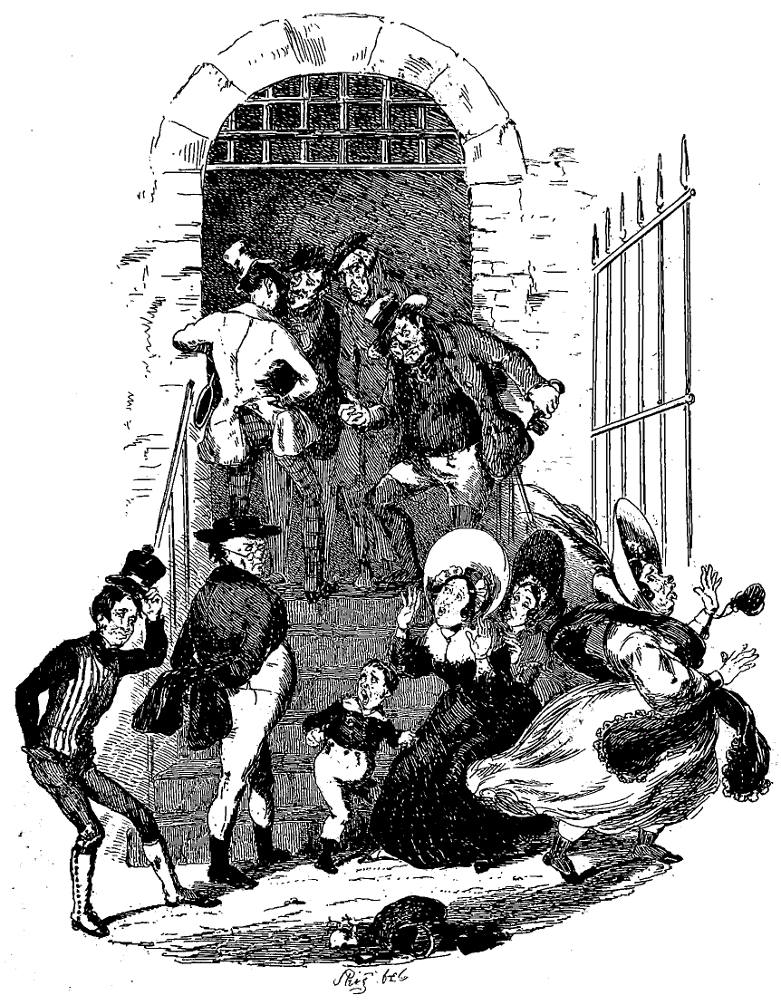
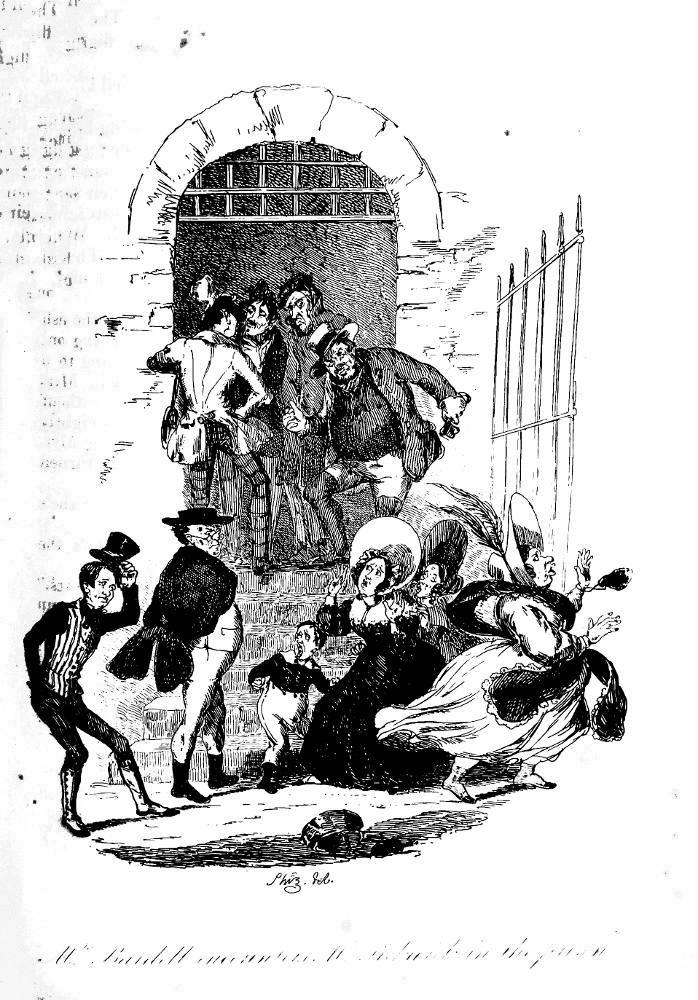
Mrs. Bardell encounters Mr. Pickwick in the Prison, or, Mrs. Bardell recognising Mr. Pickwick — thirty-fifth steel engraving for Charles Dickens's The Posthumous Papers of the Pickwick Club, instalment 16; two versions by Phiz (Hablot K. Browne) for the August 1837 number and the 1838 bound volume; Chapter XLVI, “Records a touching Act of delicate Feeling, not unmixed with Pleasantry, achieved and performed by Messrs. Dodson and Fogg,” facing page 498. The original illustration is 12.8 cm high by 10.1 cm wide (5 by 4 inches), vignetted. The initial or A engraving of Plate 35, as Johnannsen (1956) notes, has a left-hand railing on the steps, but no caption, whereas version B has no such railing, and Sam Weller has no cockade in his hat. The volume version of B, which Johnannsen labels B2 is identical to B, except that it has the legend (Johannsen, 61). [Click on the images to enlarge them.]
Details


Passage Illustrated: The Recognition Scene
"What place is this?" inquired Mrs. Bardell, pausing.
"Only one of our public offices," replied Jackson, hurrying her through a door, and looking round to see that the other women were following. "Look sharp, Isaac!"
"Safe and sound," replied the man with the ash stick. The door swung heavily after them, and they descended a small flight of steps.
"Here we are at last. All right and tight, Mrs. Bardell!" said Jackson, looking exultingly round.
"What do you mean?" said Mrs. Bardell, with a palpitating heart.
"Just this," replied Jackson, drawing her a little on one side; "don't be frightened, Mrs. Bardell. There never was a more delicate man than Dodson, ma’am, or a more humane man than Fogg. It was their duty in the way of business, to take you in execution for them costs; but they were anxious to spare your feelings as much as they could. What a comfort it must be, to you, to think how it’s been done! This is the Fleet, ma’am. Wish you good–night, Mrs. Bardell. Good–night, Tommy!"
As Jackson hurried away in company with the man with the ash stick another man, with a key in his hand, who had been looking on, led the bewildered female to a second short flight of steps leading to a doorway. Mrs. Bardell screamed violently; Tommy roared; Mrs. Cluppins shrunk within herself; and Mrs. Sanders made off, without more ado. For there stood the injured Mr. Pickwick, taking his nightly allowance of air; and beside him leant Samuel Weller, who, seeing Mrs. Bardell, took his hat off with mock reverence, while his master turned indignantly on his heel.
"Don't bother the woman," said the turnkey to Weller, "she's just come in."
"A prisoner!" said Sam, quickly replacing his hat. "Who's the plaintives? What for? Speak up, old feller."
"Dodson and Fogg," replied the man; "execution on cognovit for costs." [Chapter XLVI, “Records a touching Act of delicate Feeling, not unmixed with Pleasantry, achieved and performed by Messrs. Dodson and Fogg,” ]
Commentary: Stern Pickwick, Startled Mrs. Bardell in the Prison Yard
In the second of the August 1837 illustrations, the last of the debtors' prison sequence, Phiz realises one of the key moments in the "breach of marriage" plot as Mr. Pickwick confronts his accuser, the devious Mrs. Bardell. The ingenious agent of Dodson and Fogg, Jackson, on the pretext of hastening the client to an emergency meeting with her attorneys, has just delivered Mrs. Bardell, Tommy Bardell, and Mrs. Cluppins to the central yard of the Fleet Prison, which Phiz identifies by the portcullis-like grating and the four disreputable characters in the doorway; the one to the right, gesturing inward, is holding a bunch of keys, and is therefore likely a turnkey.
Since the scene in the foreground is full of emotion (ranging from Sam's facetiousness, to Pickwick's obvious hauteur, to Mrs. Bardell's shocked disbelief, Tommy's roaring, and Mrs. Cluppins's terror) and contains ten characters (including three females) individualised by varying poses, Phiz does not limit the picture with a vignette or frame. Rather, he distributes the figures so that they seem to burst out of the margins as Sam (left) with mock politeness tips his hat, and Mrs. Sanders hastily exits in a baroque swirl of fabric (right), abandoning her friends to the very institution in which Mrs. Bardell through pursuing her unjust suit had caused her unscrupulous lawyers to incarcerate Pickwick. Having used the devious Dodson and Fogg as her tools but having failed to to pay her court costs, although she has won Pickwick v. Bardell, Mrs. Bardell is now the subject of poetic justice as her own attorneys (through their suave functionary, Jackson), Pickwick still proving obdurate, seize their own client "in execution of costs." To paraphrase Shakespeare's Hamlet, she has been hoisted on her own petard, and must become an inmate — together with her odious son Tommy (centre, beside his shocked mother) — of the Fleet. Phiz reprised precisely this scene in his 1874 Household Edition illustrations as Mrs. Bardell screamed violently; Tommy roared; Mrs. Cluppins shrunk within herself; and Mrs. Sanders made off without more ado, but brought his focus well down stage, so to speak, retaining only the turnkey from the figures on the steps to the rear, and treating the comic scene less exuberantly, as is consistent with the new realism of the Sixties.
In this [1837] plate, the horizontal band formed by the main characters is juxtaposed both to the vertical of the gateway and to the dynamic thrust of the jailer, who appears to have just pushed the ladies and child down the steps. One reads from top to bottom left, and then to the right, just as one "sees" in the text the arrival at prison, the revelation to Mrs. Bardell that she is a prisoner, and then the encounter with Pickwick. The triangular arrangement, however, makes it possible to read the illustration in two directions, as though causally: from Mrs. Bardell up to the jailer and down to Pickwick, implying that her lawsuit has brought him to prison; or in reverse, beginning with Pickwick, implying that his stubborn adherence to principle has caused him unwittingly to make a victim out of his former landlady. Yet Pickwick and Mrs. Bardell also are part of the same compositional horizontal band, linked as victims of a vicious system. [Steig 36]
To emphasise their incarceration and loss of liberty, Phiz gives prominence to the details he suppresses in his 1874 version: the high iron bars (right), the stout stone archway and iron portcullis (upper centre), and the ugly turnkey's utter disregard for the scene playing out in the foreground. The overturned basket (lower centre) — a detail apparently of Phiz's invention — implies that Mrs. Bardell was not expecting to become an inmate of the Fleet. In the original serial illustration, "A dressed chicken with its toes turned up lies on the ground near the basket in the foreground" (Johnannsen, 61). Pickwick's posture (with his hands clutched under his coat-tails) echoes that of the scrutinising turnkey (upper left) here, and in Mr. Pickwick Sits for His Portrait, implying that she, too, is about to undergo the humiliation of the induction portrait.
Other artists who illustrated this work, 1836-1910
- Robert Seymour (1836)
- Thomas Onwhyn (1837)
- Felix Octavius Carr Darley (1861)
- Sol Eytinge, Jr. (1867)
- Thomas Nast (1873)
- Harry Furniss (1910)
- Clayton J. Clarke's Extra Illustrations for Player's Cigarettes (1910)
Scanned images and text by Philip V. Allingham. [You may use these images without prior permission for any scholarly or educational purpose as long as you (1) credit the person who scanned the images, and (2) link your document to this URL in a web document or cite the Victorian Web in a print one.]
Bibliography
Cohen, Jane Rabb. Charles Dickens and His Original Illustrators. Columbus: Ohio State U. P., 1980.

Davis, Paul. Charles Dickens A to Z: The Essential Reference to His Life and Work. New York: Facts On File, 1998.
Dickens, Charles. The Posthumous Papers of the Pickwick Club. Illustrated by Robert Seymour, Robert Buss, and Phiz. London: Chapman and Hall, November 1837. With 32 additional illustrations by Thomas Onwhyn (London: E. Grattan, April-November 1837).
Dickens, Charles. The Posthumous Adventures of the Pickwick Club. Illustrated by Sol Eytinge, Jr. 14 vols. The Diamond Edition. Boston: Ticknor and Fields, 1867. Vol. 1.
Dickens, Charles. Pickwick Papers. Illustrated by Hablot Knight Browne. The Household Edition. 22 vols. London: Chapman and Hall, 1874. Vol. 6.
Dickens, Charles. Pickwick Papers Illustrated by Thomas Nast. The Household Edition. New York: Harper and Bros., 1873.
Guiliano, Edward, and Philip Collins, eds. The Annotated Dickens.2 vols. New York: Clarkson N. Potter, 1986. Vol. I.
Hammerton, J. A. The Dickens Picture-Book. London: Educational Book Co., 1910.
Johnannsen, Albert. "The Posthumous Papers of The Pickwick Club." Phiz Illustrations from the Novels of Charles Dickens. Chicago: University of Chicago Press; Toronto: The University of Toronto Press, 1956. Pp. 1-74.
Kitton, Frederic G. Dickens and His Illustrators. 1899. Rpt. Honolulu: U. Press of the Pacific, 2004.
Steig, Michael. Chapter 2. "The Beginnings of 'Phiz': Pickwick, Nickleby, and the Emergence from Caricature." Dickens and Phiz. Bloomington & London: Indiana U. P., 1978. Pp. 24-50.
Created 25 December 2011
Last updated 1 April 2024