

Tony Weller ejects Mr. Stiggins
Phiz (Hablot K. Browne)
November 1837
Steel Engraving
11.3 cm high by 9.5 cm wide (4 ⅜ by 4 ¾ inches), vignetted
Chapter 53 of Dickens's Pickwick Papers
[Click on image to enlarge it.]
Details


Scanned images and text by Philip V. Allingham.
Passage illustrated: Stiggins's Nemesis at The Marquis of Granby
Sam dutifully adjusted the hat with the long hatband more firmly on his father's head, and the old gentleman, resuming his kicking with greater agility than before, tumbled with Mr. Stiggins through the bar, and through the passage, out at the front door, and so into the street — the kicking continuing the whole way, and increasing in vehemence, rather than diminishing, every time the top-boot was lifted.
It was a beautiful and exhilarating sight to see the red-nosed man writhing in Mr. Weller's grasp, and his whole frame quivering with anguish as kick followed kick in rapid succession; it was a still more exciting spectacle to behold Mr. Weller, after a powerful struggle, immersing Mr. Stiggins's head in a horse-trough full of water, and holding it there, until he was half suffocated.
"There!" said Mr. Weller, throwing all his energy into one most complicated kick, as he at length permitted Mr. Stiggins to withdraw his head from the trough, "send any vun o' them lazy shepherds here, and I'll pound him to a jelly first, and drownd him artervards! Sammy, help me in, and fill me a small glass of brandy. I'm out o' breath, my boy." [Chapter LII, "Involving a serious change in the Weller family, and the untimely downfall of the red-nosed man, Mr. Stiggins," pp. 458-59]
Commentary: A Comic Comeuppance
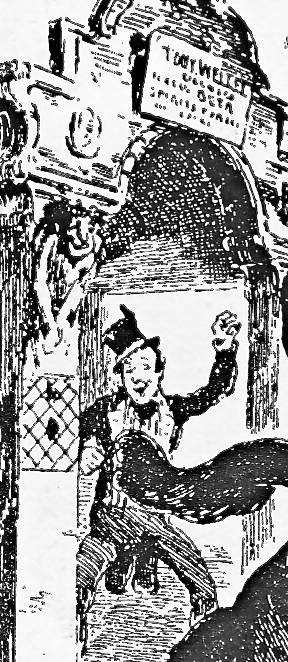
In the final instalment — Parts 19 and 20, which appeared in the November 1837 double number — Phiz has elected to depict a series of comic moments that are not associated with the titular character at all. These choices imply that Dickens had come to trust Phiz's sense as to what topics and scenes would be most suitable for illustration. In Tony Weller ejects Mr. Stiggins, for example, the writer and illustrator act, as it were, as co-presenters of the comic comeuppance of the hypocritical dissenting minister and "shepherd" of the Ebenezer Chapel at Dorking, Surrey. At the borough's venerable Marquis of Granby public house on a tranquil, tree-lined street, coachman and publican Tony Weller, incensed with Stiggins's hypocrisy and manifest greed, gives the alcoholic "pastor" a drubbing and then immerses him in the pub's horse-trough, as a mock baptism, perhaps. The scene depicted occurs shortly after the sudden death of Sam Weller's "mother-in-law" (stepmother), a devoted member of Stiggins's gullible (largely female) congregation; vulture-like Stiggins hovers over Tony in hopes of securing a bequest, despite the fact that he was inadvertently the cause of her death, for his prolonged, sermonical rant while she was sitting on the grass in the rain listening to him for hours occasioned her contracting the severe cold that eventually did her in.
Sam, having repaired to his father's pub as soon as he received a letter at London's George and Vulture announcing her demise, in the background of the illustration cheers on his incensed father. The coachman's assault seems to be triggered by the alcoholic preacher's helping himself to pineapple rum, sugar, and water on the strength of some sort of financial commitment to the Emanuel he feels sure that Tony's wife, Susan, just buried, has made in her will. Suddenly throwing the hot liquor in Stiggins's face, Tony proceeds to kick him vigorously from the bar, through the passage, and out into the street. Thus, the illustration shows the culmination of this operation of comic nemesis.
(Ironically, although his Christianity was compatible with middle-of-the-road Anglicanism throughout his life, in the next decade the author was a regular member of a Unitarian congregation in London.)
The sign above the entrance to the pub in Phiz's illustration designates Tony Weller rather than his wife, Susan, as the publican, reinforcing his connection to the real Moses Pickwick, a tavern-keeper who also operated a stagecoach business from Bath. Gargoyles supporting the ornamental lintel smile appreciatively at the unfolding drama and rough justice that Tony, their owner, exacts. The streaming funereal hatband, Stiggins's hat on the ground, and the overturned wicker basket (right) suggest the energy of Tony's attack. The illustration provides details about the setting — especially about the architectural features of the pub's facade — that the bare text alone does not, so that author and illustrator become, in effect, joint originators of this delightful scene of physical comedy and poetic justice. The red-nosed "shepherd" (a complete mockery of the "Good Shepherd" of the Gospels) appears to be almost comatose as he feebly grips the trough and positions his spindly legs to push himself back.
Although the text focuses on Tony's feelings and actions, the plate encompasses Stiggins's condition, Sam's ebullient response, and the most minute details of the physical setting that Dickens seems to have relied upon Phiz to express, including the pub's bay window of leaded panes and even a straw broom (left) to clean the sidewalk in front of the establishment. This latter detail may betoken Tony's settling his unfinished business with the predatory Stiggins, a catharsis for the long-suffering coachman and the reader alike. Thus, through his vivid realisation of Dickens's scene and his elaboration of the text Phiz enforces the reader's sympathy for the widower and contempt for the hypocritical pastor, who physically is no match for the massive coachman, who has had to restrain his indignation far too long. In this respect, the illustration also prepares the reader for Pickwick's denunciation of the lawyers Dodson and Fogg as "as a well-matched pair of mean, rascally, pettifogging robbers" (Ch. 53, p. 466) in Perker's law offices.
Johnannsen (1956) notes that only two rather than the usual three steels were etched for the engraved title-page; although one was etched before the other, both were printed at the same time, and the chief difference lies in the sign above the door of the public-house, with A being the version with "Tony Weller" rather than B's "Tony Weller, licensed to sell beer, spirits, tobac" (Johannsen 74).
The Comparable Household Edition Illustrations of this scene (1873-74)


Left: The American edition's illustration by Thomas Nast that gives us the scene from inside the public house, Resuming his kicking with greater agility than before (1873). Right: Phiz's re-drafted version of the same scene for the Household Edition, Mr. Weller . . . . . immersing Mr. Stiggins's head in a horse-trough. [Click on the images to enlarge them.]
Phiz's Other Scenes Involving The Convivial Tony Weller
- The Valentine (March 1837 instalment)
- The Red-Nosed Man Discourseth (August 1837 instalment)
- Mr. Weller and his friends drinking to Mr. Pell (November 1837 instalment)
Other artists who illustrated this work in other editions, 1836-74
- Robert Seymour (1836)
- Felix Octavius Carr Darley (1861)
- Sol Eytinge, Jr. (1867)
- Hablot Knight Browne (1874)
- A selected list of illustrations by Harry Furniss for the Charles Dickens Library Edition (1910)
- Clayton J. Clarke's Extra Illustration for Player's Cigarettes (1910)
Related Material
- An introduction to the Household Edition (1871-79)
- Illustrators of Dickens's Pickwick Papers in the 1873 Household Edition
Tony Weller in Onwhyn's "Extra" Illustrations (1837)
- “He called me a wessel, Sammy — a wessel of wrath — and all sorts of names. So my blood being reg’larly up, I first gave him two or three for himself, and then two or three more to hand over to the man with the red nose, and walked off.” Page 225. [Chapter XXII, “In which Mr. Pickwick Journeys to Ipswitch and Meets with a Romantic Adventure with a Middle-Aged Lady in Yellow Curl-Papers,” issued August 31, 1837]
- “Well, that's a blessing,’” said Mr. Weller. “Sammy, help your master up to the box; t’other leg, Sir, that’s it; give us your hand, Sir. Up with you. You was a lighter weight when you was a boy, Sir.’” Page 227. [Chapter XXII, issued September 30, 1837]
- “Brother Tadger, Sir,” said Mr. Stiggins, suddenly increasing in ferocity, and turning sharp round on the little man in the drab shorts, “you are drunk, Sir.” Page 214. [Chapter XXXIII, “Mr. Weller the Elder Delivers Some Critical Sentiments Respecting Literary Composition; And, Assisted by his Son Samuel, Pays a Small Instalment of Retaliation to the Account of the Reverend Gentleman with the Red Nose,” issued October 26, 1837]
- “Mr. Weller surveyed the attorney from head to foot with great admiration, “And what’ll you take, Sir?” / “Why, really,” replied Mr. Pell “you’re very_Upon my word and honour, I’m not in the habit of_ It’s so very early in the morning, that, actually, I am almost_Well, you may bring me three penn’orth of rum, my dear.” Page 458. [Chapter LV, “Mr. Solomon Pell, Assisted by a Select Committee of Coachmen, Arranges the Affairs of the Elder Mr. Weller,” issued October 26, 1837]
- “Well, I’ll bet you half a dozen of claret,” said Wilkins Flasher, Esquire_ This was addressed to a very smart young gentleman who wore his hat on his right whisker, and was lounging over the desk killing flies with a ruler.” Page 591. [Chapter LV, issued November 30, 1837]
Bibliography
Cohen, Jane Rabb. Charles Dickens and His Original Illustrators. Columbus: Ohio State U. P., 1980.
Davis, Paul. Charles Dickens A to Z: The Essential Reference to His Life and Work. New York: Facts On File and Checkmark Books, 1998.
Dickens, Charles. The Posthumous Papers of the Pickwick Club. Illustrated by Robert Seymour, Robert Buss, and Phiz. London: Chapman and Hall, November 1837. With 32 additional illustrations by Thomas Onwhyn (London: E. Grattan, April-November 1837).
_______. "Pickwick Papers. Illustrated by Hablot Knight Browne. The Charles Dickens Edition. Boston: Ticknor & Fields, 1867.
_______. The Posthumous Papers of the Pickwick Club. Illustrated by Thomas Nast. The Household Edition. New York: Harper and Brothers, 1873.
_______. The Posthumous Papers of the Pickwick Club. Illustrated by Hablot Knight Browne. The Household Edition. London: Chapman and Hall, 1874. Vol. VI.
Guiliano, Edward, and Philip Collins, eds. The Annotated Dickens. Vol. 1. New York: Clarkson N. Potter, 1986.
Hammerton, J. A. The Dickens Picture-Book. London: Educational Book Co., 1910.
Johannsen, Albert. "Part XX. Plate 43. The Etched Title." Illustrations from the Novels of Charles Dickens.. Chicago: University of Chicago Press,1956. Pp. 74-75.
Lester Valerie Browne. Phiz: The Man Who Drew Dickens. London: Chatto and Windus, 2004.
Patten, Robert L. "The Art of Pickwick's Interpolated Tales." English Literary History 34 (1967): 349-66.
Steig, Michael. Chapter 2. "The Beginnings of 'Phiz': Pickwick, Nickleby, and the Emergence from Caricature." Dickens and Phiz. Bloomington & London: Indiana U. P., 1978. Pp. 24-50.
Vann, J. Don. "The Pickwick Papers, twenty parts in nineteen monthly instalments, April 1836-November 1837." Victorian Novels in Serial. New York: The Modern Language Association, 1985. P. 61.
Created 12 January 2012
Last modified 19 February 2024