
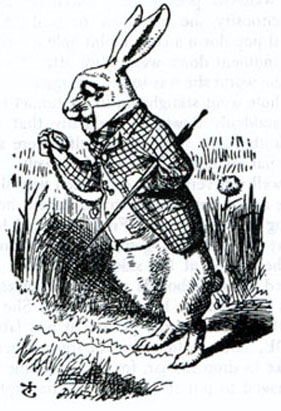
"I'm late, "I'm late."
Sir John Tenniel
1865
Wood-engraving by Dalziel
Illustration for the first chapter of Lewis Carroll's Alice in Wonderland
[See commentary below]
Student assistants from the University Scholars Program, National University of Singapore, scanned this image under the supervision of George P. Landow.
[You may use this image without prior permission for any scholarly or educational purpose as long as you (1) credit the site and (2) link your document to this URL.]
Commentary by Leighton Carter
The appearance of the White Rabbit, both in picture and in prose, shows how the author and the illustrator ease Alice (and her surrogate explorer, the reader) into Wonderland. Boredom with her sister's book "without pictures or conversations" causes Alice to drift suddenly into a dream-world:
So she was considering, in her own mind (as well as she could, for the hot day made her feel very sleepy and stupid), whether the pleasure of making a daisy-chain would be worth the trouble of getting up and picking the daisies, when suddenly a White Rabbit with pink eyes ran close by her.
There was nothing so very remarkable in that; nor did Alice think it so very much out of the way to hear the Rabbit say to itself "Oh dear! Oh dear! I shall be too late!" (when she thought it over afterwards it occurred to her that she ought to have wondered at this, but at the time it all seemed quite natural); but, when the Rabbit actually took a watch out of its waistcoat pocket, and looked at it, and then hurried on, Alice started to her feet, for it flashed across her mind that she had never before seen a rabbit with either a waist-coat pocket, or a watch to take out of it, and burning with curiosity, she ran across the field after it, and was just in time to see it pop down a large rabbit-hole under the hedge. [Carroll 7-8]
Carroll begins with a very ordinary, almost dull, scene in which a little girl, exhibiting a characteristically small attention span, becomes dissatisfied with her current activity. The adult reader can extrapolate from Carroll's writing that Alice has fallen asleep and begun to dream when the White Rabbit appears, but Carroll does not explicitly describe this process (he only hints at it by mentioning Alice's sleepy state and reclined position). Carroll does not blur the boundary between the real and fantastical worlds by explicitly describing the mediating dream state; instead he thrusts the fantastical element into the real world. Alice then acts by her own volition to follow the White Rabbit into the fantasy-world proper.
Carroll uses the White Rabbit, instead of the dream, to introduce Alice and the reader to the fantastical nature of Wonderland. The White Rabbit is, by far, the most human of the characters Alice will encounter underground (Carroll first shows the Rabbit's humanness by capitalizing White Rabbit like a formal, human name). What surprises Alice most about the Rabbit is not that it speaks (such an imaginative child as Alice likely hears animals talk all the time in her mind) but that it has human accoutrements. Tenniel chooses to illustrate this moment — when the Rabbit looks at his pocket-watch — and, following Alice's perspective, emphasizes that the Rabbit's human clothes make it odd. (This strategy makes sense when dealing with illustration because Tenniel cannot visually represent the Rabbit's speech as effectively as its clothing.) In the illustration, the anthropomorphic white rabbit holds the stop-watch with one human hand and tucks an umbrella under his arm with the other hand to strike an almost dandified posture. His eyes bulge wide in distress over the late time and, perhaps due to his tip-toeing rabbit-feet, he leans forward as if about to hurry (on two feet, of course) away. The reader, like Alice, realizes, detail by detail, how different this White Rabbit is from Carroll's first mention of a "White Rabbit with pink eyes" (7).
Although Alice considers the Rabbit's human dress fantastic, it also conversely serves to soften the intrusion of the fantastical into Alice's world for the reader. Especially in Tenniel's illustration, the rabbit's clothes, human hands, posture and expression of distress makes it familiar to us while its essentially realistic rabbit-body makes it recognizable. Tenniel inverts mutually exclusive conceptions of animal and man, but he also bridges that divide visually in order to create a point of departure for fantasy within the everyday world with which the reader is familiar. [complete essay: ""Which way? Which way?": The Fantastical Inversions of Alice in Wonderland"]
Last modified 24 December 2007