
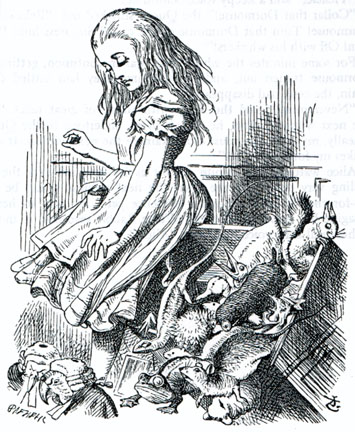
Chaos in the Courtroom
Sir John Tenniel
1865
Wood-engraving by Dalziel
Illustration for the twelfth chapter of Lewis Carroll's Alice in Wonderland
Student assistants from the University Scholars Program, National University of Singapore, scanned this image under the supervision of George P. Landow in 2000.
[You may use this image without prior permission for any scholarly or educational purpose as long as you (1) credit the site and (2) link your document to this URL in a web document or cite the Victorian Web in a print one. ]
Commentary by Leighton Carter
The final inversion that Alice experiences in Wonderland comes about at the trial scene when she, emboldened by her sudden growth in size, rebels against the proceedings. Even though the trial's components are recognizable from the aboveground world, Wonderland steeps it in a familiar brand of chaos. Alice, due to her previous experiences with this chaos, recognizes it as such:
"That's the most important piece of evidence we've heard yet," said the King, rubbing his hands: "so now let the jury — "
"If anyone can explain it," said Alice, (she had grown so large in the last few minutes that she wasn't a bit afraid of interrupting him,) "I'll give him sixpence. I don't believe there's an atom of meaning in it." [Carroll 95]
Alice's repudiation of the trial shows that the validity of aboveground systems of thought has begun to return. She invokes the British monetary system and physics and, though both occur in idiomatic expressions, they hold true to the situation: none of the cards can explain the evidence and it does not contain even an atom of meaning. As Donald Rackin claims, Alice here "is becoming just as subversive towards Wonderland as Wonderland has been towards her and her aboveground principles" (413). This inversion marks the beginning of her exit from the fantasy world.
An abandonment of the aboveground decorum and silence that children should obey marks Alice's final departure from Wonderland. She breaks her previous acceptance of the cards' humanness by naming them as they are in her reality:
"No, no!" said the Queen. "Sentence first — verdict afterwards."
"Stuff and nonsense!" said Alice loudly. "The idea of heaving the sentence first!"
"Hold your tongue!" said the Queen, turning purple.
"I wo'n't!" said Alice.
"Off with her head!" the Queen shouted at the top of her voice. Nobody moved.
"Who cares for you?" said Alice (she had grown to her full size by this time). "You're nothing but a pack of cards!"
At this time the whole pack rose up into the air, and came flying down upon her; she gave a little scream, half of fright and half of anger, and tried to beat them off, and found herself lying on the bank, with her head in the lap of her sister, who was gently brushing away some dead leaves that had fluttered down from the trees upon her face. [Carroll 96-97]
[complete essay: ""Which way? Which way?": The Fantastical Inversions of Alice in Wonderland"]Last modified 24 December 2007