
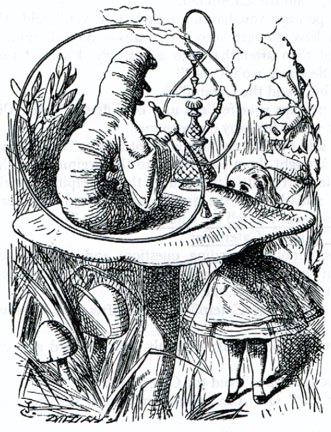
Alice meets the Caterpillar
Sir John Tenniel
1865
Wood-engraving by Dalziel
Illustration for the fifth chapter of Lewis Carroll's Alice in Wonderland
[See commentary below]
Student assistants from the University Scholars Program, National University of Singapore, scanned this image under the supervision of George P. Landow in 2000.
[You may use this image without prior permission for any scholarly or educational purpose as long as you (1) credit the site and (2) link your document to this URL.]
Commentary by Leighton Carter
Tenniel's illustration establishes a hierarchical relationship between Alice and the Caterpillar. The insect, pictured in profile facing away from the viewer, grasps the hookah with a human hand that emerges from a wide-sleeved shirt. The coil of his hookah wraps a fully around his body — creating a bordered circular shape that immediately draws the viewer's eye to the figure inside it. The mushroom upon which he sits raises him to the top of the picture-space. Alice, conversely, stands below the Caterpillar on tip-toe. His mushroom impedes the viewer's view of her body, cutting her off from midsection to nose. The eyes are the most noticeable feature in this depiction of Alice; she raises them up, widened in wonder, toward the Caterpillar. The naturalistically drawn plants in the background emphasize Alice's small size: shoots of leaves and foxgloves tower over her, hemming her into the Caterpillar's mushroom. The Caterpillar therefore dominates the visual space of the illustration, almost as if Tenniel envisioned a type of court scene in which the lowly Alice presents herself to the imperious insect.
The Caterpillar also assumes the dominant role in the verbal exchange that occurs between girl and insect. For the first time, Alice doubts her identity and shows that the continuous reversals — especially the dramatic alterations in her size — of Wonderland have altered her conception of reality as primarily predictable. The Caterpillar begins the conversation with a rude question that Alice answers politely (again inverting the relationship between decorum and indecorum, since previously the Mouse was polite while Alice was rude):
"Who are you?" said the Caterpillar.
This was not an encouraging opening for a conversation. Alice replied, rather shyly, "I — I hardly know, Sir, at present — at least I know who I was when I got up this morning, but I think I must have changed several times since then."
"What do you mean by that?" said the Caterpillar, sternly. "Explain yourself!"
"I ca'n't explain myself, I'm afraid, Sir," said Alice, "because I'm not myself, you see."
"I don't see," said the Caterpillar.
"I'm afraid I ca'n't put it more clearly," Alice replied, very politely, "For I ca'n't understand it myself to begin with; and being so many different sizes in a day is very confusing." [Carroll 35]
With the pun on "yourself" as meaning both "your actions" and "your self," Carroll demonstrates the impossibility of correctly answering the commonly used command "Explain yourself." Adults often behave like the caterpillar since they unremittingly demand children to answer questions to which the young people cannot know the answer. Here, Alice begins to understand the troubles that shroud self-explanation in a world that denies a static conception of self. Carroll here points to one of the key tenets of fantasy-writing — that it investigates the problems of individual thinking — according to Eric Rabkin:
What is known is known, and there is no use worrying about it. One can accept it, reject it, work to change it, or try to ignore it, but what is, is. The true field of freedom is in consideration of what is not, what might be, what we think. What we think and how we think . . . are inevitably crypto-subjects of fantasy, even when the overt subjects may be quite different. [14-15] [complete essay: ""Which way? Which way?": The Fantastical Inversions of Alice in Wonderland"]
Last modified 24 December 2007