
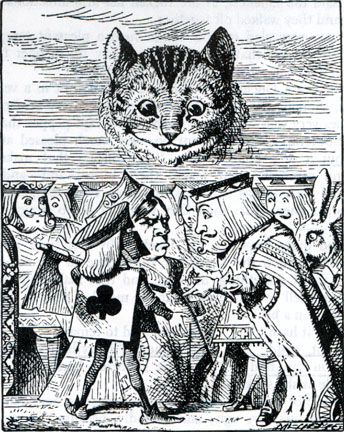
The Chesire Cat reappears above the cast of characters
Sir John Tenniel
1865
Wood-engraving by Dalziel
Illustration for the eighth chapter of Lewis Carroll's Alice in Wonderland
Student assistants from the University Scholars Program, National University of Singapore, scanned this image under the supervision of George P. Landow in 2000.
[You may use this image without prior permission for any scholarly or educational purpose as long as you (1) credit the site and (2) link your document to this URL in a web document or cite the Victorian Web in a print one. ]
Commentary by Leighton Carter
Even the rulers of Wonderland are unable to secure control of their subjects, as seen in the appearance of the Cheshire-Cat's head in Chapter VIII "The Queen's Croquet Ground." Alice greets the cat with considerable relief ("Now I shall have somebody to talk to," she states) since she cannot adequately cope with the croquet-players and their endless arguments. The pandemonium of croquet must indeed be considerable for Alice to consider such an unwieldy personage as the Cheshire-Cat a friend:
"Who are you talking to?" said the King, coming up to Alice, and looking at the Cat's head with great curiosity.
"It's a friend of mine — a Cheshire-Cat," said Alice: "allow me to introduce it."
"I don't like the look of it at all," said the King: "however, it may kiss my hand, if it likes."
"I'd rather not," the Cat remarked.
"Don't be impertinent," said the King, "and don't look at me like that!" He got behind Alice as he spoke.
"A cat may look at a king," said Alice. "I've read that in some book, but I don't remember where."
"Well, it must be removed," said the King very decidedly; and he called to the Queen, who was passing at the moment, "My dear! I wish you would have this cat removed!"
The Queen only had one way of settling all difficulties, great or small. "Off with his head!" she said without even looking around . . . [Carroll 68]
The King attempts to draw the Cheshire-Cat into the formalities of court behavior by asking it to kiss his hand. The Cat, in keeping with the anarchy in Wonderland, declines in a most informal way, especially since his facial expression maintains the sly smile. The Cat's smile, in fact, comes to represent him fully as evidenced by the pun on "look": the King does not like the look the Cat has on its face and therefore does not like the looks of it in general. The synecdoche of the smile is especially fitting for Wonderland, because Carroll can easily literalize it and bring it down from the figurative realm by causing the Cat to disappear, leaving only its smile behind. Alice again tries to use aboveground thinking to understand the relationship between cat and king: the proverbial statement "a cat may look at a king." Carroll reverses the implications of this statement, however: the proverb is traditionally meant to signify that a huge gulf in social stature, such as between a cat and king, makes the cat's looking inconsequential and inoffensive, but, in Wonderland, a cat can literally look at a king and talk to him as an equal (Oxford Dictionary of Proverbs). While the King is powerless to make the Cheshire-Cat stop looking at him, the Queen exerts her power in a dogmatic manner that solves nothing. Her constant solution of "Off with his head" only demonstrates that no higher authority can change the anarchy that engulfs Wonderland. [complete essay: ""Which way? Which way?": The Fantastical Inversions of Alice in Wonderland"]
Last modified 24 December 2007