
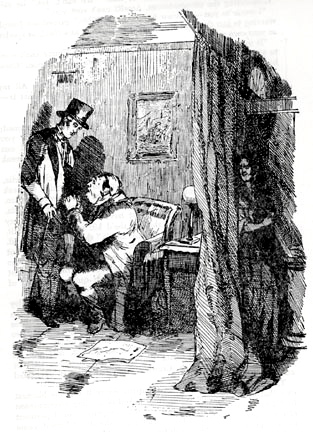
Becky's second appearance in the character of Clytemnestra
William Makepeace Thackeray
Wood engraving
c.1861
Illustration for Chapter 67, Thackeray's Vanity Fair
(Becky's second appearance as the seductive Clytemnestra does not appear as a theatrical piece as in the earlier chapter. Rather, she has became the character of Clytemnestra herself, seducing Jos and through clever manipulation, infirms him psychologically.)
Image scanned by Gerald Ajam and captions by Tiaw Kay Siang and Sabrina Lim.
[You may use this image without prior permission for any scholarly or educational purpose as long as you (1) credit the person who scanned the image and (2) link your document to this URL]
Commentary by Matthew Macguire, MA Candidate, Anglia Ruskin University in Cambridge (UK)
One of Thackeray's full page illustrations to Vanity Fair is peculiar in that it definitely carries narrative information additional to the textual narrative. In the final chapter of the novel there is an image entitled "Becky's second appearance in the character of Clytemnestra" (686). During this chapter Amelia becomes concerned when she hears news that Jos "had effected a heavy insurance upon his life" (685). She sends Dobbin to Brussels to "inquire into the state of [Jos'] affairs" (685). When Dobbin finds Jos living in fear of Becky, the text suggests that Becky may kill Jos. It is immediately clear that Becky has taken control of Jos' financial affairs. When Dobbin brings the matter up Jos responds: "Mrs Crawley — That is — I mean, — it is laid out to the best interest" (687). This makes Dobbin's next question almost rhetorical. When he asks "Why did you insure your life?" (687), Becky's apparent control over Jos' finances implies that she has instigated Jos' insurance venture. This chapter reveals that Jos, Dobbin and the solicitor all suspect Becky. Dobbin suggests that Jos' connection to Becky "might have the most fatal consequences" (687). In response to Dobbin's offer to take him away, Jos says that "they mustn't say anything to Mrs. Crawley: — she'd — she'd kill me if she knew it" (687). Jos does die three months later, and Becky receives the insurance money. The suspicion this has roused is stated by the solicitor of the Insurance Company who "swore it was the blackest case that had ever come before him" (687). Though Dobbin, Jos and the solicitor would have us believe that Becky is capable of murder, Gilmour explains that "in the text Becky's complicity in [Jos'] death remains a supposition. The illustration hardens it into an accusation" (56). He then asserts that
Becky's second appearance in the character of Clytemnestra shows a terrified Jos pleading with Dobbin, and Becky listening behind a curtain with what looks like a phial of poison in her hand. The analogy with Clytemnestra is underlined, and murder is added to the list of Becky's sins. [56]
This is a fairly accurate account of the illustrated scene, though the object in Becky's hand is better described as an ambiguous white protrusion. The assertion that it is a kind of poison can be supported by an observation Jos makes in Chapter LXIV. When Jos is appealing to Amelia to come and see Becky he mentions: "God bless my soul! Do you know that she tried to kill herself? She carries laudanum with her — I saw the bottle in her room" ( 658). In the absence of any other suggestion, it is fair to assume that the unknown object is a phial, possibly containing the laudanum Jos spoke of previously. It is also possible that this is a phial of medicine, which Becky has continued to administer to Jos since "She tended him through a series of unheard — of illnesses" (685). This is certainly plausible considering the fact that Jos is still in "a condition of pitiable infirmity" (685) and his "health is so delicate" (687). Whatever the object, Becky's crime is only truly confirmed by the reference to Clytemnestra in the illustration's title. Without it the image would not demonstrate Becky's guilt so definitely. The illustration itself only shows that Becky is hidden behind a curtain, holding an unknown object, whilst Jos is speaking with Dobbin. It is true that Becky's presence is only communicated by the illustration and not by the text; this extratextual information is unusual in Vanity Fair's larger illustrations. However the fact that Becky's presence goes unmentioned simply suggests that the fallible narrator does not know she is there. Though the image of Becky's eavesdropping does warrant heightened suspicion, it does not prove her guilt. Gilmour feels that "this is an unfortunate illustration, unnecessarily coarsening the character of Becky" (56). This is not entirely accurate. Michael Steig points to the interpretive importance of this caption, for the title — "Becky's second appearance in the character of Clytemnestra" — accuses Becky of murder, and not the image itself.
In the renowned etching for Vanity Fair, in which Becky Sharp appears in the caption and a small [3/4] allusive detail as Clytemnestra (i.e., a murderess), Thackeray's intentions can hardly be doubted. [. . . ] Thackeray surely intended this illustration as a hint (rather a heavy — handed one) about something never directly confirmed in the text. (Dickens and Browne: Illustration, Collaboration, and Iconography, 1)
Tellingly, Steig has also pointed at the reference to Clytemnestra before asserting that "Thackeray's intentions can hardly be doubted" (1). Both critics have felt it necessary to mention the caption before they can comfortably assert that the illustration accuses Becky. The text certainly does not provide any solid evidence against Becky, only the suspicions of others. The illustration is also suspicious, because Becky goes unmentioned in the narrative, but the identity of the object in Becky's hand is uncertain at best. Additionally, Jos does not die until "Three months afterwards [ . . . ] at Aix — La — Chapelle" (687). Chronologically, the relevance of the object in Becky's hand is rather diminished by this fact. If it is the murder weapon, why would Becky risk arousing suspicion by carrying it around three months before the murder? Why would she choose to do so during Dobbin's visit? It is established then, that both the narrative and the illustration do leave room for the reader to doubt Becky's guilt. The caption is in fact the "heavy — handed" element. The parallel which it draws between Becky and Clytemnestra cannot be attributed to the fallible created narrator because it is not part of the narrative. It is an anomalous piece of text, which sits below the image and restricts its potential for interpretation. The caption may be clumsy but it is necessary, due to the lack of evidence against Becky, in order to clarify Thackeray's intention.
References
Gilmour, Robin. Thackeray: Vanity Fair. London: Edward Arnould, 1982.
Steig, Michael. "Dickens and Browne: Illustration, Collaboration, and Iconography." The Victorian Web. Ed. George P. Landow. Viewed 8 February 2008.
Thackary, William Makepeace. Vanity Fair. New York: Norton, First Edition, 1994.
last modified 10 May 2000