
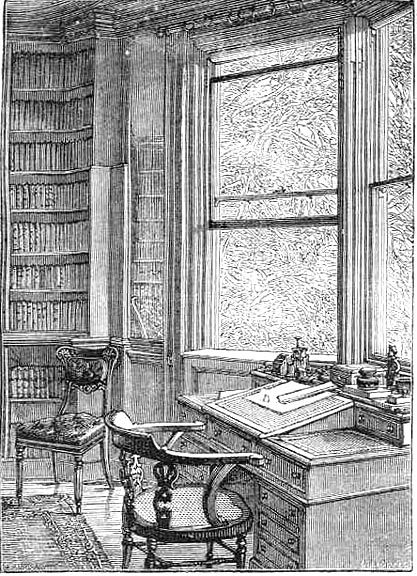
The Chalet at Gadshill
Rochester, Kent
Source: Forster, 1872: II, 153; 1879, 332.
Other views of Gadshill


Scanned image and text by Philip V. Allingham.
[This image may be used without prior permission for any scholarly or educational purpose.]

Commentary by Philip V. Allingham
The Swiss Chalet:
In 1864, Charles collected a special gift a Higham Station. A friend sent him a miniature Swiss Chalet which he had erected in a part of his garden known as The Wilderness at Gads Hill. To avoid the busy and muddy road he had to cross to reach it, near The Falstaff public house, Dickens constructed a tunnel to go underneath the road. This tunnel still exists, so does the chalet but it is now situated in the grounds of the Dickens Museum at Eastgate House along Rochester High Street. It was in the chalet that Dickens was writing the last chapters of Edwin Drood the day before he died. [www.thevoid.plus.com]
The back garden of Eastgate House is somewhat changed from its presentation in the novel in two respects: first, the hedges and bench shown by Fildes have been replaced by ponds and water gardens; second, for the time being at least, Swiss actor Charles Fechter's splendid Christmas 1864 gift to Charles Dickens, the Swiss Chalet in which the author loved to write in the "wilderness" (across the road and through a tunnel from Gad's Hill), is now located here. Originally Dickens seems to have felt that he and his "bachelor guests" (Marcus Stone in particular) could unpack and assemble the kit themselves, but it proved too complicated (the instructions were all in French), so that Fechter had to summon M. Godin, the stage carpenter from London's Lyceum Theatre, to assist in the assembly of the two-storey edifice. As Peter Ackroyd in his biography of Dickens notes:
Dickens arranged for it to be erected on that piece of ground belonging to him on the opposite side of the Rochester High Road; there the chalet was shaded by the cedars and stood in a place from which Dickens could see the fields of corn beneath him and, in the distance, the Thames with its yachts and steamboats. . . . . And the chalet itself was like a fantasy of boyhood, this secret place among the trees. It became his place of work in the spring and summer, an alternative to his study in the house, one which was even brighter and lighter. He had a telescope placed there so that he might observe the world around and above him but, more importantly, he had mirrors fastened along the walls so that the whole interior sparkled and shone with sunlight even as he wrote at his desk." [955-56]
Dickens so arranged the building that the second floor afforded him a view of the Thames, whose shipping he sometimes inspected with the aid of a telescope that he had placed in his study.
Belonging to the house, but unfortunately placed on the other side of the high road, was a shrubbery, well wooded though in desolate condition, in which stood two magnificent cedars; and having obtained, in 1859, the consent of the local authorities for the necessary underground work, Dickens constructed a passage beneath the road from his front lawn; and in the shrubbery thus rendered accessible, and which he then laid out very rettily, he placed afterwards a Swiss châlet presented to him by Mr. Fechter, which arrived from Paris in ninety-four pieces fitting like the joints of a puzzle, but which proved to be somewhat costly in setting on its legs by means of a foundation brickwork. "It will really be a very pretty thing," he wrote (January 1865), "and in the summer (supposing it not to be blown away in the spring), the upper room will make a charming study. It is much higher than we supposed." Once up, it did really become a great resource in the summer months, and much of Dickens's work was done there. [Forster, II, 151-52; 1879, 331]
In the 1960s, the Swiss Chalet which actor Charles Fechter sent to Charles Dickens for his waterside property at Gad's Hill was moved to the back of Eastgate House.
Conclusion
The last day in the Chalet: Dickens's last few days at Gads Hill were entirely given over to the writing of The Mystery of Edwin Drood, during which time he began to look unusually fatigued. On the 8th he spent the entire day in the Chalet, except to have lunch in the main building. Dickens suffered what proved to be a fatal attack after leaving here for the main house on the afternoon of 9 June 1870. At ten minutes past six in the late afternoon, expiring on the sofa, he cried, "On the ground." These were the last words he uttered.
Bibliography
Forster, John. The Life of Charles Dickens. The "Charles Dickens Edition." 2 vols. London: Chapman and Hall, [1872].
Forster, John. The Life of Charles Dickens. Book VII. — Public Reader. Chapter III. "Gadshill Place." The Household Edition. 22 vols. London: Chapman and Hall, 1879. Vol. XXII, pp. 328-335.
Scenes and characters from the works of Charles Dickens; being eight hundred and sixty-six drawings, by Fred Barnard, Hablot Knight Browne (Phiz); J. Mahoney; Charles Green; A. B. Frost; Gordon Thomson; J. McL. Ralston; H. French; E. G. Dalziel; F. A. Fraser, and Sir Luke Fildes; printed from the original woodblocks engraved for "The Household Edition." London: Chapman and Hall, 1908.
Victorian
Web
Authors
Charles
Dickens
Gallery
Next
Created 19 July 2007
Last updated 5 January 2025