
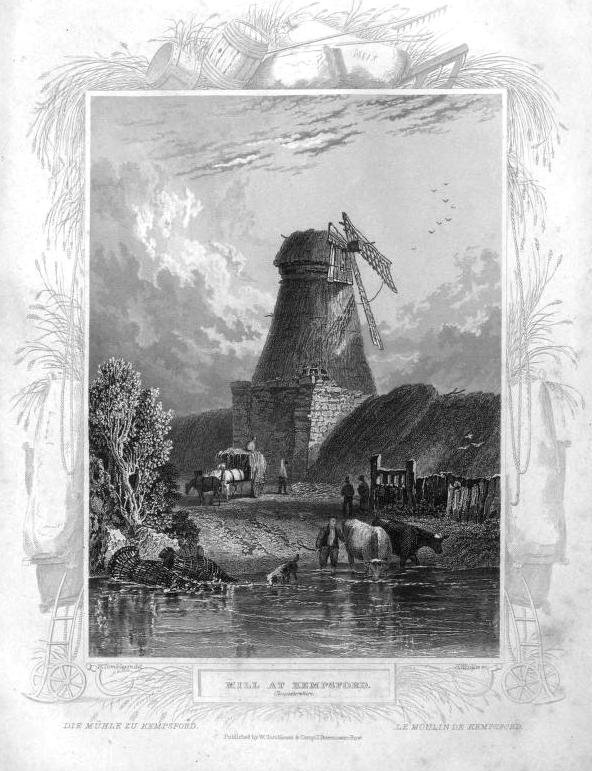
Mill at Kempsford, Berkshire
Artist: W. Tombleson
Engraver: H. Winkles
Steel engraving.
Source Eighty Picturesque Views of the Thames and Medway
[Image with decorative border]
See commentary below
Other Windmills along the Thames
Text and formatting by George P. Landow
[You may use this image without prior permission for any scholarly or educational purpose as long as you (1) credit the University of California Library and the Internet Archive and (2) link your document to this URL in a web document or cite it in a print one.]
Commentary by W. G. Fearnside
The river, which has now widened to the extent of fifty or sixty feet, sweeps boldly to the left, through the meadows; and then, bending towards the right, flows, within a short distance, parallel to the canal, for two miles, until it arrives at Kempsford. Before reaching this village the river regains its native county of Gloucester, and continues for a few miles, between the two shires of Wilts and Gloucester. The pasturage that borders the Isis, during its course through North Wilts, is exceedingly rich, and has given rise to the adage, "That an ox left to himself, would, of all England, choose to live in the north of Wiltshire." The meadows of Gloucestershire, which here nearly unite and assimilate with those of Wiltshire, are equally exuberant in dairy produce. By the earlier chronicles, the county is reported to have been as fruitful as the land of Gerar, wherein Isaac sowed and reaped an hundredfold; and "the pasturage so rich, that, in spring time, let it be bit bare to the roots, a wand laid along therein, over night, would be covered with new grown grasse by the next morning." This part of the country was also formerly thought, from its fecundity, to be more favoured by God's presence than any other; it had, likewise, more mitred abbeys and sacred edifices than any other two shires, whence arose the ancient proverb of, " As sure as God's in Gloucestershire."
The village of Kempsford, in Gloucestershire, contains 800 inhabitants. The church, which is dedicated to St. Mary, consists of a nave, with a lofty and handsome square gothic tower, and is prettily situated on a slight acclivity, near the margin of the river, presenting a commanding and interesting object to the neighbouring country. It was erected partly at the expense of Henry Duke of Lancaster, in the fourteenth century, whose arms, with those of Edward the Confessor, and the cognizance of the houses of Clare and Plantagenet, are displayed upon the capitals of the columns which support the roof. The name of the place was anciently written Chenemeresford, Chene or Kyn, signifying, in a compound word, great or principal, — Mer denoting a sea or large water, and Mere also a boundary. The name, therefore, implies the ford of the principal river or great boundary, which the Isis may be justly denominated in this part of the country. The manor was, in the reign of Edward the Confessor, the property of Earl Harold, but was afterwards granted by the Conqueror to Hernulf de Heseling, a Norman soldier, who had accompanied him to England. After some years it came, by marriage into the possession of Henry Earl of Lancaster; and his son, Henry Duke of Lancaster, occupied here an extensive mansion, "whose walls were washed by Isis' purhng stream." Owing, however, to the unfortunate death of his only son, which took place at Kempsford, he quitted the village, and granted the property, in 1355, to the college of St. Mary the Great, at Leicester. On his departure, his horse cast a shoe, which the peasantry nailed over the church door as a memorial of the event, where it now remains. The manor ultimately devolved to the Coleraine family, by whose orders the mansion was levelled with the ground, towards the close of the last century, and the materials purchased by Mr. Loveden, of Burscott Park, near Lechlade, who used them in the structure of the present elegant house belonging to that family. The outer walls, by the side of the river, as well as the entrance porch and gateway, are yet standing, and also the stabling and out-houses, which are used for farming purposes and a dwelling. The mansion, or palace, was a quadrangular building of considerable dimensions, in the style of the ornamented architecture prevalent in the thirteenth and fourteenth centuries. Near the river is a picturesque mill, in a dilapidated state, and forms the subject of the accompanying engraving. It was erected by the farmer, who resides on the premises, for his private use.
Bigland observes, there is a well founded tradition that Kempsford was the site of a royal palace in the Saxon times, and that the Chaworths and Plantagenets resided here in their castle. The vicinity, also, by some authors, is supposed to have been the place where a battle was fought, about the year 800, between Ethulmund, chief of the Wiccii, or inhabitants of Gloucestershire, and Werstan, Earl of Wiltshire; Ethulmund is reported to have crossed the river at this ford. Rudder, however, with more probability, thinks that this hostile meeting took place at Cummersford, near Calne, where large entrenchments still remain. Both Generals were killed, but the men of Gloucestershire were victorious. The river Coin passes through part of the village. [19-20; bold emphasis added, italics in original]
References
Fearnside, W. G. Eighty Picturesque Views of the Thames and Medway, Engraved on Steel by the First Artists. London: Black and Armstrong, [n.d. after 1837]. Internet Archive version of a copy in the University of California at Berkley Library. Web. 30 March 2012.
Last modified 6 May 2012
