

Plan of the Palace in 1864. Registered park boundary shown in red. Courtesy Bodleain Library University of Oxford [ref 17:70 (316); Click on thumbnail for larger image.]
Unfolding Drama
There is a living, if unfortunate, drama unfolding with links to our Victorian past. The splendid "Crystal Palace", which housed the Great Exhibition of 1851 in Hyde Park in the centre of London, was one of the most remarkable constructions of the Victorian era. It can be considered as the culmination of the early development of metal construction and was one of the two largest places of entertainment in London, the other being Alexandra Palace built in 1873. After the 1851 exhibition, the entire building was dismantled and moved to a new permanent site on parkland at Sydenham in the south London suburbs. The area became known as Crystal Palace. The destruction of the building by fire in 1936 left a void in the park which has never been filled. Sixty years on, the site is now under threat by the local council of Bromley within whose borders it lies. Bromley is proposing a wholly inappropriate development for the site a 20-screen cinema multiplex with restaurants, bars and rooftop parking for a thousand cars, housed in a building which has been described by a local newspaper as having the appearance of an aircraft terminal.
The Crystal Palace Campaign has been formed by local residents and businesses, angered by the monstrous edifice which Bromley wishes to impose on the landscape and the complete disregard for the site's history. There is virtually no local support for the development. The plans are being fought in the High Court in London where the Crystal Palace Campaign has already been given leave to seek judicial review of Bromley's outline planning permission. The legal objection turns on the question of style. The Crystal Palace Act of 1990 stated that any building on the Park site should be "in the style and spirit of the former Crystal Palace".
To find out more about the issues and the campaign go to the official website for the Crystal Palace Campaign.
A Happy Postscript (19 May 2006)
The above note refers to a time when the threat to our historic park was real and imminent. Today's prognosis looks much brighter. The multiplex was cancelled. It was one of the most significant victories for people-power in recent memory. The Crystal Palace Campaign, with help from other local groups, had defeated a powerful organisation backed by the local council.
It was not a victory about which we wished to get too euphoric for there was always a chance another developer would come along with another inappropriate scheme - what could we do to prevent that happening? Two things mainly: to try and promote a dialogue between the interested parties and to conduct a detailed survey of local opinion, the first since the Palace moved to Sydenham Hill in 1854. The latter confirmed quantitatively the views promoted by the Campaign and also pointed the way to the future with a good idea of what the public wanted or, in some cases, did not want. The dialogue is ongoing and about to bear fruit.
The confluence of a number of streams of activity now seem to be on the brink of delivering about £100 million of improvements to Crystal Palace Park. More than that, the ideas have developed in full consultation with local people and various authorities. In the coming years a large proportion of the money will be spent on providing a brand new sports facility which will probably host one of the Olympic countries participating in the games of 2012. There will also be improvements all round the park especially at the gate-ways. Further, it may be possible, although it is a long way from being resolved, to retain the old National Sports Centre (NSC), since it is a Grade II listed building and considered an important example of 20th-century architecture.
Exciting times, but what is left of the Victorian Heritage? We have an 81 hectare park (200 acres) which has retained the basic Paxton shape. It will have a restored central axis which he placed so positively to link the higher terraces with the lower parts of the park. The sphinxes are still present but almost none of the statuary. The dinosaurs, of course, stand proud in the greenery in and around the lakes. Much of the central part of the park, now part of the NSC, will be made accessible once again. In short the legacy left to us by the Victorians will get a new lease of life, will help regenerate the area and will play its part in lifting the spirit of London.
The Future of Crystal Palace Park (31 December 2008)
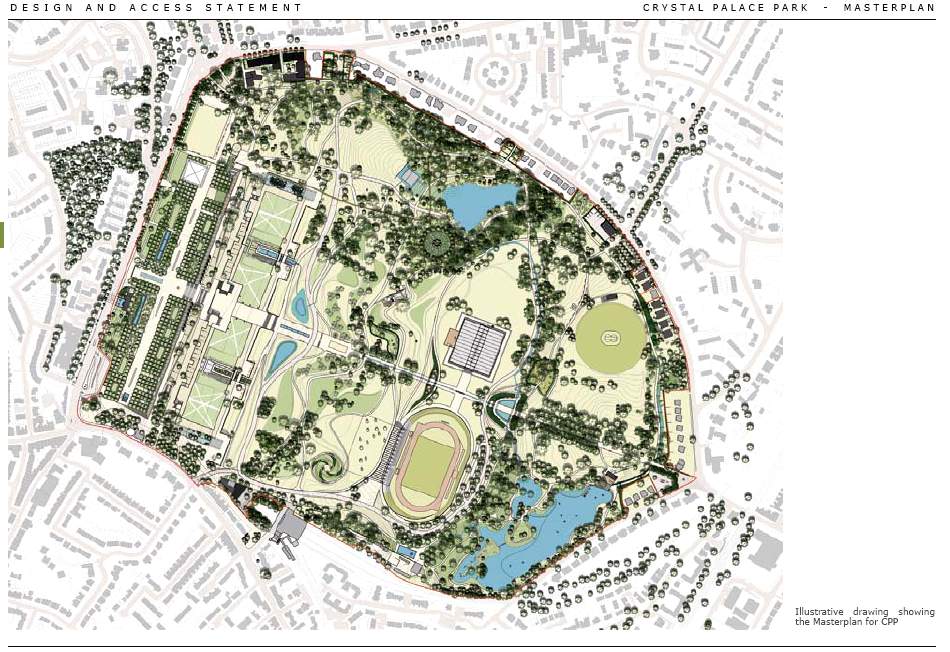
The dialogue process led to the appointment of a Master Planner for the Park, Latz and Partner of Munich. The Master Plan was completed in late 2007. The official web site (see above), has the important Master Plan documents and plans, was submitted to the planning authority Bromley Council (who are also the park's owners) in November 2007.
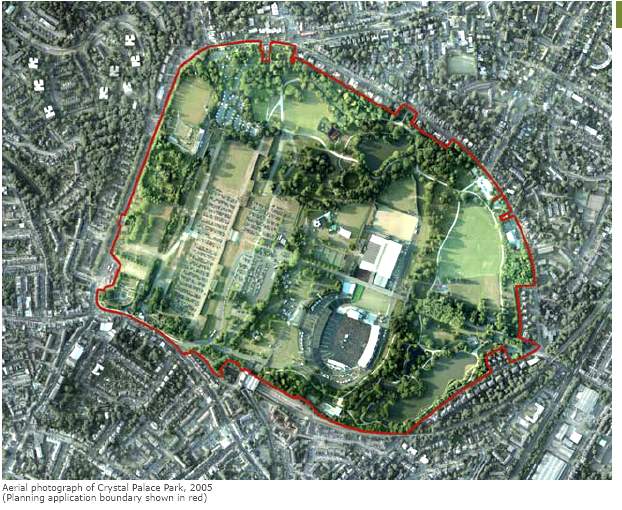
Left: Aerial Photograph of Crystal Palace Park, 2005.. Right: Planning application boundary shown in red. [Click on images to enlarge them.]
Left: . Right: Illustration showing master plan for Crystal Palace Park. [Click on thumbnails for larger images.]
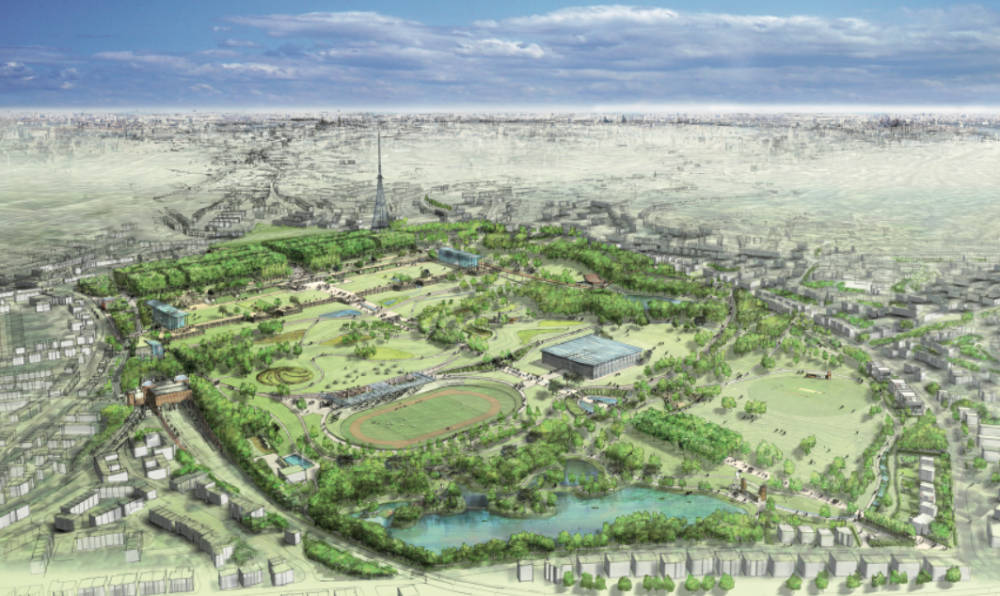
Artist's rendering of planned improvements.
Bromley Council's Planning Development Committee met on 9 December 2008 and voted to approve the Application for Outline Planning Permission for the Master Plan for Crystal Palace Park. This is a big step forward for the regeneration of the park (and the area); the plan is the most comprehensive scheme for the park since the Crystal Palace was moved to Sydenham Hill in 1854. The Master Plan is large and complex, and clearly doesn't satisfy everyone. It is therefore bound to involve some controversy. Therefore, in some ways, acceptance was a brave step for Bromley; but they recognised that a start had to be made after so many decades of neglect and that there was time to resolve some remaining problems. So now, the real work starts: how does the Master Plan get implemented? And where will the money be found; somewhere between £41 and £67 million (currently $60-$97 million).
A very important part of the 'how' question is the issue of park governance. What will be the constitution of the organisation seeking the finance needed to deliver the Master Plan? Bromley are the current owners of the park but the LDA (London Development Agency) have an option, until March 2009, to take over the ownership the option could be extended if a decision isn't made by that time. The most achievable arrangement is probably that of joint ownership by the neighbouring boroughs Bromley, Lambeth, Croydon, Southwark and Lewisham in conjunction with the LDA; and there needs also to be a place for the voice of the community.
In spite of the current dire economic climate [in 2007], the future for the park looks bright.
Notes 2017
The above notes were written at a time when it was believed that the direction of the regeneration of Crystal Palace Park was set fair. Thus the rhetoric reflected the battle lines drawn up between the Local Council (London Borough of Bromley) and local residents. Much has happened since then some within the expectations of local people and some events out-of-the-blue but not wholly surprising. In spite of the ups and downs, the net effect is that the future still looks good even if a bit further away.
Crises are certainly not new to the park - when the Crystal Palace Company went bankrupt in 1911, the whole park was due to be sold at public auction by Knight, Frank and Rutley. If that had taken place we would have had ranks of terraced houses instead of a great, life-enhancing breathing space for south London.
Park Ownership. Bromley Council are the owners of the park (still) but the LDA was disbanded by the Greater London Authority (GLA) when the London Mayor changed in 2008 from Ken Livingstone (Labour Party) to Boris Johnson (Tory). Further, any thoughts that a sort of joint ownership by the surrounding councils is not realistic. However, the emergence of the notion of a trust, in some form or other, seems to offer some promise (see below).
The Master Plan. legal challenges were finally dismissed in the UK Court of Appeal in April 2013 effectively supporting the legality of the whole Master Plan document. This included the permission to build 180 residential housing units within the park boundaries. Permission was given for the build on 0.81 hectares (2 acres) of a 2.4 hectares (6 acres) caravan site - the remaining 1.6 hectares (4 acres) would revert to park-land and the caravan site would move. This land is positioned on the north-most perimeter of the park and has not been accessible to the public but significant amounts of money would be generated to help the regeneration of the whole park. Compare these arras to the whole park area of 81 hectares - around 1%.
The Chinese Bid. a company called ZhongRong offered (2014) a large sum of money (£500 million) with which they claimed to want to rebuild the Crystal Palace and regenerate the park i.e. fulfill the Master Plan. A tempting offer which Bromley Council were obliged to take seriously - the story of the delays to the regeneration project and Zhong Rong’s final pullout of the whole deal are best dealt with at another time. Suffice to say, two years went by when not much happened in the park.
The Trust. A group called the Community Stakeholder Group (CSG) was set up principally to investigate governance of the park with a long term perspective. Ultimately a Shadow Board was appointed to work with the council to develop plans for the final trust format. The CSG was dissolved and the work towards a trust being set up to administer the whole park, separate from Bromley Council, is proceeding to a conclusion expected within a couple of years.
The details of regeneration, based on the Master Plan, and what the time line might be are still to be confirmed but we haven't seen any real surprises (like the ZhongRong bid) to suggest that disaster for the park is at hand! Possibly, the next note will reflect the beginnings of the above governance progress.
Last modified 2 January 2009