
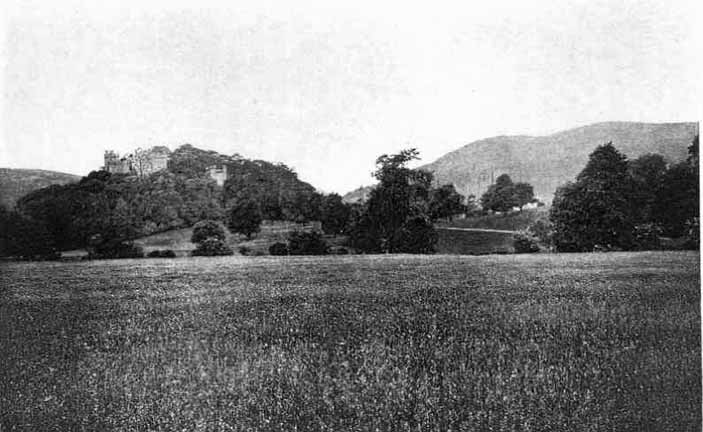
Dunster Castle — supposedly the original of Stancy Castle, Markton, in Hardy's A Laodicean. Source of photograph: Anniversary Edition of the Wessex Novels, 1920, facing XIII, 416. Scanned image (2002) by Philip V. Allingham; text by Allingham and George P. Landow. [You may use this image without prior permission for any scholarly or educational purpose as long as you (1) credit the person who scanned the image and (2) link your document to this URL.]
According to the editors, many of whose remarks seem based on Thomas Hardy's Wessex (1913) by Herman Lea,
Stancy Castle, another view of which is shown in the frontispiece, was evidently suggested by Dunster Castle. The name Dunster prepares us to some extent for the situation of the castle. "Tor" means tower; "dun" means hill; and hence we are not surprised to find an almost precipitous hill clothed with grand old trees, from which the richly coloured stone towers and parapets arise against the skyline. When Edward the Confessor was King, Dunster Castle was held by Aluric, but William the Conqueror made it over to William de Mohun. During the Parliamentary wars its politics changed rapidly; first it declared for the Parliament, afterwards for King Charles; then it was beseiged for several months by Cromwell's forces, to whom it finally surrendered. In 1376 it was purchased by the ancestors of the present owner.

Bibliography
Hardy, Thomas. A Laodicean, A Story of To-day. "Anniversary Edition of the Wessex Novels." Vol 13. New York & London: Harper & Brothers, 1920. This edition derives in part from previous editions and the photographs of 1912.
Last modified 19 April 2024