
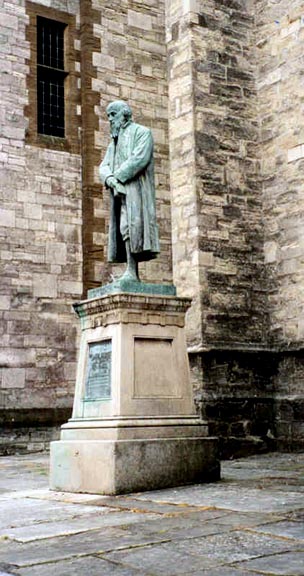
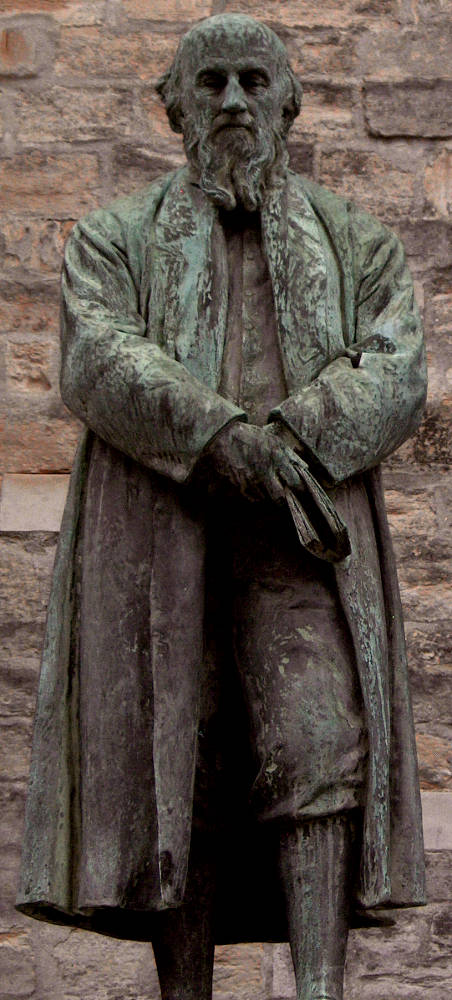
William Barnes (1801-1886). Bronze. St. Peter's. Church, Dorchester. Installed February 1889.
Although William Barnes was born in the Blackmoor Vale at Rushay, near Sturminster Newton in North Dorset on 22 February 1801, and educated in the vicinity, he is often associated with the town of Dorchester because, after his 1848 graduation from Cambridge as a Bachelor of Divinity and his ordination as a minister in the Church of England, Barnes served at nearby Whitcombe as curate and then rector of Winterbourne Came in 1862. A gifted schoolmaster (he was virtually a polymath interested in mathematics, astronomy, natural sciences, and geography) and brilliant student of languages, Barnes tutored young Thomas Hardy, for whom Barnes's scholarship and dialectal verse served as personal models.
A considerable poet, Barnes published numerous volumes of verse, including Poems of Rural Life in the Dorset Dialect (1844), Hwomely Rhymes (1857), and Poems of Rural Life in Common English (1868). A great believer in the power of the language of his native county, which he held to be a purer form of English because of its close relationship to the Wessex dialect of Anglo-Saxon England, Barnes developed the Dorset Dialectal Dictionary, which remains a classic reference work; he also published over two hundred engravings based on natural scenes from Dorsetshire. A one-man musical based on his life and writings was staged in the Dorchester Corn Exchange during the Hardy 2002 Conference in July. His most famous lyric is probably "Linden Lea."

Photograph (2002) by Charlotte Pabst-Kastner, Köln, Germany. Text by Philip V. Allingham. [You may use this image without prior permission for any scholarly or educational purpose as long as you (1) credit the photographer and (2) link your document to this URL in a web document or cite the Victorian Web in a print one.]
Related Web Resources
Last modified 19 April 2024