
Photographs by Ramnath Subbaraman, Robert Freidus, and Simon Stock. Formatting, perspective correction, and scanned image (linked below) by George P. Landow. [You may use these images without prior permission for any scholarly or educational purpose as long as you (1) credit the person who scanned the image and (2) link your document to this URL.]
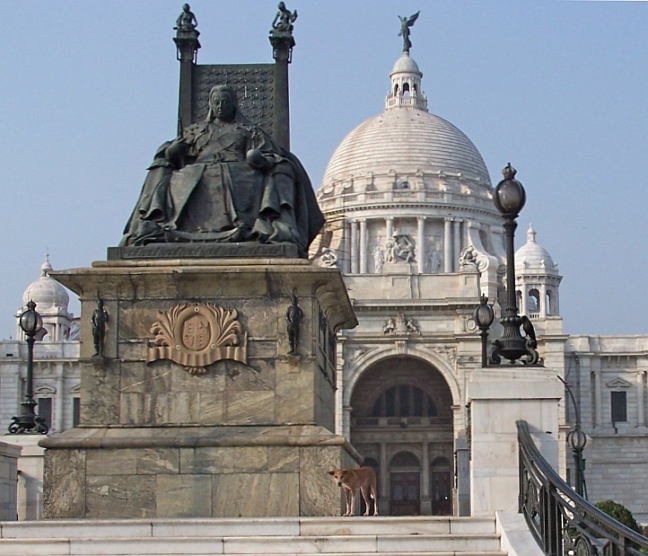
Jubilee Monument for Queen Victoria in front of the Victoria Memorial Hall, Calcutta, by Sir George Frampton, R.A., P.R.B.S. (1860-1928). 1897-1901. Bronze. Unveiled in Calcutta: 19 March, 1901 on Red Road near Government House and moved in front of the Victoria Memorial in 1921. Exhibited at the Glasgow International Exhibition, 1901 [Photograph].
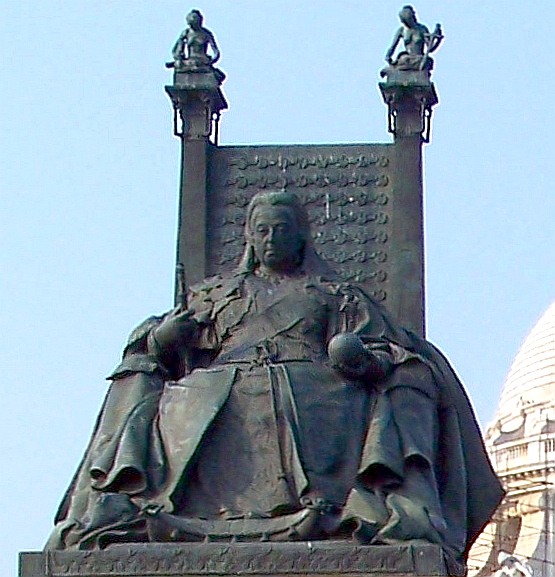
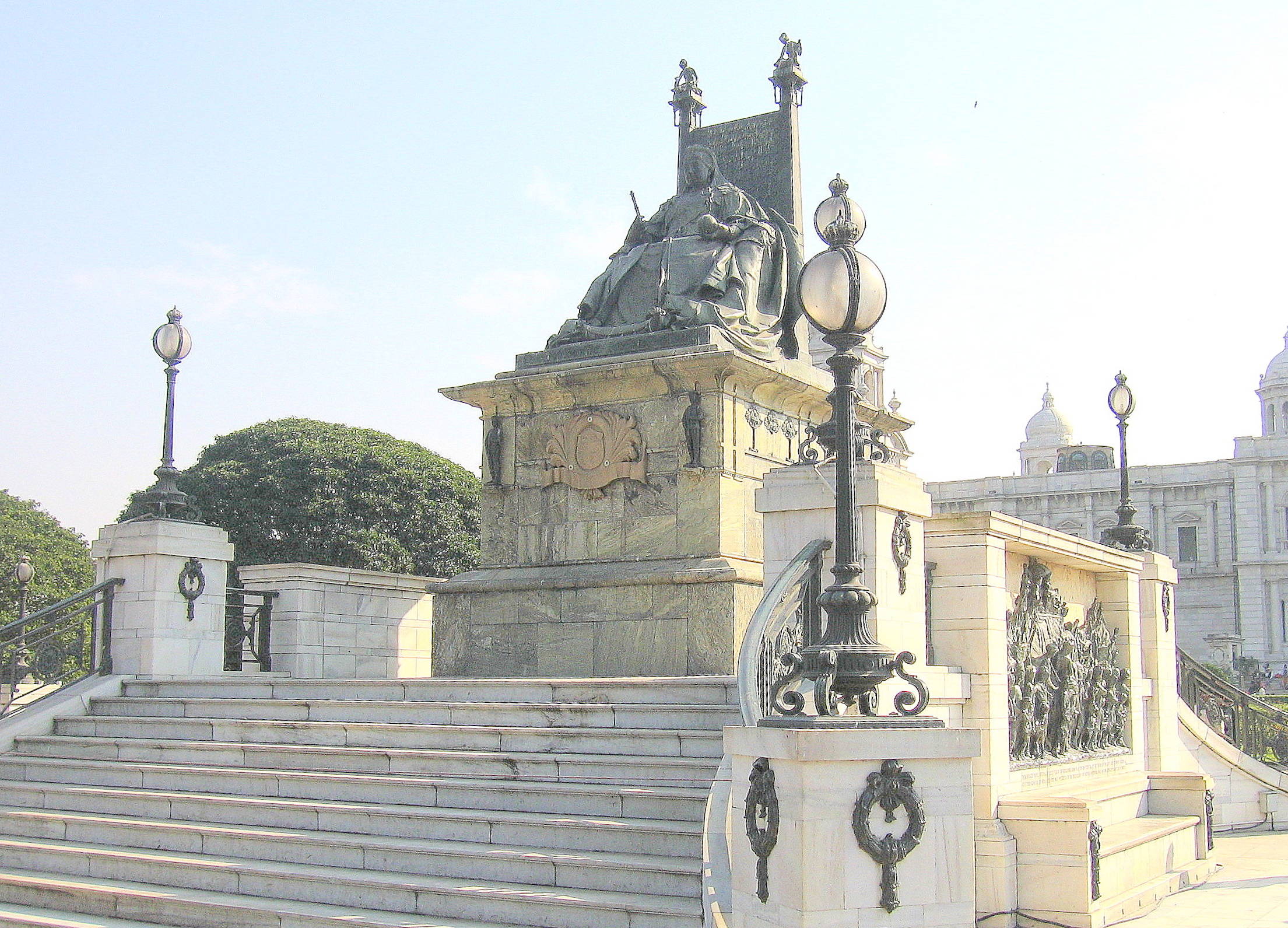
Left: Frontal view. Right: Three-quarter view showing entire monument in its setting. [Click on these images and those below for larger pictures.
In the course of praising Frampton's sculpture, the 1898 issue of The Studio, provides information about its size and symbolism:
The figure, which is some two and a half times larger than life, stands with its pedestal twenty-seven feet high. Certain details of the material employed may be worth setting down. The figure itself is to be of light bronze, the sceptre of ivory with gold ornaments, the orb of blue lapis-lazuli, surmounted” by a golden figure of St. George; the crown and wreath will also be in gold, and the cushion behind the figure enamelled, probably in pale blue and white. The robes are those pertaining to the Order of the Star of India which her Majesty wore when she assumed the title of Empress. The lion and tiger side” by side on the back of the statue typify respectively the British Kingdom and the Indian Empire. Two figures at the top represent Art and Literature and Justice. The capitals which support them are carved to represent English oak leaves, and a typical Indian tree, which is a sacred symbol of the Indian religion. Roses ornament the throne behind the head of the Queen. The base, which will be of richly coloured marble, will bear the Royal arms in enamel, supported” by bronze figures of two Indians. It is fortunate that a work of art, at once novel in treatment and remarkably stately in its conception, should represent the flourishing condition in our Indian empire but it is impossible to avoid feeling a slightly jealous regret that so fine a work should leave the country.

The polychromy provided by the “the orb of blue lapis-lazuli” and “golden figure of St. George” does not appear in the photographs, so that assuming the gold leaf did not wear away, the final work probably replaced these elements and the cushion behind the Queen “enamelled, probably in pale blue and white,” with bronze. The marble also does not appear to be “richly coloured marble.”


Left: A view from below of St. George standing on the imperial orb, the head of Victoria, and two allegorical figures above. Right: Side view with Goscombe John's bas relief. (the other side also has one.)


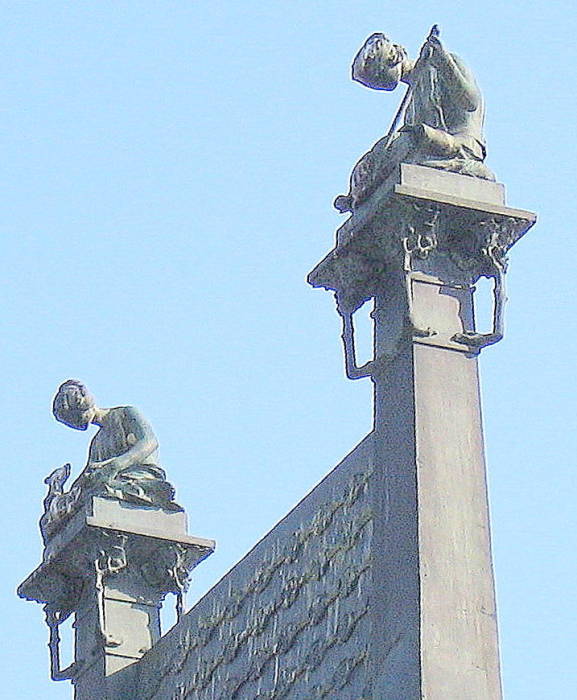
Left: St. George standing on the imperial orb.. Right two: Art and Literature and Justice [?]. It is not clear if the figures in the final version of the memorial are as The Studio described. The closer figure of a seated woman appears to be either spinning closth or playing an instrument. The other woman sits with a dog next to here.
Other views of the statue of Queen Victoria
- Queen Victoria
- Front and rear views of the monument in the 1898 Studio
- Bas relief panel” by Goscombe John originally intended for statue of Lord Minto (I)
- Bas relief panel” by Goscombe John originally intended for statue of Lord Minto (II)
Photographs of the adjacent Victoria Memorial Hall
- The Victoria Memorial Hall designed by Emerson
- Bas relief panel on plinth” by the steps of the Hall,” by Goscombe John (Indian soldiers with musical instruments and women in saris.
- Bas relief panel on plinth” by the steps of the Hall.” by Goscombe John (Sikh troops marching through an archway)
Bibliography
Beattie, Susan. The New Sculpture. New Haven: Yale University Press, 1983.
Steggles, Mary Ann. Statues of the Raj. Putney, London: BACSA [British Association for Cemeteries in South Asia], 2000.
Studio 14 (July 1898): 120, 122.
Last modified 18 January 2013