
Part 4 of Benedict Read's Introduction to Gibson to Gilbert: British Sculpture 1840-1914, the catalogue of the 1992 exhibition at the The Fine Art Society, London. The Fine Art Society has most generously given its permission to use information, images, and text from its catalogues in the Victorian Web. This generosity has led to the creation of hundreds and hundreds of the site's most valuable documents on painting, drawing, sculpture, furniture, textiles, ceramics, glass, metalwork, and the people who created them. The copyright on text and images from their catalogues remains, of course, with the Fine Art Society. [GPL]
A revolution in the decorative function of sculpture was another of the movement's principal properties. Thornycroft, Frampton, and Pomeroy were leading participants in the move to raise the level of architectural sculpture from hackwork to fully integrated craft, often in close association with architect members of the Art Workers' Guild and the Arts and Crafts movement.


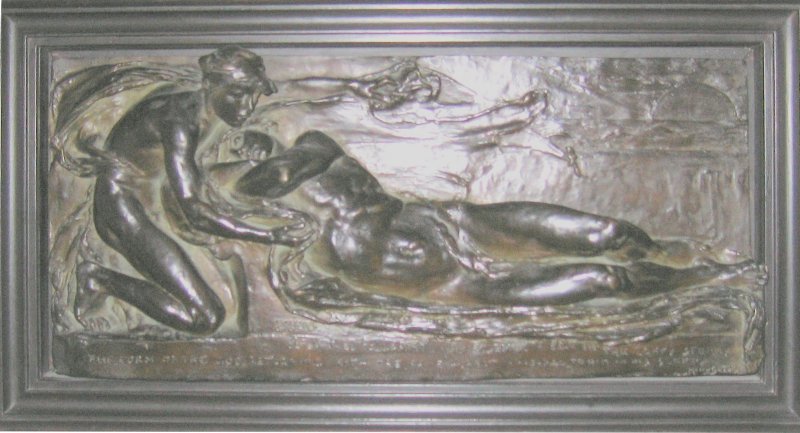
Bates's Æneid triptych — left to right: (a) Whither does he fly. (b) Then Indeed Æneas Wept and (c) The Form of the Gods. [Click on these images for larger pictures.]
Harry Bates in particular specialised in independent relief panels that could be set in buildings, as his Aeneid triptych of 1884 has been in Glasgow Art gallery. Again the integration of sculpture into the domestic interior was a rallying cry, Gosse wrote an article on "The Place of Sculpture in Daily Life" in the Magazine of Art in 1985, whole Spielmann organized an exhibition of Sculpture for the Home at The Fine Art Society in London in 1902. What was envisaged was not a collection of life size marbles or bronzes for which most art lovers (even) would have neither the money nor adequate premises. The perfect solution lay in the series of edited bronze statuettes that the sculptors were determined to circulate.


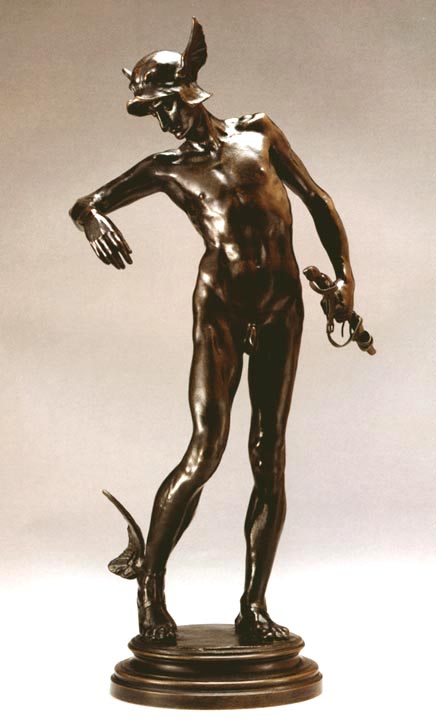
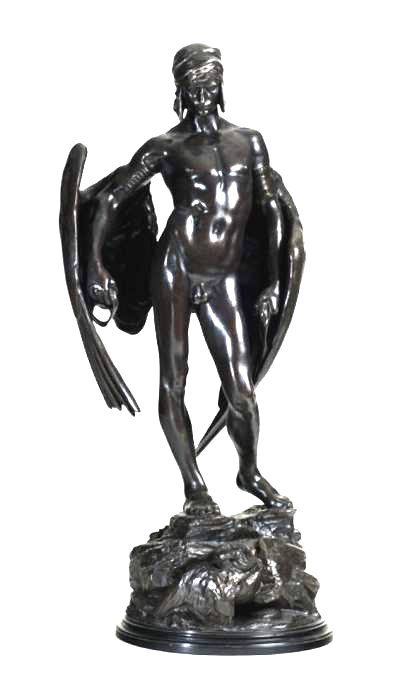
Four works by Gilbert — from left to right: (a) The Kiss of Victory (b) Comedy and Tragedy, (c) Perseus Arming, and (c) Icarus. [Click on these images for larger pictures.]
Gilbert produced reduced-size editions of his Kiss of Victory (1882), Perseus Arming (1882), Icarus (1884), and Comedy and Tragedy (1892)
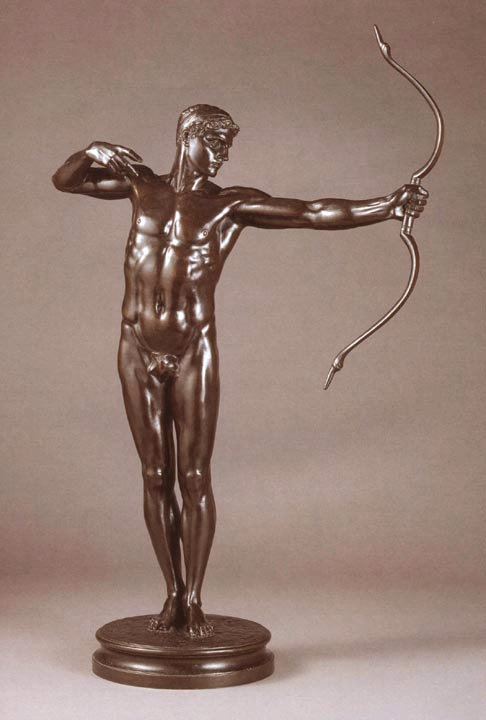
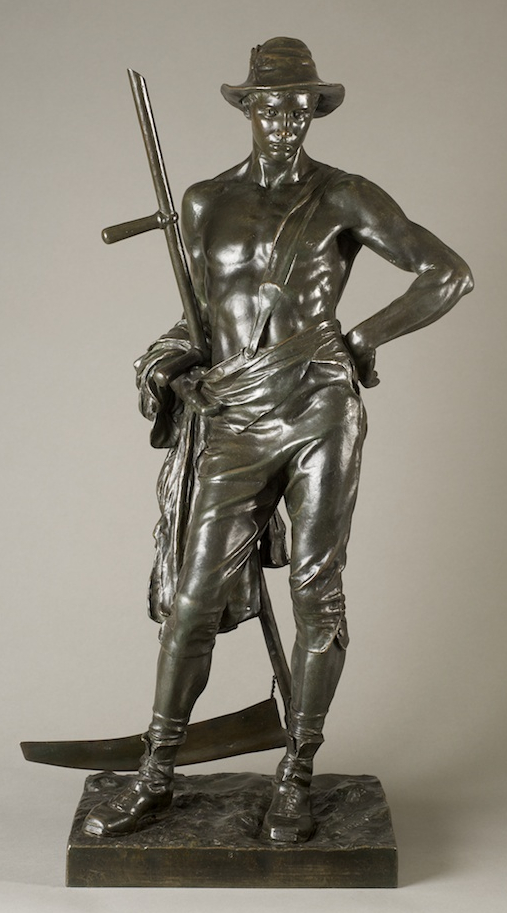


Four works by Thornycroft — from left to right: (a) Teucer (b) The Mower, and (c) General Gordon, and (d) The Bather. [Click on these images for larger pictures.]
Thornycroft [produced-reduced size editions] of his Teucer (1882), Mower (1884), General Gordon (1888), John Bright (1891) and the Bather (1898), Pomeroy of his Perseus (1898) and Mackennal of his Circe (1893), to mention only a sample. The sculptors would often personally supervise the editing and casting, both Gilbert and Thornycroft being known to treat each example as an individual object, retrieving it from the professional founder for their own attention to chasing and patination. It was also possible for the artist to hand over the entire transaction of production and marketing to a firm like Collie -- this certainly happened with the reductions of Leighton's Athlete Wrestling with a Python and some of Thornycroft's works.

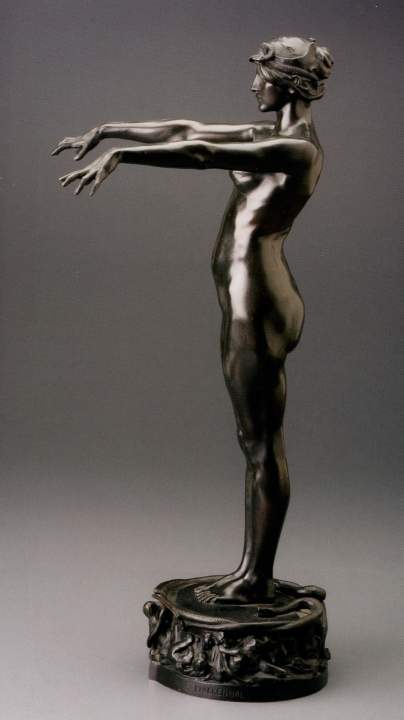
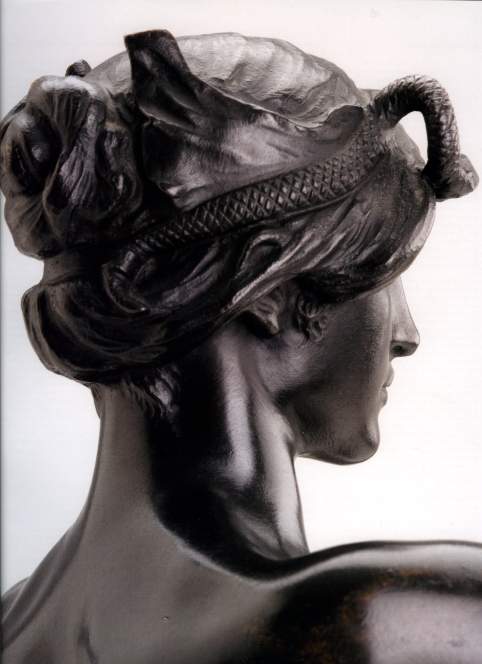

From left to right: (a) Pomeroy's Teucer (b) and (c) Mackennal's Circe, and (c) Leighton's Athlete Wrestling with Python. [Click on these images for larger pictures.]

- The New Sculpture and the Old Sculpture in Victorian Britain
- Advocacy of the New Sculpture in Contemporary Criticism
- Realism and the New Sculpture
- A Revolution in the Decorative Function of Sculpture
- The Work of Art within the Work of Art
- Subject in the New Sculpture
- Influence of French Sculpture
Created 2 January 2005
Last modified 21 February 2020