
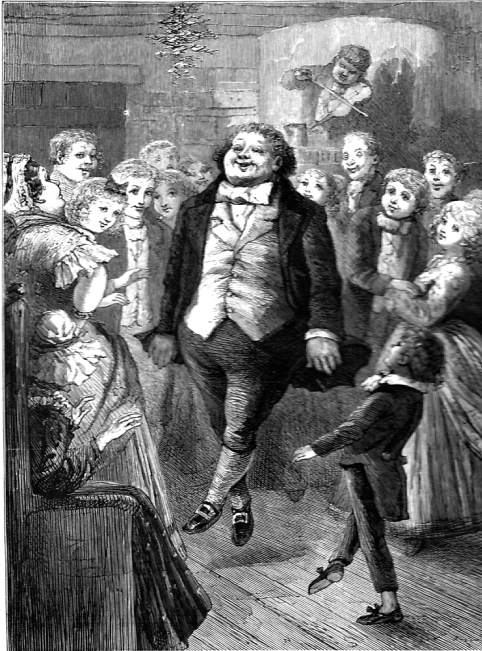
The Fezziwig Ball
Sol Eytinge
Wood engraving
12.5 high x 9.4 cm
Seventh full-page Illustration for Dickens's A Christmas Carol in Prose: being a ghost story of Christmas in the Ticknor and Fields (Boston), 1869, Diamond Edition.
Scanned image and text by Philip V. Allingham.
[You may use these images without prior permission for any scholarly or educational purpose as long as you (1) credit the photographer and (2) link your document to this URL in a web document or cite the Victorian Web in a print one. ]
For "The Fezziwig Ball" (p. 47) in "Stave 2: The First of the Three Spirits" Sol Eytinge has chosen one of those iconic moments that John Leech chose to realise in his 1843 illustrations for the first edition of A Christmas Carol. Knowing that his readers would inevitably compare his treatment of the subject of the Regency era "office party" that the good man of business, Old Fezziwig, customarily threw for his employees every Christmas eve in his warehouse, Eytinge chose to focus on the employer himself as a extroverted terpsichorean celebrant, an exuberant and accomplished dancer, despite his age and girth, in contrast to the communal country dance "Sir Roger de Coverly" that he leads off with his wife in Leech's more highly populated "Mr. Fezziwig's Ball" in the second stave, the steel etching that Leech himself reworked as a wood-engraving for the frontispiece of the volume Christmas Books in the 1852 "Cheap Edition":
But scorning rest upon his reappearance, he instantly began again, though there were no dancers yet, as if the other fiddler had been carried home exhausted, on a shutter; and he were a bran-new man resolved to beat him out of sight, or persish. [Stave Two, "The First of the Spirits"]
Later, after a round of "Sir Roger," Old Fezziwig performs a "cut," that is,
a fancy dance step, in which the dancer, on springing in the air, quickly alternates his feet, one in front of the other, before touching the ground again. [Hearne, note 45, p. 100]
In his version of the famous scene, Eytinge depicts Fezziwig dancing on his own, rapturously, with both feet off the ground. As in Leech's pair of illustrations and Dickens's text, he wears a Welch wig, "capacious waist-coat," as well as the breeches and stockings that were the standard "respectable" male fashion before that arbiter of Regency style Beau Brummell (1778-1840) invented the stove-pipe pant. Above Fezzwig, to the left, is mistletoe (embodying like the dancer and the Spirit of Christmas Past the principle of eternal life), and to his right the fiddler to whose imagined tune Fezziwig capers.
Creating his scene out of the old traditions of Christmas which Washington Irving celebrated in Bracebridge Hall, or The Humorists, A Medley (1822), as well as directly from Leech's illustrations and Dickens's text, Eytinge includes young and old, male and female, working and middle class figures in this celebration of the dance of life. We can see the three adolescent Miss Fezziwigs, some of their six young followers, the young men and women whom Fezziwig employed; Eytinge has not included those people whom Dickens specifically mentions: the couple's housemaid and her cousin, a baker, the cook and her escort, the milkman. Amomng the sixteen figures in the Eytinge treatment — in the foreground — is (presumably) "the boy from over the way," a detail suggesting that this is as much a community festivity as a party exclusively for the staff of Fezziwig & Co. Like Leech before him, Eytinge extends the gathering's composition by including the elderly woman in her high-backed chair (left), undoubtedly based on a similar figure to the right of Leech's woodcut. Leech's interior is more obviously a warehouse, with bare floorboards, bales, and stocked shelves. Romance is more explicit in Leech's illustrations as he shows a young couple under a mistletoe in each.
Shortly after the crowning moment of the evening, the employer's cutting an exemplary dancing figure, the host and hostess bid the company good-night at the warehouse door, — and Ebenezer Scrooge suddenly regrets his parsimonious and unsympathetic treatment of his own employee. He then turns to see himself reject the love of his life for the love of the golden idol of Exodus 32: 1-35.
Reference
Dickens, Charles. A Christmas Carol in Prose: being a Ghost Story of Christmas. Il. Sol Eytinge, Jr. Boston: Ticknor & Fields, 1868.
Hearne, Michael Patrick, ed. The Annotated Christmas Carol. New York: Avenel, 1989.
Last modified 28 December 2010