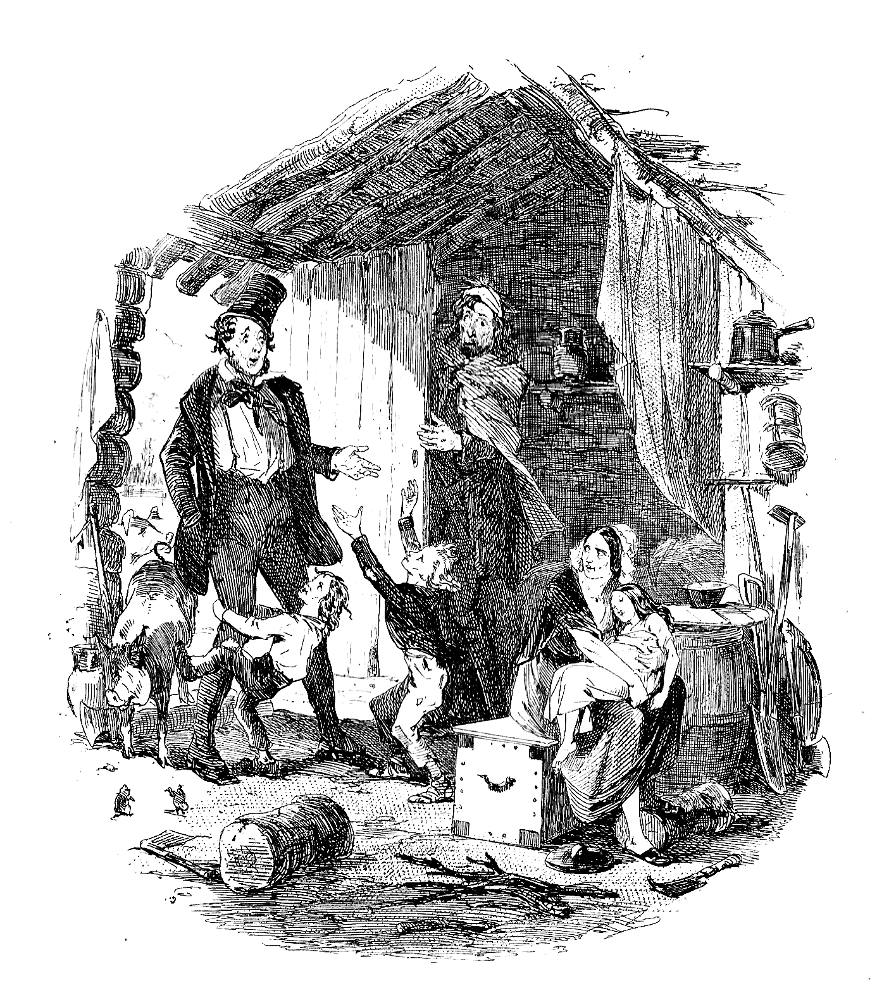
Mr. Tapley is Recognised by Some Fellow-Citizens of Eden
Phiz (Halbot K. Browne)
January 1844
Etching
He recognized as his fellow-passengers on the Screw, the man and the two boys, the woman nursing her daughter.— Chapter 33
Dickens's Martin Chuzzlewit
Scanned image, caption, and commentary by Philip V. Allingham.
[This image may be used without prior permission for any scholarly or educational purpose.]
By the time that Chapter 33 in Part XIII of Martin Chuzzlewit was published, a great event in the history of English literature and Victorian publishing had transpired: Chapman and Hall's issuing the first and most famous of the Christmas Books, A Christmas Carol, in December 1843. In that celebrated yuletide novella, Dickens contrasts the jollity of the season with the privations of the poor and the terrors of the future which confront the misanthropic, self-centred Ebenezer Scrooge. In this final American scene by Phiz, we observe a similar contrast, with the jovial Mark Tapley, despite the tribulations of Eden, standing in for the Spirit of Christmas Present and the suffering colonist family from "The Screw" standing in for the Cratchits. Like that cheerful family, they are happy just to be in each other's company—and like them they are about to lose their youngest child.
Although it is hardly the expose of appalling conditions endured by English immigrants that Dickens delivers, Phiz's twenty-fifth illustration for Martin Chuzzlewit shows us those squalid quarters, with rough shelves and flour cask in the corner, as described by Dickens. The artist, however, focuses our attentions on the cheerful Mark and the "young shavers" who respond with undiluted joy to Mark's sudden arrival in their unhealthy cabin, as Mark unexpectedly renews his acquaintance with his fellow passengers from steerage. Mark has just announced himself their "neighbour" and has just recognized them as the boys in glee hug his legs. As yet, the wraith-like, ill-kempt, and ill-clad father has yet to respond as he holds the door. This is therefore not a true tableau or moment of stasis, but rather a snapshot catching its figures in the midst of action: shortly the mother (decorously holding rather than "nursing" the sick child) will be overwhelmed by tears of gladness. In the illustration, we do not have a real sense of the feverous child's perilous state of health, but the letterpress makes clear the fate of the youngest member of the little family apparently foreshadows a similar tribulation for the named partner of Chuzzlewit and Co.
Last modified 28 April 2008