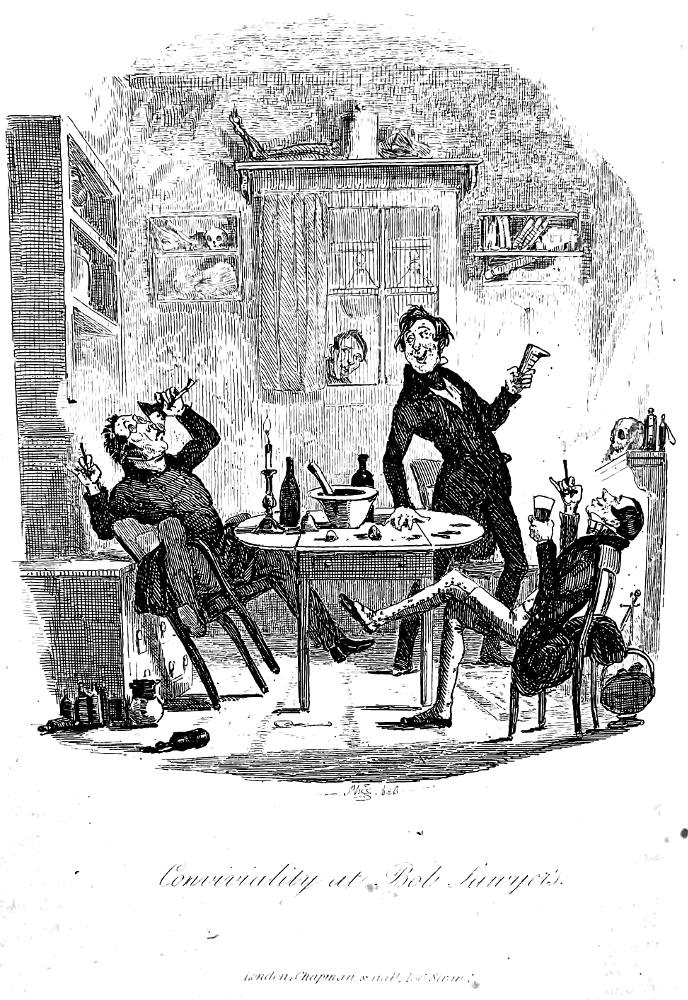
Conviviality at Bob Sawyer's
Phiz (Hablot K. Browne)
May 1837
Steel Engraving
Dickens's Pickwick Papers
[Click on image to enlarge it.]
As one might well expect in a picaresque novel, the indefatigable flim-flam artist Bob Sawyer turns up again, this time established as an apothecary in Bristol, which Mr. Pickwick visits in order to bring back the fugitive Mr. Winkle to Bath.
Details
Scanned image and text by Philip V. Allingham.

[You may use this image without prior permission for any scholarly or educational purpose as long as you (1) credit the photographer and (2) link your document to this URL in a web document or cite the Victorian Web in a print one.]
Winkle has fled Royal Crescent (photograph)for fear of Dowler's exacting vengeance for Winkle's supposedly trying to elope with Mrs. Dowler (see the second April illustration). Although formerly a medical student at Guy's Hospital in London, clearly Bob knows little about the professional calling he has assumed; otherwise, he would not be drinking punch from a chemist's vessel! He and his fellow student Ben Allen, proprietors of the Bristol surgery, are going bankrupt, so that the numerous drawers in the apothecary shop contain nothing. However, the bachelor medical students have their shop well-stocked with alcohol, which the timid Winkle agrees reluctantly to consume with them, despite the earliness of the hour. Only Winkle's presence is out of the ordinary — the pair over the past three weeks of their business arrangement have "been wavering between intoxication partial, and intoxication complete."
Bob Sawyer's return was the immediate precursor of the arrival of a meat-pie from the baker's, of which that gentleman insisted on his staying to partake. The cloth was laid by an occasional charwoman, who officiated in the capacity of Mr. Bob Sawyer's housekeeper; and a third knife and fork having been borrowed from the mother of the boy in the gray livery (for Mr. Sawyer's domestic arrangements were as yet conducted on a limited scale), they sat down to dinner; the beer being served up, as Mr. Sawyer remarked, "in its native pewter."
After dinner, Mr. Bob Sawyer ordered in the largest mortar in the shop, and proceeded to brew a reeking jorum of rum-punch therein, stirring up and amalgamating the materials with a pestle in a very creditable and apothecary-like manner. Mr. Sawyer, being a bachelor, had only one tumbler in the house, which was assigned to Mr. Winkle as a compliment to the visitor, Mr. Ben Allen being accommodated with a funnel with a cork in the narrow end, and Bob Sawyer contented himself with one of those wide-lipped crystal vessels inscribed with a variety of cabalistic characters, in which chemists are wont to measure out their liquid drugs in compounding prescriptions. These preliminaries adjusted, the punch was tasted, and pronounced excellent; and it having been arranged that Bob Sawyer and Ben Allen should be considered at liberty to fill twice to Mr. Winkle's once, they started fair, with great satisfaction and good-fellowship. [chapter 38]
Since the gentleman to the right holds a tumbler, he must be Winkle; Ben Allen falls back in his chair as he drinks punch from a funnel; Bob, presiding as the host, rests his right hand on the table, perhaps to steady himself against advancing tipsiness, while he consumes his potation from an apothecary's measuring vessel. The shop boy peeps through the glass door in the rear, watching his employers rather than "devoting the evening to his ordinary occupation of writing his name on the counter, and rubbing it out again" (ch. 38). Remark Guiliano and Collins,
The reintroduction of Bob Sawyer serves two functions: it aids in the development of the Winkle/Arabella [Allen romantic] subplot that is now put centre stage, and it permits Dickens to take some more comic jabs at the medical profession, as he has with the clergy and the law. All three are traditional objects of satire in the picaresque novel. [Note 2, page 363]
Travelling medical students Ben Allen and Bob Sawyer made their initial appearance in chapter 30, when old Mr. Wardle introduces Pickwick — and the reader — to the hedonistic pair of bachelors. Clearly Phiz has made use of the following descriptions in his May illustration of the hosts of the party in the back room of the apothecary shop:
Mr. Benjamin Allen was a coarse, stout, thick-set young man, with black hair cut rather short, and a white face cut rather long. He was embellished with spectacles, and wore a white neckerchief. Below his single-breasted black surtout, which was buttoned up to his chin, appeared the usual number of pepper- and-salt coloured legs, terminating in a pair of imperfectly polished boots. Although his coat was short in the sleeves, it disclosed no vestige of a linen wristband; and although there was quite enough of his face to admit of the encroachment of a shirt collar, it was not graced by the smallest approach to that appendage. He presented, altogether, rather a mildewy appearance, and emitted a fragrant odour of full-flavoured Cubas.
Mr. Bob Sawyer, who was habited in a coarse, blue coat, which, without being either a greatcoat or a surtout, partook of the nature and qualities of both, had about him that sort of slovenly smartness, and swaggering gait, which is peculiar to young gentlemen who smoke in the streets by day, shout and scream in the same by night, call waiters by their Christian names, and do various other acts and deeds of an equally facetious description. He wore a pair of plaid trousers, and a large, rough, double-breasted waistcoat; out of doors, he carried a thick stick with a big top. He eschewed gloves, and looked, upon the whole, something like a dissipated Robinson Crusoe.
Such were the two worthies to whom Mr. Pickwick was introduced, as he took his seat at the breakfast-table on Christmas morning. [chapter 30]
Referring back to that chapter, the reader can identify Ben Allen (left) by virtue of his "black hair cut rather short," and his spectacles, and Bob Sawyer (centre) merely by his "slovenly smartness, and swaggering gait."
References
Cohen, Jane Rabb. Charles Dickens and His Original Illustrators. Columbus: Ohio State U. P., 1980.
Guiliano, Edward, and Philip Collins, eds. The Annotated Dickens. Vol. 1. New York: Clarkson N. Potter, 1986.
Hammerton, J. A. The Dickens Picture-Book. London: Educational Book Co., 1910.
Steig, Michael. Dickens and Phiz. Bloomington & London: Indiana U.P., 1978. Pp. 51-85.
Dickens, Charles. "Pickwick Papers (1836-37). London: Chapman & Hall.
Last modified 13 December 2011