
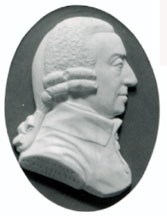
Portrait Medallion of Adam Smith by James Tassie (1735-1799). National Galleries of Scotland.
Introductory material
Economics
- Adam Smith's Laissez-Faire Policies
- A Corrective to common views of Smith's ideas of Laissez-Faire — Smith, Townsend, and the Workhouse Test Act
Smith’s own words
- Value defined
- Smith on Educating the Working Classes
- On the importance of good roads and canals
- Smith on the “invisible hand”
- Productivity and the Division of Labor
- The Evil Done by the East India Company and other Monopolies
- Fundamental Conflicts and Incoherence of the East India Company
Reputation and Influence
Reviews
Recent Scholarly Studies
Rasmussen, Dennis C.. The Infidel and the Professor: David Hume, Adam Smith, and the Friendship That Shaped Modern Thought. Princeton: Princeton University Press, 2019.
Schliesser, Eric. Adam Smith: Systematic Philosophy and Public Thinker. Oxford: Oxford University Press, 2018.
Related Web resources
- Adam Smith's An Inquiry Into the Nature and Causes of the Wealth of Nations. London: T. Nelson & Sons, 1852. Project Gutenberg. [EBook #38194]
Last modified 7 May 2019