
 usic can convey emotions better than poetry or prose and what I'm trying to convey is an emotion. To understand it better, therefore, perhaps you should stand on the Malvern Hills where Piers Plowman went one May morning ("in a summer season when soft was the sun") and look across the green counties while listening to Vaughan Williams's The Lark Ascending and The Thomas Tallis Suite. Then you can both see and feel what I'm trying so clumsily to say.
Ralph Vaughan Williams was born in 1872 in the Cotswolds. In the 1890s, while Chesterton was writing the poems in The Wild Knight, Vaughan Williams was setting poetry to music — Shelley, Shakespeare, Tennyson. Around the time Chesterton began writing The Ballad of the White Horse, Vaughan Williams was collecting folk songs and carols from country singers. In 1910, the year the Ballad was published, he wrote his Fantasia on a Theme by Thomas Tallis , the sixteenth-century court organist and composer. A Lark Ascending was written in 1914, just before the outbreak of the Great War (in which he served as an ambulance driver with the Royal Army Medical Corps). His friend and fellow composer, George Butterworth, prompted him to write it. (Butterworth was killed in the war. Both men set Housman to music; but this much-loved piece was inspired by George Meredith's poem of the same title.)


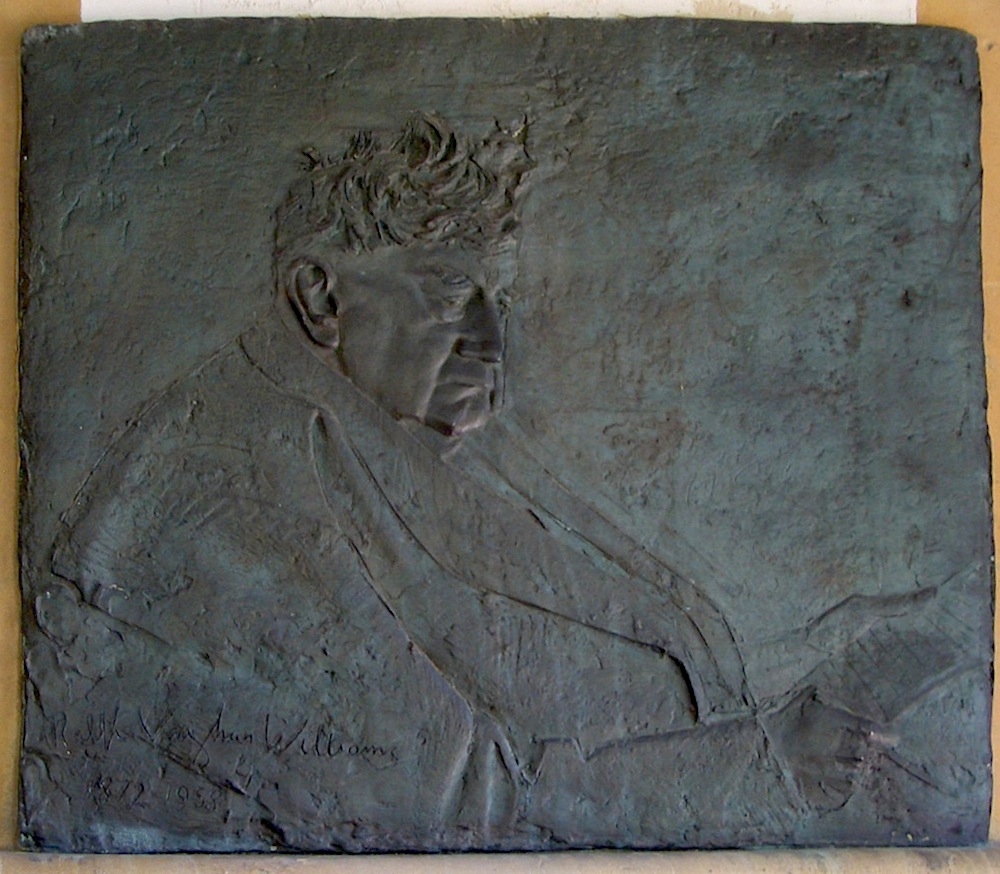
Left to right: (a) Ralph Vaughan Williams (1872-1958), bronze statue outside Dorking Halls, Dorking, Surrey, by William Fawke, ARBS, 2001. (b) The view from Leith Hill, Surrey. (c) Memorial to Vaughan Williams in St Martin's Church, Dorking, by David McFall, 1961. [Photographs by Jacqueline Banerjee; click to enlarge.]
Vaughan Williams was conductor of the Leith Hill Music Festival from its inception in 1905 until 1953. Leith Hill is not quite a mountain but very nearly, being just short of a thousand feet. It is the highest point in Surrey (the southern kingdom in the speech of the South Saxons) above the town of Dorking and the River Mole. Nearby are the great beauty spots of Box Hill and the Devil's Punch Bowl, places redolent of that elusive quality of Englishness Vaughan Williams expresses in his music. He died in 1958, just as the England he'd portrayed was ending.
The Persistence of the Victorians: Things Remembered and Things Forgot
- Forgetting Obvious Things: The legacy of the Victorians?
- The Last of the Victorians:June 2008
- Laurence Binyon (1869-1943)
- Sir Edwin Landseer Lutyens OM (1989-1944)
- John McCrae (1872-1918)
- Portrait of a Victorian: A Washerwoman's Daughter
- Stained Glass and Gaslight — Darkness, Smog, and a Litte Light in Victorian Cities
- "Weeping Willow" stands for "Pillow": Victorian Rhyming Slang
- Earth Yenneps: Victorian Back Slang
- Victorian Costermongers: "A Penny Profit out of the Poor Man's Dinner"
Photographs, and reference to George Meredith, added on 21 November 2016