

© William Morris Gallery, Walthamstow, provided by Dennis T. Lanigan in connection with his review of Pre-Raphaelites: Art and Poetry at the Laing, Newcastle (2026-27) (see Related Material).
Love Leading the Pilgrim Through the Briars, derived from Guillaume de Lorris’s “Roman de la Rose,” translated by Chaucer as “The Romaunt of the Rose.” Designed by Sir Edward Coley Burne-Jones, Bt ARA (1833-1898) and William Morris (1834-1896), and made by Margaret Bell (1820-1886) and her daughter Florence Johnson, from 1874-1876, for the dining room of Sir Isaac Lowthian Bell's home, Rounton Grange, Northallerton, Yorkshire. Size: 88 x 582. Embroidered textile: "linen embroidered with coloured silk, wool, and gold thread" (Wildman and Christian 180), now at the William Morris Gallery, Walthamstow, catalogue number F140d. The tapestry was presented to the gallery by Sir Hugh Bell, Bart. in 1953.
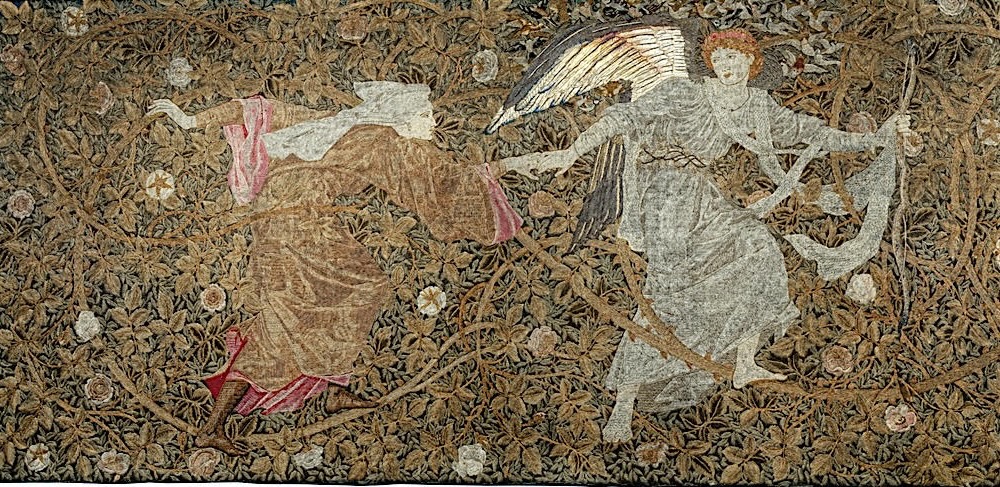
Closer view of the figures on the left, with Love propelling the Pilgrim forward through a maze of briars towards his goal.
Both Burne-Jones and Morris are named as the designers, the figures being very clearly based on pictures drawn by the former, while the latter was responsible for the pattern around them, of briars and pink roses against a gold background.
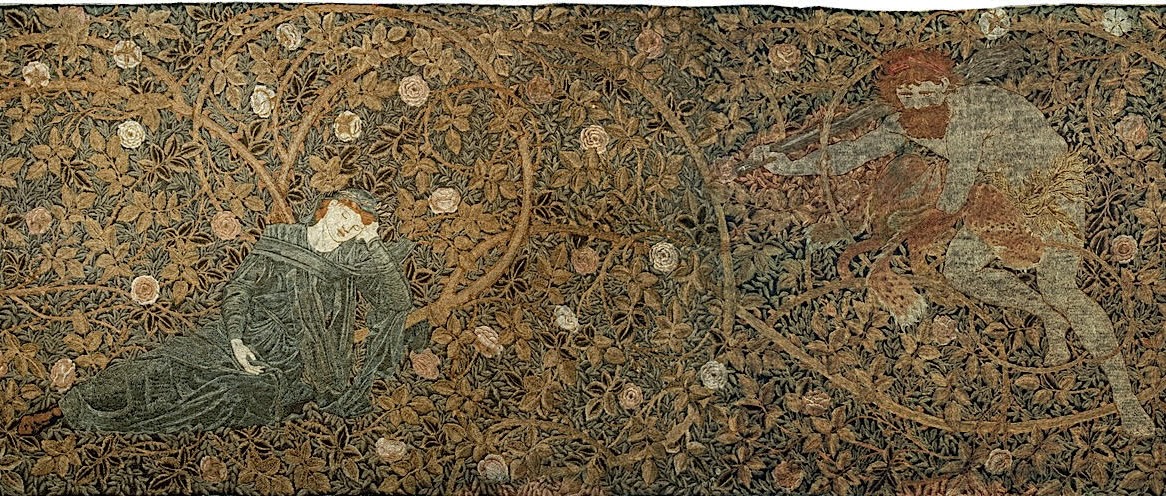
Closer view of the central figure, and the figure nearby on the right.
The figure in the middle of this part of the tapestry (which extended over three walls and took eight months to complete) is a personification of Idleness, still quite oblivious to the advances on either side. But she is also the "Keeper of the Gate," essential to the next and final stage of the Pilgrim's journey. Unlike the Pilgrim, the two seekers on the right have no guide, but appear to be slashing their way forward: one, a determined-looking red-bearded one, closes in, but is still fighting through the encircling thorns. Behind him (shown more closely below right), is yet another figure, forcing a way through a coiling tangle of briars that seem to be successfully impeding his progress.
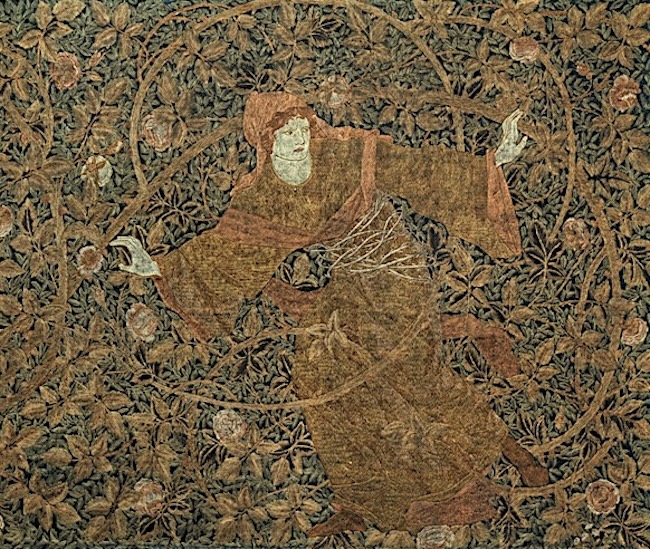
Although it is only one section of a longer wall-hanging, and although the central figure is perfectly still, this is a dynamic and panoramic scene. Idleness will be roused, and will open the gate that allows the Pilgrim to reach his goal: the heart of the rose. Here, the promise of this triumph is carried only by the surrounding roses, which are more prominent on the left and seem fewer and somewhat faded on the right.
This was a literary theme that fascinated Burne-Jones over a long period, and found expression in other media too. The medieval English Romaunt consists of translated fragments, only the first of which is now generally accepted to have been Chaucer's work. The characters in the dream-allegory are "incarnations of inner experience" (Lewis 175), engaged in the long and difficult struggle of life, with the most influential aspect of it being the courtly love narrative. This is expressed through the Pilgrim, who, when at last he reaches the heart of the rose, seems to have emotional fulfilment, or the ideal, within his grasp. However, in the medieval version he will then be thwarted by the wiles of Jealousy.... — Jacqueline Banerjee.
Related Material
- Pre-Raphaelites: Art and Poetry (exhibition review)
- The Heart of the Rose by Sir Edward Coley Burne-Jones, Bt ARA (discussion of the artist's various works on this theme)
Images courtesy of the William Morris Gallery, Walthamstow, reproduced for purposes of non-commercial academic research to illustrate Dennis T. Lanigan's review of Pre-Raphaelites: Art and Poetry at the Laing, Newcastle (2026-27) — where, at the time of writing, it is one of the stand-out artworks on display. [Click on all the images to enlarge them.]
Bibliography
Lewis, C. S. The Allegory of Love: A Study in Medieval Tradition. Oxford: Oxford University Press, 1958.
Love Leading the Pilgrim through the Briars. William Morris Gallery. Web. 10 November 2026.
Wildman, Stephen, and John Christian. Edward Burne-Jones. Victorian Artist-Dreamer. New York: Metropolitan Museum of Art, 1998.
Created 10 November 2026