

"I perceived him loosening my shadow," by George Cruikshank (1792-1878). 1861. Frontispiece to Adelbert von Chamisso's Peter Schlemihl (originally published in 1814) [Click on the image to enlarge it.]
Cruikshank excels himself in this frontispiece to the influential tale, showing the "silent, meagre, pale, tall, elderly man" (25) loosening Peter's shadow from the ground with "wonderful dexterity" (33). He already holds one of the legs up by its ankle. Meanwhile the spindly stranger's own shadow remains firmly attached to him, but crouched close to the other one like an attacker over its prey. The sundial in the center of the picture reminds us that time cannot be properly marked without a shadow.
Peter will not enjoy the wealth that the stranger (who turns out to be the devil) gives him in exchange, but virtuously refuses to buy his shadow back in return for his soul. He ends up wandering the world in his seven-league boots, with the object of unravelling the secrets of nature and writing them up for posterity, thus undergoing a form of redemption.
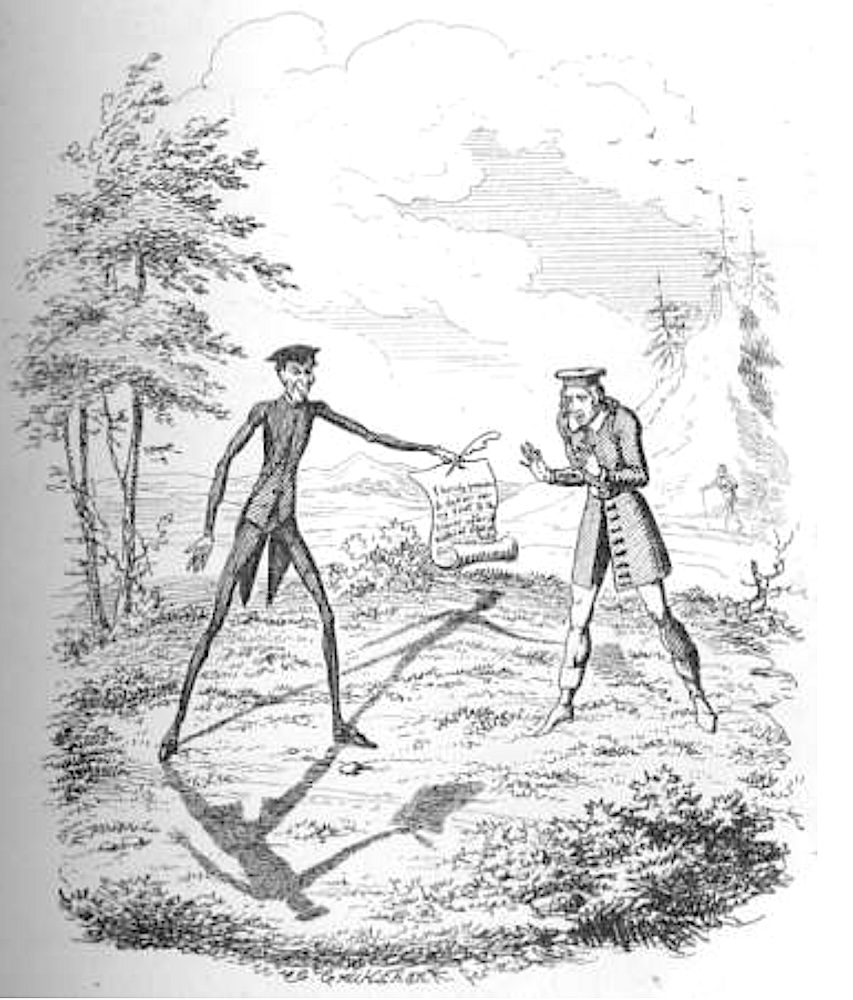
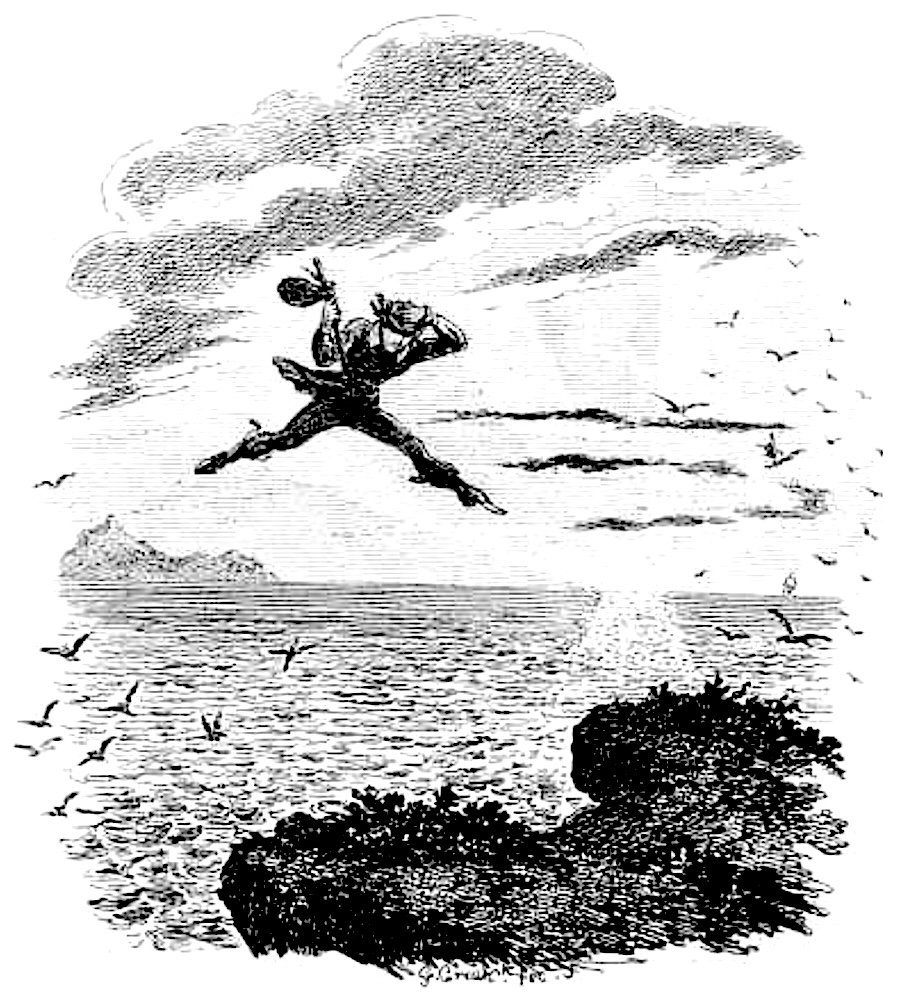
Left: Rejecting the devil's offer to return his shadow (72). Right: The seven-league boots (113).
The other illustrations in the book are just as successful as the frontispiece in capturing the key episodes of Peter's story. The two shown above are particularly evocative: the one on the left emphasises the horrified rejection of the second offer made by the creepy stick-thin figure with its wicked leer. The one on the right, altogether more positive, spirited and buoyant, shows the amazing power and speed of the seven-league boots as the shadowless Peter leaps across an ocean. Seabirds scatter as he comes in to land on some wild shore.
As a footnote, Hans Christian Andersen was greatly influenced by the tale. His story, "The Shadow," is a reworking of the narrative (which he actually refers to, though not by name). He greatly shortens the original, and uses it to take vicarious revenge on his patron's son Edvard Collin, who had a great hold over him and yet refused to address him familiarly. His main protagonist (unnamed but apparently based on Collin) whose shadow (clearly representing Andersen himself) enters the abode of Poetry and takes on a separate life of its own. The shadow then becomes fleshed out, dresses elegantly and gains power because of his insight into the dark springs of human behaviour. Then he returns to the unnamed man and enslaves him, finally having him killed so that he can enjoy the life he has made for himself without fear of being found out. Not one of Andersen's better known tales, and far from endearing, "The Shadow" is nevertheless powerful and intriguing.
Chamisso's use of a person's shadow, with the "double" having a dubious life of its own, can be found in folklore, but he seems to have brought it into play for the nineteenth-century audience: as well as Andersen, various other writers would use it to suggest the conflicted self — most famously R.L. Stevenson, in Dr Jekyll and Mr Hyde. Andersen would use the idea of the seven-league boots, too, in his tale, "The Galoshes of Fortune" (1838). Again, this kind of wondrous footwear can be found in earlier folklore; but Chamisso seems to have encouraged a new awareness of its literary potential, at least for fairytales. — Jacqueline Banerjee
Related Material
- Hans Christian Andersen and His Impact on Victorian Fiction
- Robert Louis Stevenson's The Strange Case of Dr. Jekyll and Mr. Hyde
Bibliography
von Chamisso, Adelbert. Peter Schlemihl. Trans. Sir John Bowering. 3rd ed. London: Robert Hardwicke, 1861. Project Gutenberg. Web. 6 November 2026.
Created 21 December 2008
Last modified 6 November 2026