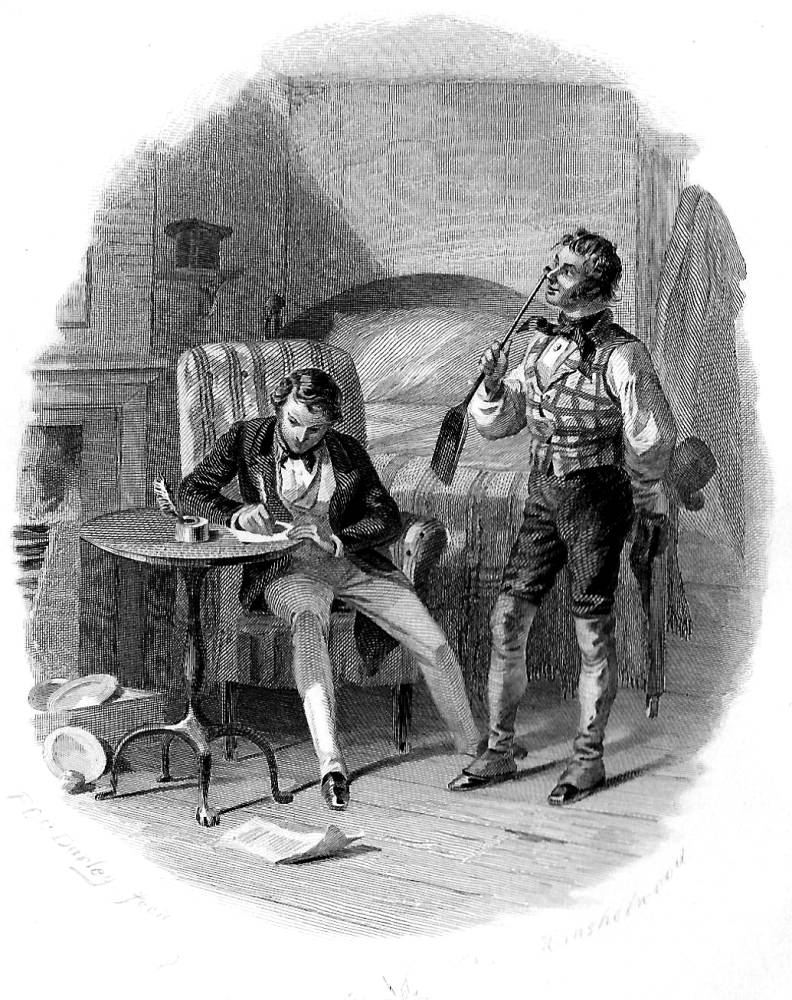
"Jolly sort of lodgings," said Mark.
Felix O. C. Darley
1863
Photogravure
10.2 by 8.3 cm (4 by 3 ¼ inches) vignetted
Dickens's Martin Chuzzlewit, Household Edition, vol. 2 frontispiece.
Scanned image and text by Philip V. Allingham.


[Victorian Web Home —> Visual Arts —> Illustration —> Martin Chuzzlewit —> F. O. C. Darley —> Next]
"Jolly sort of lodgings," said Mark.
Felix O. C. Darley
1863
Photogravure
10.2 by 8.3 cm (4 by 3 ¼ inches) vignetted
Dickens's Martin Chuzzlewit, Household Edition, vol. 2 frontispiece.
Scanned image and text by Philip V. Allingham.
"Jolly sort of lodgings," said Mark, rubbing his nose with the knob at the end of the fire-shovel, and looking round the poor chamber; "that's a comfort. The rain's come through the roof too. That a'n't bad. A lively old bedstead, I'll be bound; popilated by lots of wampires, no doubt. Come! my spirits is a-getting up again. An uncommon ragged nightcap this. A very good sign. We shall do yet! Here, Jane, my dear," calling down the stairs, "bring up that there hot tumbler for my master as was a-mixing when I come in. That's right, sir," to Martin. "Go at it as if you meant it, sir. Be very tender, sir, if you please. You can't make it too strong, sir!" [Vol. II, Chapter 13, "Showing What Became of Martin and His Desperate Resolve, After He Left Mr. Pecksniff's House; What Persons He Encountered; What Anxieties He Suffered; And What News He Heard," p. 37]
In selecting his subjects for the four frontispieces for the four volumes in the American "Household Edition" of the early 1860s, Felix Darley had merely to consider the original forty monthly illustrations by Dickens's graphic collaborator, Phiz, Hablot Knight Browne. Among the incidents which occur within the scope of the second volume (Chapters 13 through 25), the decision of Mark Tapley to take up the emotional and moral challenge of acting as Young Martin's valet and companion is significant in the development of the picaresque plot, for Don Quixote had his Sancho Panza and Samuel Pickwick his Sam Weller. In other words, perennially jolly and morally focused but street-wise Mark is necessary as a foil to the egotistical and impractical Martin; moreover, he will be instrumental in effecting the young bourgeois' epiphany on the shores of the Ohio River. Whereas for Chapter 7, Phiz's sixth illustration (for the third monthly instalment, March 1843), Mark Begins to be Jolly Under Creditable Circumstances depicts the ebullient Mark, looking somewhat dejected as he leaves the comfortable circumstances of the village, The Dragon, and Mrs. Lupin, in his illustration for Chapter 13 (in the sixth monthly part, June 1843) Phiz depicts the circumstances under which Martin by chance meets Montague Tigg in London — Martin Meets an Acquaintance at the House of a Mutual Relation — and leaves the meeting of Martin and Mark in London unrealized in the original series. Phiz's choice of subject was inspired to the extent that it permitted him to reveal Martin's poverty and desperation while offering social commentary; as a result of the illustration, Martin exists within the urban context that Dickens's serial readers knew best: the English metropolis of the 1840s. However, having already introduced Tigg, Darley must have felt inclined to avoid repeating the secondary character of Tigg in favour of introducing another, more important pair of characters: the large-hearted, wise-cracking, working-class Dickensian optimist and the upper-middle-class, callow youth who is the story's eponymous character and protagonist.
The decade after Darley's frontispieces for the novel appeared in America, Fred Barnard also created an illustration of these characters for the British Household Edition (1871-79). [He] Stuck his hands in his skirt-pocket and swaggered round the corner depicts the meeting of the pallid protagonist and the flashy confidence man in a manner which makes his illustration complementary to Phiz's interior of "Uncle's" — that is, the pawnbroker's, where, having met inside, Martin and Tigg part company outside: Martin to a new identity in America as a practising architect in Eden (the epicentre of Mississippi Valley land swindles), and Tigg to the free-wheeling life assurance fraud schemes of the City as re-christened financial entrepreneur "Tigg Montague." Barnard focuses on the parting of the lovers, Martin and Mary Graham, while the helpful Mark Tapley stands guard in Seeing that there was no one near, and that Mark was still intent upon the fog, he not only looked at her lips, but kissed them into the bargain. (His best study of the serviceable Mark is, however, that in which he assists the other steerage passengers On board the "Screw").
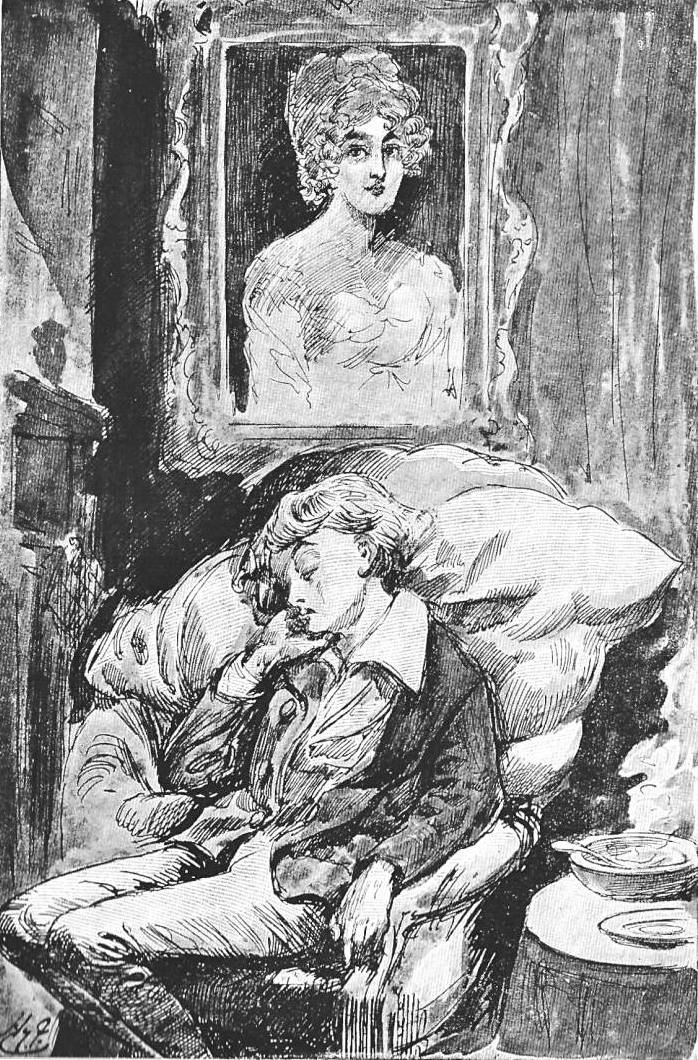
In the Diamond Edition of 1867, Sol Eytinge, Junior, likewise depicts Martin and Mark together as a team, but his is a much less steady and self-assured Martin who appears to be succumbing to the debilitating effects of malarial swamp fever in Martin Chuzzlewit and Mark Tapley, following the visual conventions established by the original Phiz illustration of Martin and Mark in America, The Thriving City of Eden as it Appeared in Fact, (September, 1843).
Since The Life and Adventures of Martin Chuzzlewit was a nineteen-month serialisation, a sprawling narrative with a large cast of humorous characters, it was not especially well suited to Darley's sober and realistic style. However, with its caricatures directed at the exposure of hypocrisy on two continents and in two societies, it was the ideal vehicle for the comic genius and Expressionistic style of Dickens's last great Victorian illustrator, Harry Furniss. His studies of Mark Tapley in particular reveal the picaresque character's genial and whimsical nature, whether he is striking a pose for Tom Pinch in Chapter 5, assisting his "master" in an assignation in Mark Tapley's Sympathetic Sneeze in Chapter 14, or gaily waving at the reader outside any situational geographical or narrative context in Mark Tapley. Furniss and Barnard, recognizing the importance of Mark in the story and as a vehicle for verbal humour, show him repeatedly in a variety of poses and situations — but always "Jolly!" (his oft-repeated tagline).
In Darley's second frontispiece for the 1863 American edition of the novel, one has some sense of the comic possibilities in the image of immaculately dressed young ostler Mark Tapley, whom Nicolas Bentley et al. in The Dickens Index rightly dub "an invincible optimist" (256). However, Martin's comfortably furnished, tidy rented room in Darley's illustration is hardly consistent with the dilapidated room in a third-class London hotel that Mark describes, and the sixties Dickens illustrator gives one little sense of the well-dressed youth writing at the table as Mark observes him. Perhaps, however, in that Darley depicts Young Martin as a prolific writer (we note the folio page of close handwriting on the floor, permitted to drop in haste as the writer produces yet another page of manuscript) the illustrator may be suggesting that this is the image of thirty-year-old celebrity-writer Charles Dickens on his first American tour — in which case, Martin serves as the image of the author, and Mark as the comic voice. Again, Darley avoids depicting the young Englishmen in the midst of their American misadventures, for then he would have had to comment visually on such satirical characters as the self-important members of The Watertoast Association of United Sympathizers, whom Martin encounters within Volume Two, and such locales as the dubiously-named Eden (Chapter 23).
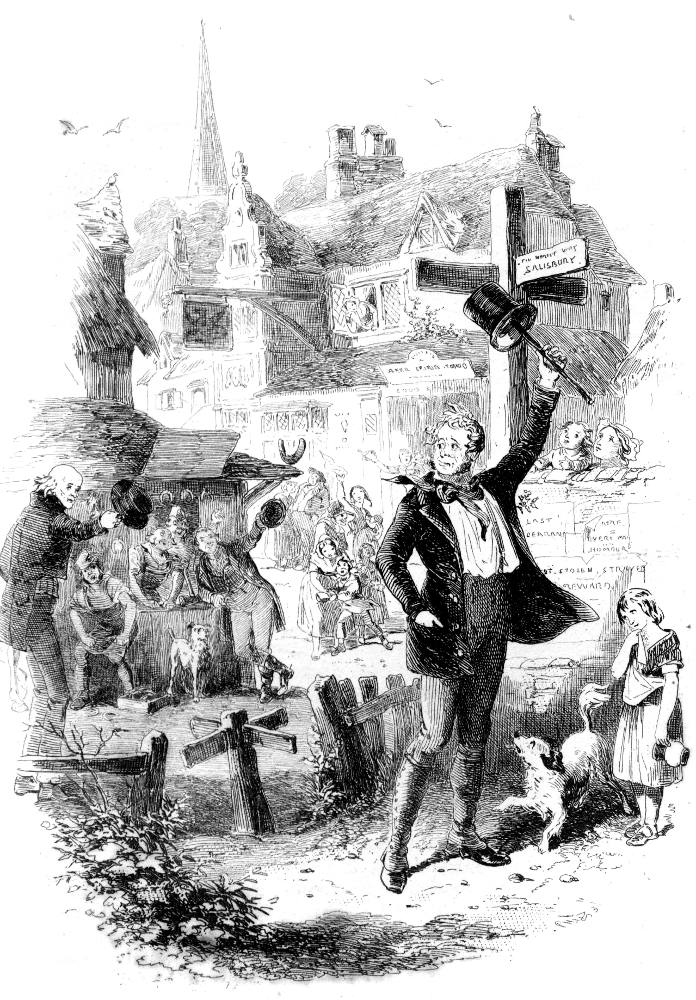
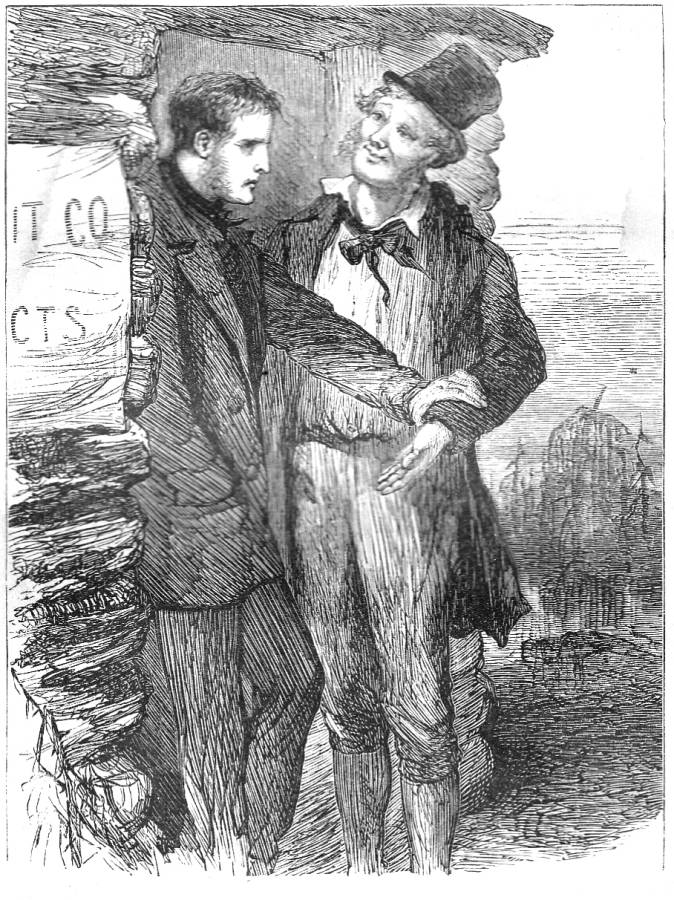
Left: Hablot Knight Browne's "Mark Begins to be Jolly Under Creditable Circumstances" (February 1843). Right: Sol Eytinge, Jr.'s "Martin Chuzzlewit and Mark Tapley" (1867). [Click on images to enlarge them.]
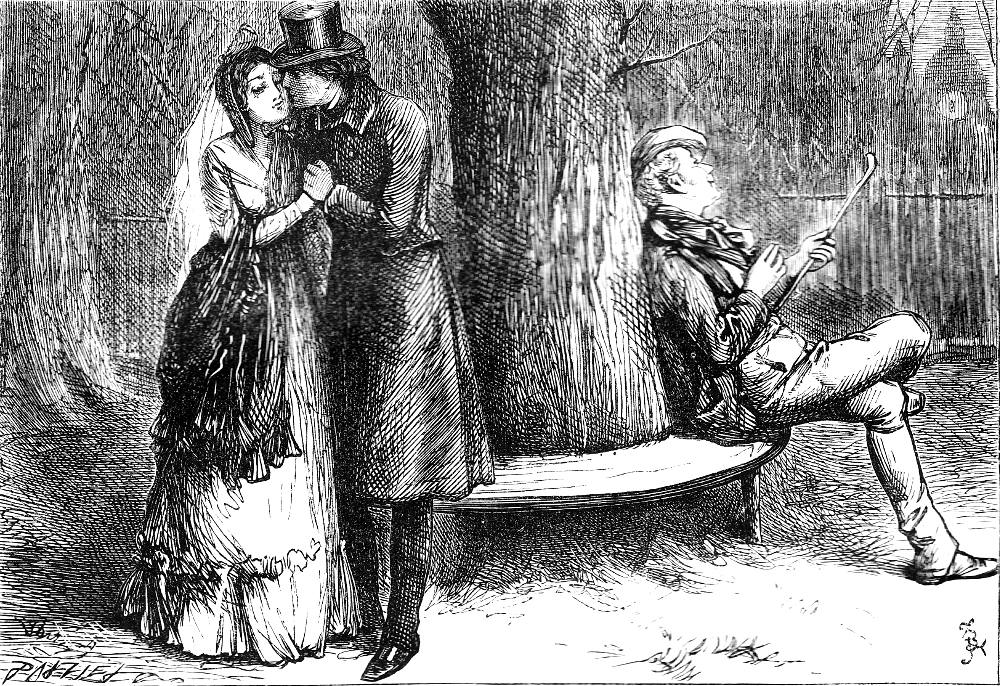
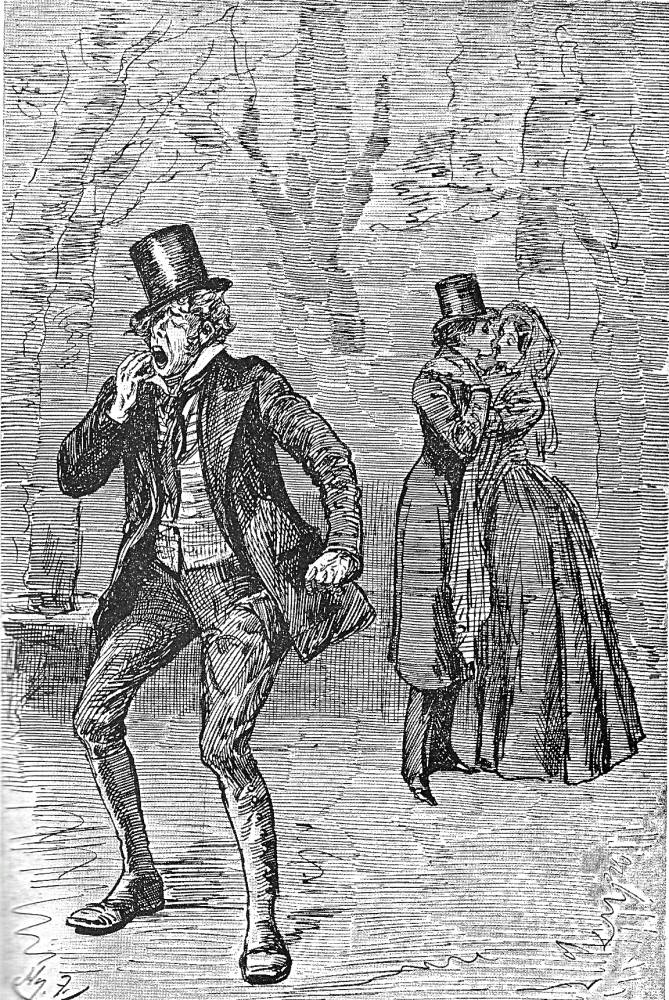
Later Editions. Left: Fred Barnard's "Seeing that there was no one near, and that Mark was still intent upon the fog, he not only looked at her lips, but kissed them into the bargin" (1872). Centre: Harry Furniss's Mark Tapley's Sympathetic Sneeze (1910). Right: Furniss's Mark Tapley. [Click on images to enlarge them.]
Bentley, Nicolas, Michael Slater, and Nina Burgis. The Dickens Index. New York and Oxford: Oxford U. P., 1990.
Dickens, Charles. The Life and Adventures of Martin Chuzzlewit. Illustrated by Hablot Knight Browne. London: Chapman and Hall, 1844.
Dickens, Charles. Martin Chuzzlewit. Works of Charles Dickens. Household Edition. 55 vols. Illustrated by F. O. C. Darley and John Gilbert. New York: Sheldon and Co., 1863. Vol. 2 of 4.
Dickens, Charles. The Life and Adventures of Martin Chuzzlewit. Illustrated by Sol Eytinge, Junior. The Diamond Edition. 14 vols. Boston: Ticknor and Fields, 1867. Vol. II.
Dickens, Charles. The Life and Adventures of Martin Chuzzlewit. Illustrated by Fred Barnard. The Household Edition. 22 vols. London: Chapman and Hall, 1872. Vol. 2.
Dickens, Charles. Life and Adventures of Martin Chuzzlewit. Illustrated by Harry Furniss. The Charles Dickens Library Edition. 18 vols. London: Educational Book, 1910. Vol. VII.
Created 12 March 2014 Last updated 18 July 2026