
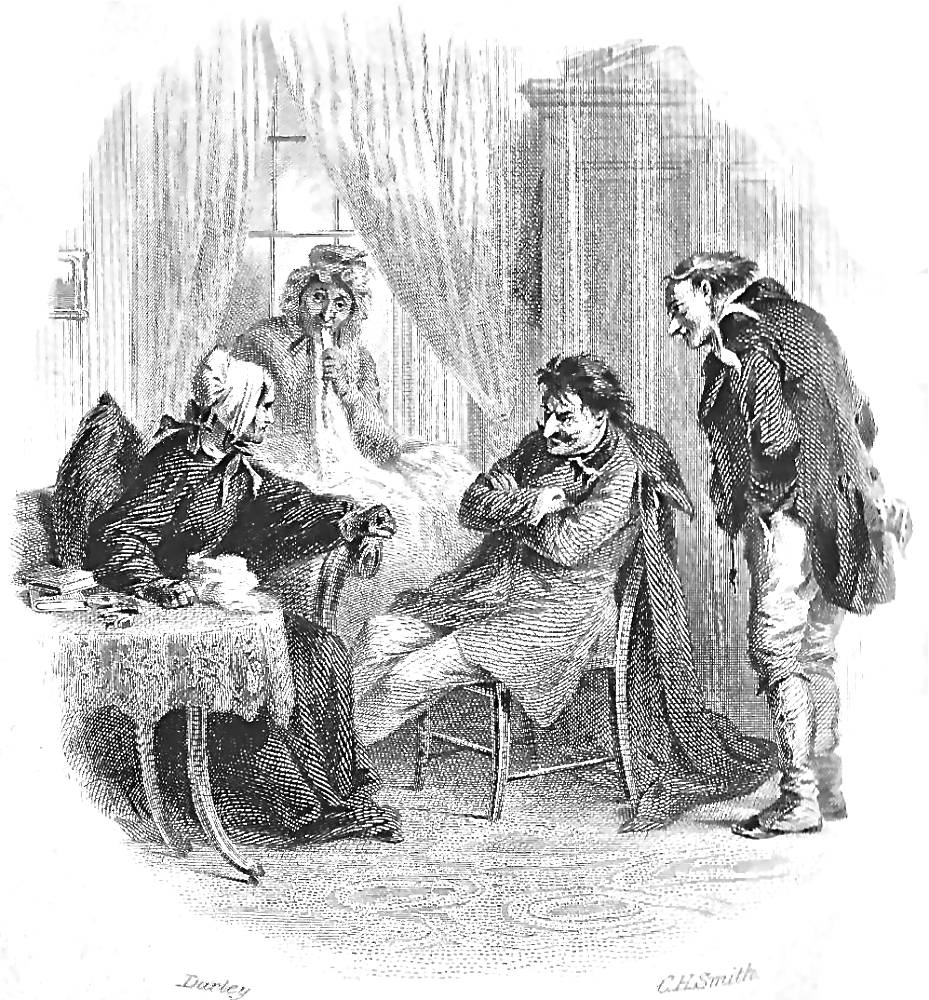
Closing in — Book II, “Riches,” Ch. XXX, “Closing In.”
Felix O. C. Darley
1863
8.6 cm high by 7.3 cm wide (3 ¼ by 2 ¾ inches), vignetted.
Photogravure
Frontispiece for Dickens's Little Dorrit, vol. 4, in the Sheldon & Co. (New York) Household Edition.
[Click on the image to enlarge it and mouse over text for links.]
Scanned image & text by Philip V. Allingham.
Passage Illustrated: Affery interrupts Rigaud's extortion scheme
Rigaud, thrusting Mr. Flintwinch aside, proceeded straight up-stairs. His two attendants followed him, Mr. Flintwinch followed them, and they all came trooping into Mrs. Clennam's quiet room. It was in its usual state; except that one of the windows was wide open, and Affery sat on its old-fashioned window-seat, mending a stocking. The usual articles were on the little table; the usual deadened fire was in the grate; the bed had its usual pall upon it; and the mistress of all sat on her black bier-like sofa, propped up by her black angular bolster that was like the headsman's block. Yet there was a nameless air of preparation in the room, as if it were strung up for an occasion. From what the room derived it — every one of its small variety of objects being in the fixed spot it had occupied for years — no one could have said without looking attentively at its mistress, and that, too, with a previous knowledge of her face. Although her unchanging black dress was in every plait precisely as of old, and her unchanging attitude was rigidly preserved, a very slight additional setting of her features and contraction of her gloomy forehead was so powerfully marked, that it marked everything about her.
"Who are these?" she said, wonderingly, as the two attendants entered. "What do these people want here?"
"Who are these, dear madame, is it?" returned Rigaud. "Faith, they are friends of your son the prisoner. And what do they want here, is it? Death, madame, I don't know. You will do well to ask them."
"You know you told us at the door, not to go yet," said Pancks.
"And you know you told me at the door, you didn't mean to go," retorted Rigaud. "In a word, madame, permit me to present two spies of the prisoner's — madmen, but spies. If you wish them to remain here during our little conversation, say the word. It is nothing to me." — Vol. 4, Book Two, "Riches"; Ch. 30, “Closing In,” pp. 202-203.
Commentary
The scene is the matriarch's room in the Clennam townhouse at the culmination of the plot concerning her having suppressed the truth of Arthur's birth and the bequest to the Dorrits. In the original serial, the illustration for this chapter only obliquely alludes to Rigaud's blackmail plot, and does not show the dramatic confrontation between Flintwinch, Rigaud (right in the Darley frontispiece) and Mrs. Clennam. Phiz's June 1857 dark plate Damocles (Book Two, Chapter 30) realises the aftermath of the blackmail scene, when Rigaud, clinking his coins, believes that he now has Mrs. Clennam in his power, even though she has quite unexpectedly risen from her wheelchair and fled the house.
However, Phiz's illustration obscures the figure of the cunning Frenchman who will shortly perish in the collapse of the collapse of the decrepit mansion. Certainly, then, the confrontational scene that Darley elected to illustrate has no precedent in the original serial, and could not have known that in his choice of subject he would be anticipating James Mahoney's illustration for Book Two, Chapter 30, in the 1873 Household Edition, in which he shows Rigaud as entirely self-composed even when Flintwinch orders an overwrought Affery out of the room as Rigaud begins his blackmail narrative — and Affery, asserting herself at last, refuses: "I'll hear all I don't know, and say all I know. I will, at last, if I die for it. I will, I will, I will, I will!" (206 in this edition). In consequence of the dialogue realised, Mahoney has minimized the figure of Mrs. Clennam in the right-hand margin of this group illustration forBook Two, Chapter 30, but her sharpness makes her a match for the cunning Frenchman at this point. Darley conveys her intelligence by contrasting her look of determined concentration with Affery's fear and uncertainty.
Relevant Plates in the original, Diamond, Household, and Collins Pocket Editions, 1857-1910
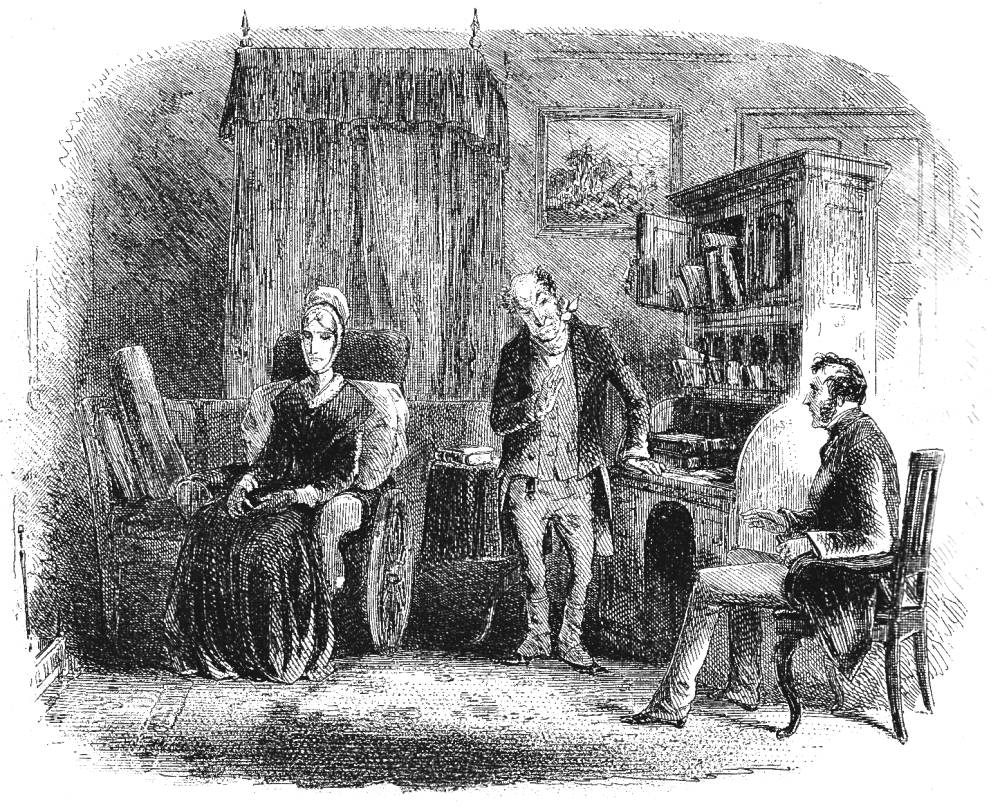
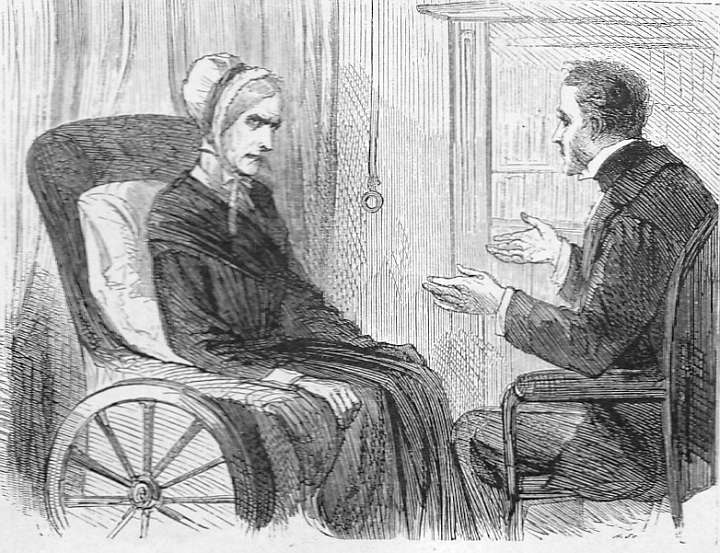
Left: Phiz's original serial illustration of Mrs. Clennam in her wheelchair, Mr. Flintwich mediates as a friend of the family (January 1856). Right: Sol Eytinge, Junior's interpretation of the devious Mrs. Clennam and her adopted son, Arthur, Mrs. Clennam and Arthur Clennam (1867). [Click on these images to enlarge them.]
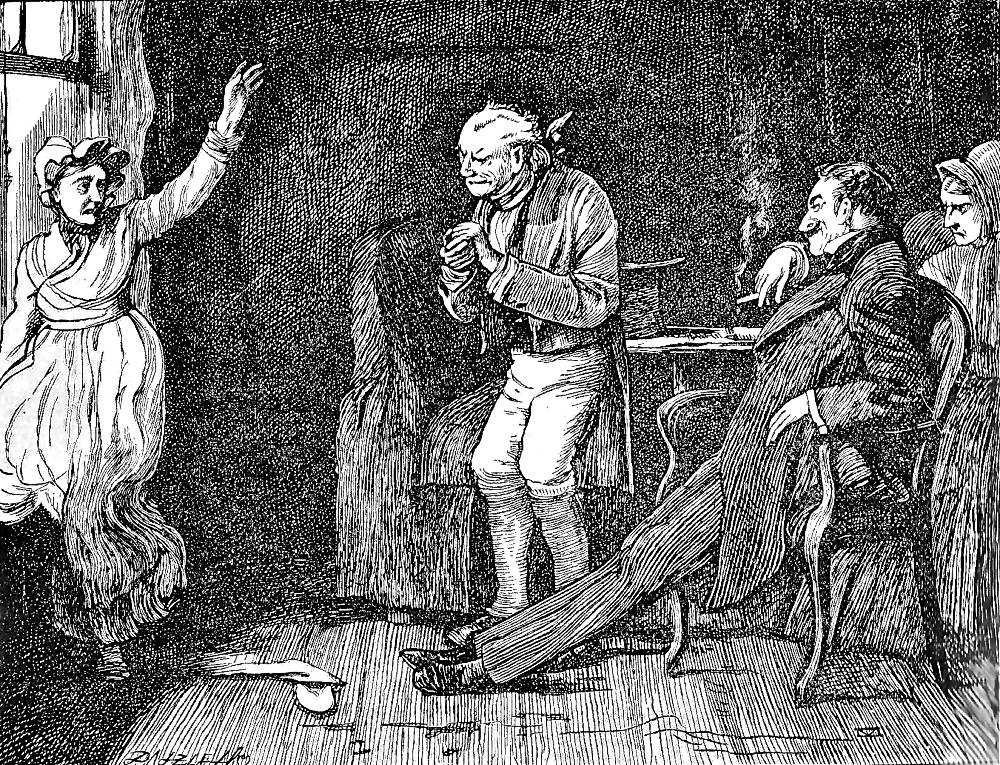
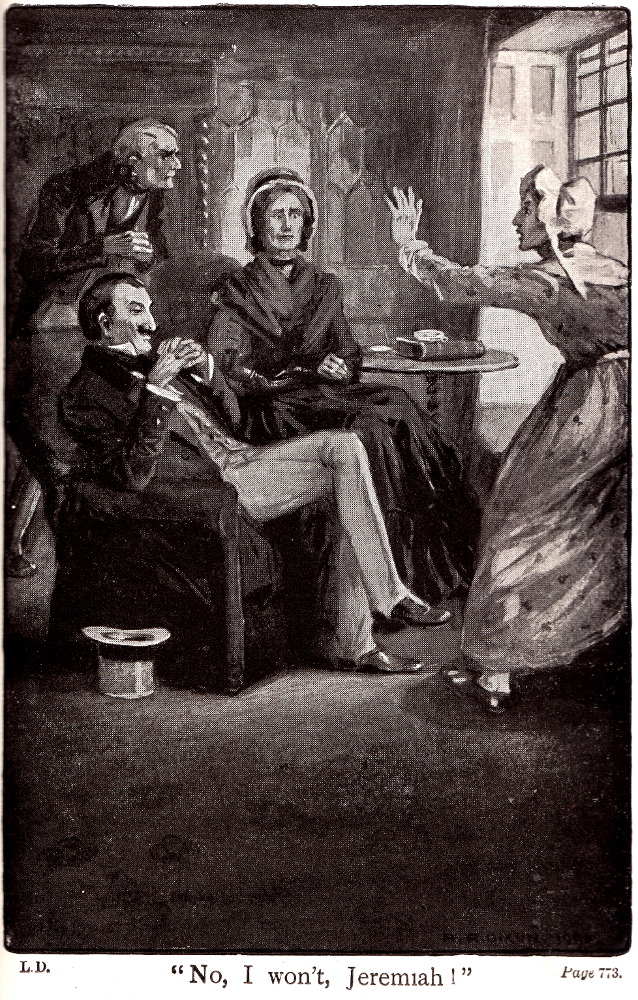
Left: James Mahoney's realistic interpretation of a subsequent event in the same meeting, In a moment Affery had thrown the stocking down, started up, caught hold of the windowsill with her right hand, lodged herself upon the window-seat with her right knee, and was flourishing her left hand, beating expected assailants off (Household Edition, 1873). Right: The same scene, much muted, in the 1906 Collins Pocket Edition, A. A. Dixon's “No, I won't, Jeremiah!” [Click on these images to enlarge them.]
Bibliography
Bentley, Nicolas, Michael Slater, and Nina Burgis. The Dickens Index. New York and Oxford: Oxford U. P., 1990.
The Characters of Charles Dickens pourtrayed in a series of original watercolours by "Kyd." London, Paris, and New York: Raphael Tuck & Sons, n. d.
Darley, Felix Octavius Carr. Character Sketches from Dickens. Philadelphia: Porter and Coates, 1888.
Davis, Paul. Charles Dickens A to Z: The Essential Reference to His Life and Work. New York: Facts On File, 1998.
Dickens, Charles. Little Dorrit. Illustrated by Hablot Knight Browne ('Phiz'). The Works of Charles Dickens. The Authentic Edition. London: Chapman and Hall, 1910 [rpt. of the 1857 single-volume edition].
Dickens, Charles. Little Dorrit. Illustrated by F. O. C. Darley and John Gilbert. The Works of Charles Dickens. The Household Edition. 55 vols. New York: Sheldon and Company, 1863. Vol. IV.
Dickens, Charles. Little Dorrit. Illustrated by James Mahoney [58 composite wood-block engravings]. The Works of Charles Dickens. The Household Edition. 22 vols. London: Chapman and Hall, 1875. Vol. V.
Dickens, Charles. Little Dorrit. Illustrated by Harry Furniss. The Charles Dickens Library Edition. 18 vols. London: Educational Book, 1910. Vol. 12.
Hammerton, J. A. "Chapter 18: Little Dorrit." The Dickens Picture-Book. The Charles Dickens Library Edition. London: Educational Book, 1910. Vol. XVII. Pp. 398-427.
Kyd [Clayton J. Clarke]. Characters from Dickens. Nottingham: John Player & Sons, 1910.
"Little Dorrit — Fifty-eight Illustrations by James Mahoney." Scenes and Characters from the Works of Charles Dickens, Being Eight Hundred and Sixty-six Drawings by Fred Barnard, Gordon Thomson, Hablot Knight Browne (Phiz), J. McL. Ralston, J. Mahoney, H. French, Charles Green, E. G. Dalziel, A. B. Frost, F. A. Fraser, and Sir Luke Fildes. London: Chapman and Hall, 1907.
Vann, J. Don. Victorian Novels in Serial. New York: Modern Language Association, 1985.
Created 25 March 2016
Last modified 15 September 2026