
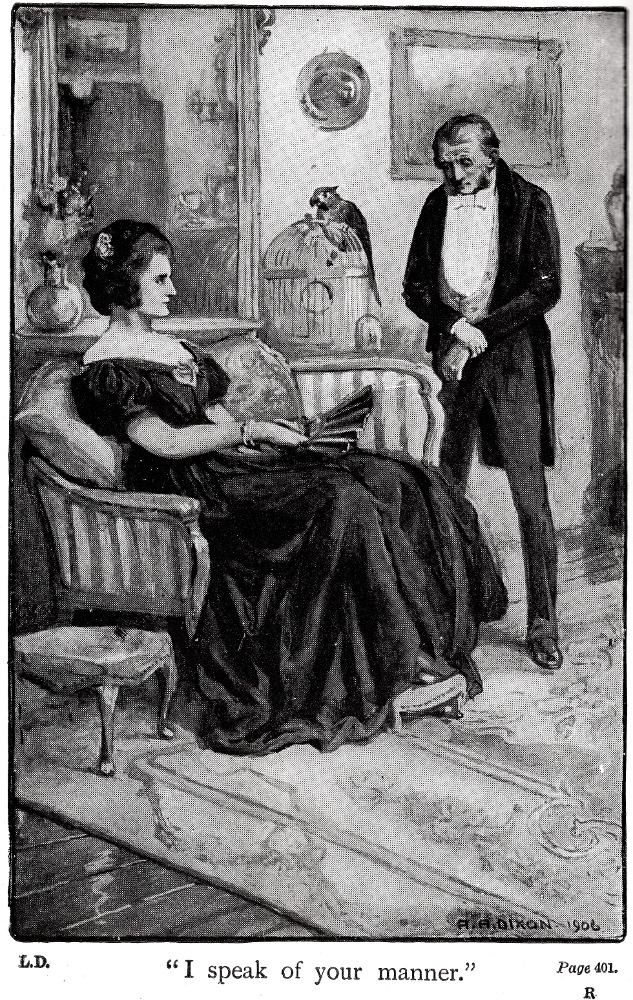
“I speak of your manner.”
Arthur A. Dixon
1906
Lithographic reproduction of a watercolour
12.1 cm high by 8 cm wide (4 ⅞ by 3 ⅛ inches), framed.
Fifth illustration for Little Dorrit, Collins' Pocket Edition (1906), facing p. 401, referencing p. 401.
[Click on the image to enlarge it and mouse over text for links.]
Scanned image and text by Philip V. Allingham.

Passage Illustrated: Mrs. Merdle's Complaint to Her Husband, the Financial Wizard
‘I say,’ answered Mrs Merdle composedly, ‘that you ought to make yourself fit for it by being more dégagé, and less preoccupied. There is a positive vulgarity in carrying your business affairs about with you as you do.’
‘How do I carry them about, Mrs Merdle?’ asked Mr. Merdle.
‘How do you carry them about?’ said Mrs. Merdle. ‘Look at yourself in the glass.’
Mr. Merdle involuntarily turned his eyes in the direction of the nearest mirror, and asked, with a slow determination of his turbid blood to his temples, whether a man was to be called to account for his digestion?
‘You have a physician,’ said Mrs. Merdle.
‘He does me no good,’ said Mr. Merdle.
Mrs. Merdle changed her ground.
‘Besides,’ said she, ‘your digestion is nonsense. I don’t speak of your digestion. I speak of your manner.’
‘Mrs. Merdle,’ returned her husband, ‘I look to you for that. You supply manner, and I supply money.’ [Chapter XXXIII, “Mrs. Merdle's Complaint,” pp. 400-401]
Pertinent illustrations in five other editions: 1857, 1863, 1867, 1873. and 1910
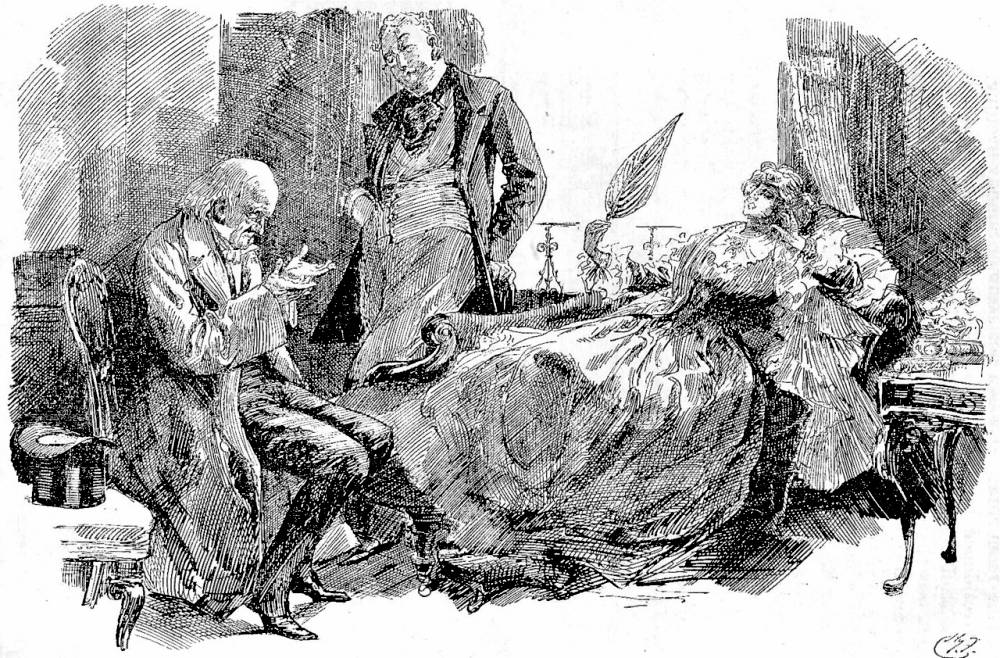
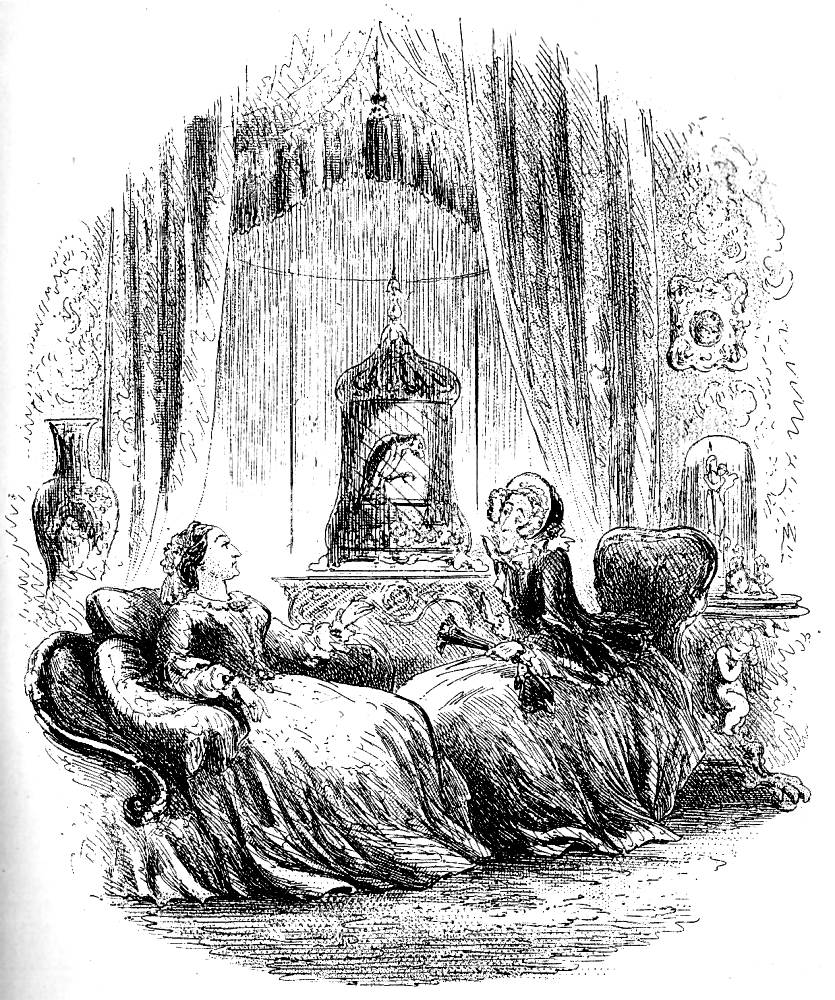
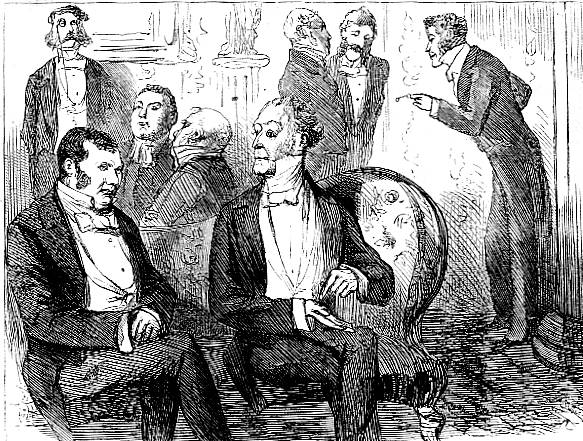
Left: Harry Furniss's characterisation of Mr. Merdle: Mr. Merdle gives the Sparklers a call, for Book II, Chapter 24 in the 1910 edition. Right: Phiz's original serial illustration of the imperious Mrs. Merdle, Society Expresses its Views on a Question of Marriage (September 1856).
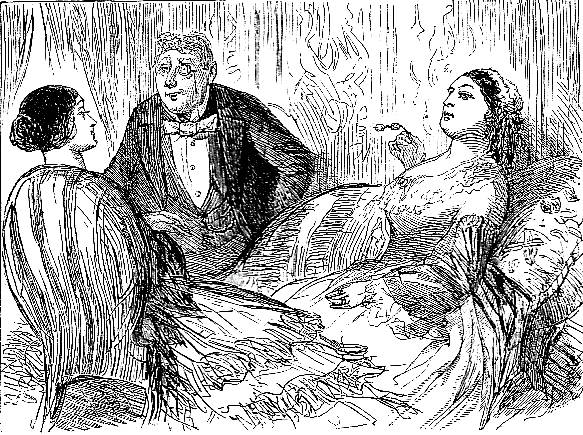
Left: Sol Eytinge, Junior's study of three "society" characters, including the aspirant, Fanny Dorrit, in Mrs. Merdle, Mr. Sparkler, and Fanny (1867), as described in Book II, "Riches," Chapter 14, "Taking Advice." Right: Eytinge's group study of the financier, The Merdle Party (1867). [Click on the images to enlarge them.]
Commentary: Introducing Dickens's Satire of Swindler John Sadleir
Dickens has introduced the crooked financier, Merdle, and his imperious, condescending wife, the doyenne of London high society, in their drawing-room in fashionable Harley Street, Cavenish Square, not merely to satirize the nation's social elite, but to lay the groundwork for the Clennams's financial collapse.
Michael Steig in Dickens and Phiz regards Dickens's dissatisfied financier and Mr. Merdle, his name suggestive of the French merde (excrement), as one of the book's "chief embodiments of evil" (168), the other being the wife-murderer and would-be extortionist Rigaud-Blandois. These figures derive from very different literary traditions: whereas Rigaud is a melodramatic villain, with foreign accent, a nutcracker visage, and predatory intentions expressed in suave but excessive gesticulation, Merdle the English banker of decidedly un-aristocratic origins epitomizes Thomas Carlyle's cash nexus — it is as if he is a mere cipher, nothing in himself, and quite ill-at-ease with himself:
In the text, Merdle is a special kind of grotesque with largely symbolic qualities. He is always "taking himself into custody" (a hint of the criminal nature of his business); he is tyrannized over by the chief butler, suggesting his nouveau riche status as a financial manipulator who has risen to power almost overnight; and his relation to his wife is consistent with the limiting of his identity to the world of finance, for she is purchased as a "bosom" upon which to hang jewels. Even his name, suggesting merde, emblematically conveys the idea of a low, filthy substance, brought into unseemly contact with the highest of the land. Yet Dickens at the same time manages to evoke a degree of pity for Merdle as someone who is basically out of sympathy with the shallow society world in which he has risen so high, someone who doesn't know what to do with his success arid would be more comfortable as a private man. He is not a monster like such earlier characters who epitomize the cash-nexus values of Dickens' society — Pecksniff, Dombey, Heep, or Bounderby. [Steig, p. 168]
See "Real and Fictional Swindlers: Sadleir, Dickens's Merdle, and Lever's Davenport Dunn." and "Real and Fictional Swindlers of the 1850s: Sadleir, Merdle, and Dunn."
Related Material: The Other Illustrated Editions (1863 — 1910)
- Illustrations by "Phiz" (Hablot Knight Browne) for Little Dorrit (December 1855 — June 1857)
- James Mahoney's 58 illustrations for Dickens's Little Dorrit (1873)
- Harry Furniss's 29 illustrations for Dickens's Little Dorrit (1910)
- Charles Dickens's Little Dorrit (1857): Site Map
- Felix Octavius Carr Darley — three engraved frontispieces, volumes 1, 2, and 4: 1863)
- Illustrations by Sol Eytinge, Jr. — 16 plates from the Ticknor and Fields' Diamond Edition (1867)
Bibliography
Dickens, Charles. Little Dorrit. Illustrated by Hablot Knight Browne ("Phiz"). The Authentic Edition. London: Chapman and Hall, 1901 [rpt. 30 May 1857 volume].
Dickens, Charles. Little Dorrit. Frontispieces by Felix Octavius Carr Darley and Sir John Gilbert. The Household Edition. 55 vols. New York: Sheldon & Co., 1863. 4 vols.
Dickens, Charles. Little Dorrit. Illustrated by Sol Eytinge, Jr. The Diamond Edition. 14 vols. Boston: Ticknor & Fields, 1867.
Dickens, Charles. Little Dorrit. Illustrated by James Mahoney. The Household Edition. 22 vols. London: Chapman and Hall, 1873. Vol. V.
Dickens, Charles. Little Dorrit. Illustrated by A. A. Dixon. With an engraved title by Harry Furniss. London and Glasgow: Collins Clear-Type Press, 1906.
Dickens, Charles. Little Dorrit. Illustrated by Harry Furniss. The Charles Dickens Library Edition. 18 vols. London: Educational Book, 1910. Vol. XII.
Steig, Michael. "Chapter 6: Bleak House and Little Dorrit: Iconography of Darkness." Dickens and Phiz. Bloomington: Indiana University Press, 1978.
Created 8 September 2026