
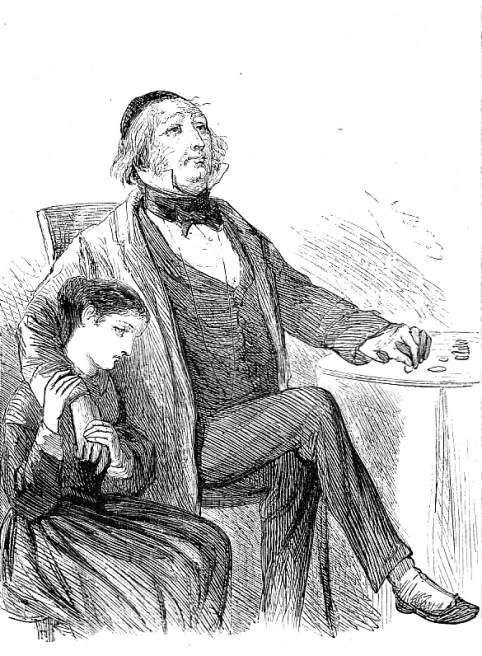
Little Dorrit and Her Father
Sol Eytinge
Wood engraving
10 cm high by 7.4 cm wide (3 ⅞ by 2 ⅞ inches), vignetted.
The initial full-page illustration, facing the title-page of the Diamond Edition, by Sol Eytinge, Jr., in Charles Dickens's Little Dorrit. Vol. VII.
[Click on the image to enlarge it, and mouse over text for links.]
Scanned image and text by Philip V. Allingham.
[You may use this image without prior permission for any scholarly or educational purpose as long as you (1) credit the person who scanned the image and (2) link your document to this URL in a web document or cite it in a print one.]

Little Dorrit and Her Father, the first full-page illustration, facing the title-page of the Diamond edition by Sol Eytinge, Jr. Charles Dickens's Little Dorrit (Boston: Ticknor and Fields, 1871), frontispiece. Scanned image and text by Philip V. Allingham. [You may use this image without prior permission for any scholarly or educational purpose as long as you (1) credit the person who scanned the image and (2) link your document to this URL.]
The first illustration — Little Dorrit and Her Father — introduces the novel's focal characters. The dual character study is different from others in Eytinge's Diamond Edition sequences of sixteen for each volume in that it post-dates Eytinge's 1869 visit to London and Gadshill. As is typical of these studies, Eytinge appears to have in mind no particular moment in the narrative. William Dorrit, Amy's father, known as "The Father of the Marshalsea" because he has been incarcerated in that debtors' prison for so many years — twenty-five, in fact — is an amiable but utterly impractical middle-aged gentleman whom Dickens based in part upon his own father, John Dickens. Like the elder Dickens, William Dorrit is providentially released from the debtors' prison by an unexpected inheritance, although the Dorrit windfall is considerably larger than that which John Dickens received. Amy, William's youngest child, born in the prison, has acquired the nickname "Little Dorrit." At the time that the story opens, the industrious, self-denying Amy is about twenty-two, even though Eytinge's plate makes her look much younger.
Bibliography
Bentley, Nicolas, Michael Slater, and Nina Burgis. The Dickens Index. Oxford and New York: Oxford U P, 1990.
Davis, Paul. Dickens A to Z: The Essential Reference to His Life and Work. New York: Checkmark and Facts On File, 1999.
Dickens, Charles. Little Dorrit, illustrated by Hablot Knight Browne ("Phiz"). (1857). Ed. John Holloway. Harmondsworth: Penguin, 1976.
Dickens, Charles. Little Dorrit. Illustrated by Sol Eytinge, Jr. The Diamond Edition. 14 vols. Boston: Ticknor & Fields, 1867. Vol. VII.
Dickens, Charles. Little Dorrit, Illustrated by Hablot Knight Browne ("Phiz"). (1857). Ed. John Holloway. Harmondsworth: Penguin, 1976.
Victorian
Web
Illus-
tration
Sol
Eytinge
Little
Dorrit
Next
Created 13 February 2011
Last modified 11 September 2026